
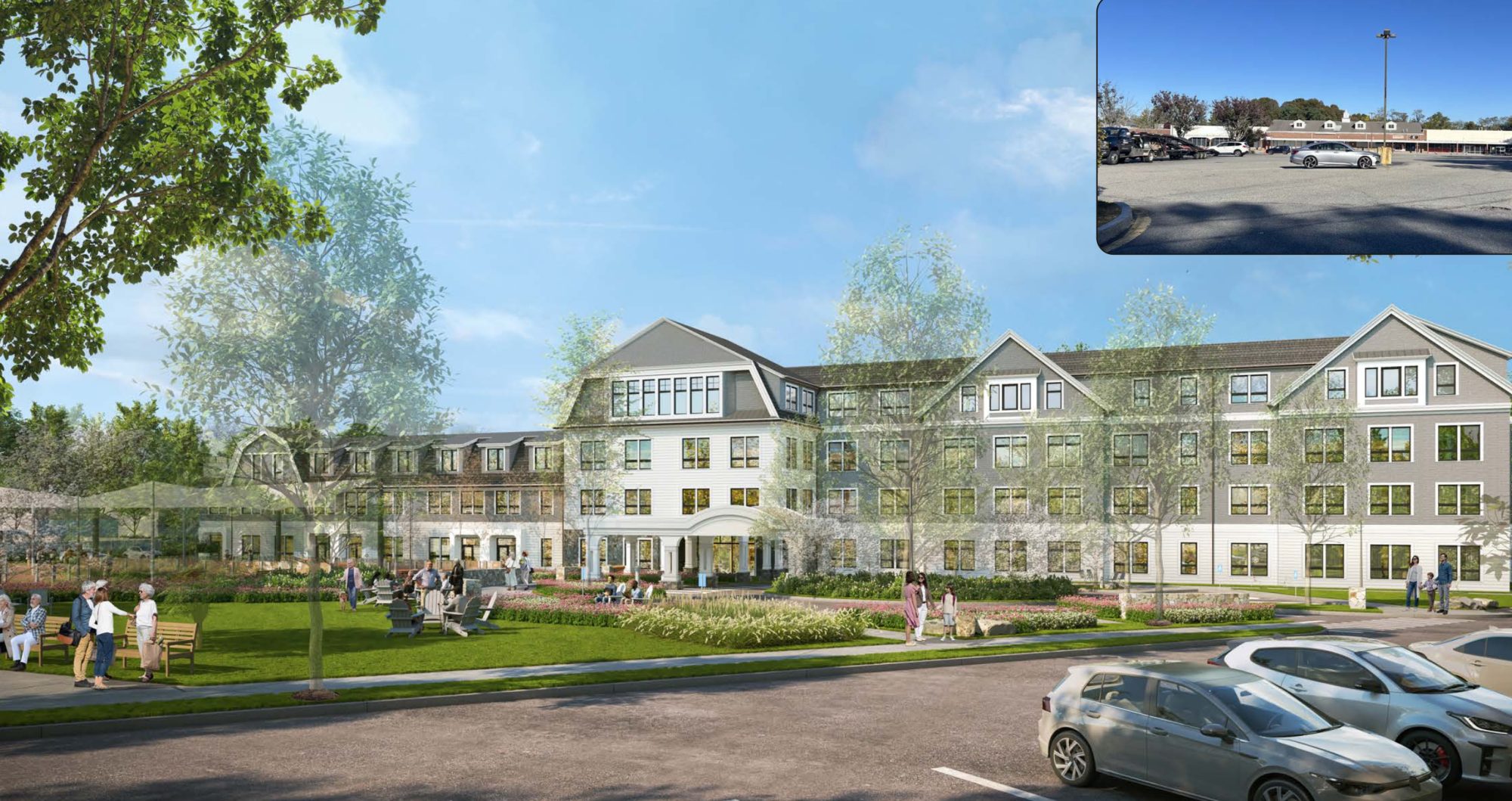
Nearly a decade after Benny’s went dark, and following a much-derided 2024 apartment proposal, the North Plymouth plaza once home to the department store finally appears on the verge of a makeover.
But first, the development group seeking to raze the decaying strip mall and build a 186-unit housing complex for seniors, along with retail space and 21 apartments, must convince the Zoning Board of Appeals its plans represent the best use of the site. Today, the 7.2-acre parcel is mostly a forlorn sea of asphalt.
While the developers have gained support of the Planning Board and Select Board – which voted 5-0 in July to approve a conceptual plan – only the ZBA wields the authority to approve or deny the project through a special permitting process. Monday evening, its members sounded inclined to give the Benny’s Plaza plans a green light, but they had questions about parking, traffic, and other issues. Several neighbors also spoke, expressing worries about how the complex might affect their quality of life.
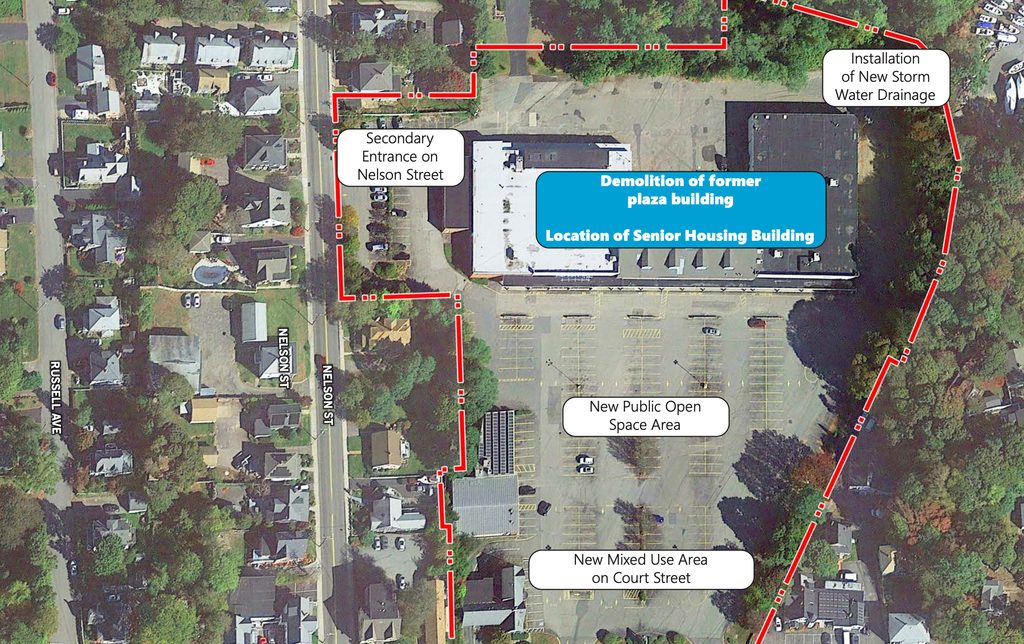
The project – a collaboration between Boston-based HYM Investment Group and two Denver firms, NexCore Group and Experience Senior Living – calls for a four-story building reaching 62 feet high at its peak and lowering to three stories at the end facing Nelson Street. It would feature mostly studio and one-bedroom apartments offering independent living, assisted living, and memory care units, with amenities such as green space, a bocce court, two pickleball courts, and a dog park.
Two three-story buildings fronting Court Street – both 38 feet tall – would house retail businesses on the first floor and apartments on the upper levels. An abandoned bank building would be torn down to make room for the new structures. Only Pioppi’s liquor store – a fixture for decades – would remain standing.
During Monday’s ZBA meeting at Town Hall, HYM’s Seamus Joyce said his company and its partners have been working on the plans for more than a year, a process that has involved two dozen meetings with government boards and community groups.
“Plymouth is very undersupplied on senior housing,” he said. “Plymouth [has] an older population compared to many other towns in Massachusetts. We think we are providing a need that the town really could use.”
As with any development involving housing, parking has been a hot topic. Joyce said there are 298 spaces on the property under its current configuration, many of which are in “rough condition.” The developers are allowing for 220, he said, “but our demand is far less than what that demand was when it was a fully functioning Benny’s shopping plaza.”
Besides being a quintessential eyesore, the property has long stood as an example of how large expanses of pavement affect the environment. They retain heat and prevent rain from soaking into the ground, causing it to run off and pollute nearby streams and other water sources. Over the years, the plaza has been plagued with underground water issues, illustrated by a persistent sag in one of Benny’s aisles.
Calling the site’s landscaping “a huge piece” of the project, Joyce said it would increase climate resiliency and reduce water runoff from the property, which is especially low-lying along the side closest to the shoreline. Native plantings would be “rainwater tolerant,” with the aim of “maintaining that classic New England coastal vibe,” he said.
An old watering trough on the Court Street end of the property would be restored, he said, not for any modern-day horses trotting through North Plymouth, but as a “homage to what was once there.”
Local developer Matt Sheridan – in an arrangement with HYM and its partners – would build the two smaller structures. They would host 8,000 square feet of retail space and 21 apartments, 11 of them studios. Twenty-five percent of the units would be classified as “affordable,” he told the ZBA, a share that would allow the town to count all 21 as part of its affordable stock.
“I’ve gone after some really aggressive price points with this project,” Sheridan said, though he did not offer any rent figures.
“The entire theme of what I’m proposing with the 21 units is to try to do a really deeply affordable product,” he said. “Even the market [rate] units would actually be cheaper than what’s currently being offered in Plymouth.”
Those, he said, would rent at 80% of the state’s area median income (AMI) guidelines, which is the standard threshold for affordable apartments. The affordable units would be rented at closer to 60% of the AMI, unusually low for Plymouth. Under the 2026 rules, a family of two can earn up to $109,700 and still qualify for affordable housing.
After the presentation, board members had questions for Joyce, none of them confrontational.
Board member Srini Mukandan questioned whether the number of parking spaces would be sufficient. He asked if the pickleball courts could be moved to “the back of the lot so that you can create more accessible parking up front near the retail spaces.”
Joyce said the developers are “open” to relocating them but believe keeping the courts near the center of the site is “the best way of breaking up that big mass of asphalt.”
Board member Alan Costello keyed in on traffic, particularly at the busy intersection of Court and Samoset streets to the south, which was not part of a study commissioned by the developers.
“It should have been included,” Costello said. He also wondered if the pickleball courts and dog park – which would be open to the public – might attract more traffic.
Joyce said town officials and staff promoted the idea of public access. He said the developers would consider restricting the hours of public use but would prefer not to put limits on access.
“It’s great for our residents to interact with other residents in the community,” he said.
Paul Leonard, a longtime Nelson Street resident, spoke about how the development might affect his “living environment.”
“Am I going to listen to the thwack of pickleball all afternoon because people are playing out behind my house and behind [the assisted living] building?” he said.
Leonard said the complex might eliminate parking spaces for people who go to nearby Nelson Park and the bike path, especially during the summer.
“You’re shoehorning a lot of items into the neighborhood that we’ve lived in for a long time,” he said.
Local attorney Kathy Muncey, speaking on behalf of Pioppi’s owner Peter Balboni, also focused on parking. She said the developers’ plans are “pretty impressive,” but “we do have a difference of opinion” on how many parking spaces should be allocated to the liquor store. Balboni wants 32 spots. The current drawings show 13.
In the end, the board continued the discussion until Dec. 21 to give the developers time to modify their plans and allow the town’s Department of Public Works to provide more information. None of the ZBA members tipped their hand as to how they might vote, but their concerns seemed more about minor modifications than signaling outright opposition.
If the ZBA signs off on the project next month, the developers hope to break ground for the senior housing building by June or July and finish work within two years. Sheridan’s retail/apartment buildings would likely be completed sooner than that, they said.
Mark Pothier can be reached at mark@plymouthindependent.org.