
A would-be peacemaker has come forward hoping to end the Select Board’s emotionally charged standoff with a Native American group over insurance coverage for its National Day of Mourning protest.
Olly deMacedo, longtime director of the America’s Hometown Thanksgiving Celebration and parade set to kick off Saturday, said he will pay the insurance tab and provide a portable stage for the annual event atop Coles Hill.
As of late Thursday afternoon, leaders of United American Indians of New England (UAINE) had not responded to him or town officials. The group and its attorney also did not respond to several messages left by the Independent.
“I’m hopeful they’ll call me back and this will be resolved,” deMacedo told the Independent on Wednesday. “I’d be more than happy to facilitate their needs.”
The potential resolution is the latest development in a furor that erupted this week after word spread of a 5-0 closed-door vote by the Select Board on Nov. 10 authorizing town counsel to seek a deal requiring UAINE to secure insurance for staging.
UAINE has argued the requirement violates a 1998 agreement governing the annual event, held on Thanksgiving Day since 1970. The agreement followed a violent clash with police in 1997 that resulted in a court battle.
The town maintains it is simply requiring UAINE to provide the same kind of coverage other organizations must have in place as liability protection in the event of an accident or other mishap during an event.
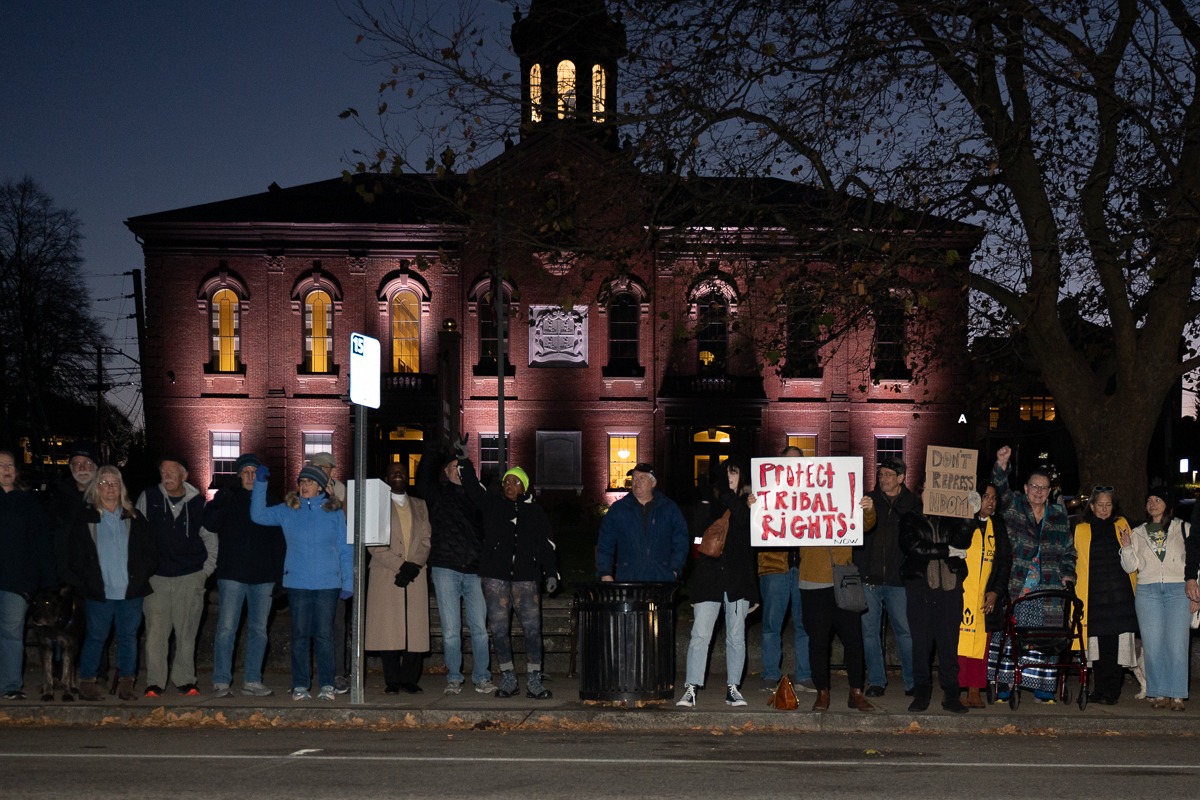
But public opinion has overwhelmingly been on the side of UAINE. The board’s decision – which it upheld by a 3-2 vote behind closed doors late Tuesday afternoon – prompted a flood of messages to officials, a protest outside Town Hall, and a long line of angry speakers who berated Select Board members at their Tuesday evening meeting.
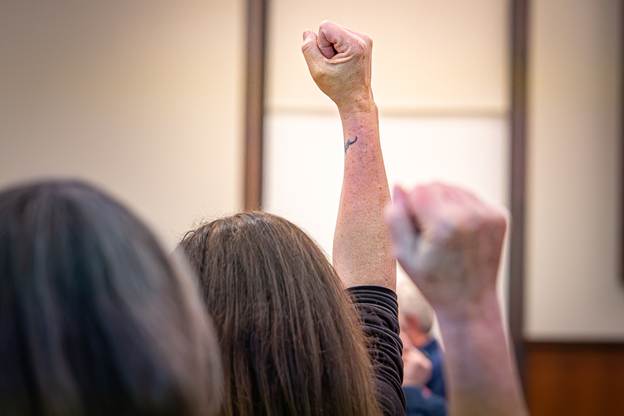
UAINE wants a court hearing to compel the town to adhere to the terms of the 28-year-old agreement, which does not require insurance or a permit to march.
An item on the Plymouth Superior Court docket says both sides are willing to appear before a judge Friday to hash out the issues, but no time has been set.
Select Board Chair Deb Iaquinto said she won’t comment on deMacedo’s offer until there is a response from UAINE leaders.
“All I will say is that we’re really hopeful that this will get resolved,” Iaquinto said. “We don’t want to put either party in a bad position by jumping out ahead of it.”
During the executive session Tuesday, Select Board member Bill Keohan made a motion aimed at defusing the controversy, according to fellow board member Richard Quintal, who participated in the meeting by phone. It called for the town to pay for insurance coverage – estimated to be just a few hundred dollars – and supply a stage. Quintal seconded the motion, but the other three members – Iaquinto, Kevin Canty, and David Golden – voted it down.
In an interview Wednesday, Quintal described the controversy as a “fiasco” and a “ridiculous” public relations disaster.
He said once his Select Board colleagues rejected the idea of footing the minuscule bill, he offered to pay it himself through his charitable nonprofit.
“I am more than willing to pay for an insurance binder for the day to get through this and have peace,” Quintal told the Independent. “And it gives us a year to straighten this out. I don’t want to be in this predicament next year.”
But Quintal said his plan to write a check was not well received by other board members – except for Keohan – during Tuesday’s executive session.
Golden questioned whether a payment connected to an elected official would constitute a conflict of interest, according to Quintal. That – and the generally contentious tone of the session – left him frustrated to the point that he considered not coming in for the regular Select Board meeting that took place afterward.
“I was steaming, ” he said, “but I did say to Deb, ‘There is no reason for this. You’re handling this all wrong. Why doesn’t anybody listen?’ We can sit down. I know they’re not an easy group, for whatever reason, that’s their own business. But we could’ve done this a lot better. It didn’t have to get this far. It’s ridiculous.”
“We need to get along,” Quintal said Wednesday. “We need to work together. I mean, $500 or $400 for insurance, is that worth all this, really?”
“All people are going to see around the country is the Plymouth Select Board gives them a hard time after screwing them over in 1997.”
DeMacedo’s solution has the potential to “save the day,” Quintal said. “And I commend him for that, but I still have trouble swallowing what’s already been done for no reason at all.”
This is the second consecutive year the town and UAINE have been at odds over the 1998 deal that came about following the calamitous National Day of Mourning protest in 1997.
That Thanksgiving, police caused a near riot after confronting participants who marched up Leyden Street. About two dozen people were arrested, including Native American elders. Many were pepper-sprayed and forced to the ground. Video footage from the chaotic scene shows dozens of police lunging into the crowd and placing protesters in headlocks.
The fallout forced local officials to dramatically reshape how they thought about the event, which some had considered a nuisance that infringed on Plymouth’s traditional portrait of Thanksgiving – a harvest celebration by friendly Pilgrims and the Wampanoag.
As a result of the agreement reached with UAINE the following year, the town dropped all charges against the protesters.
The settlement provisions also required the town to pay for an education program and legal expenses, as well as a plaque on Coles Hill near the statue of Wampanoag leader Massasoit. That marker tells a story far different from the one promoted by the chamber of commerce and tourism officials at the time.
“Thanksgiving Day is a reminder of the genocide of millions of their people, the theft of their lands, and the relentless assault on their culture,” it reads in part.
Crucially, the deal required the town to cooperate with the National Day of Mourning going forward, including by allowing people to gather and march without a permit. It did not mention an insurance requirement.
Last year, however, officials sought to mandate coverage. UAINE filed a lawsuit in response, and town officials backed down when it became apparent Plymouth Superior Court Judge Joseph Leighton would rule against them. Under pressure from the judge, both sides did agree to modify the 1998 arrangement.
The revised version says the town will “facilitate, prepare, and enable the National Day of Mourning activities to take place consistent with the historical practices after the 1998 settlement.”
In return, UAINE agreed not to hold the town responsible for injuries or other issues that take place during the event.
Canty told the Independent last year the tweaked agreement “establishes a framework for the two sides to negotiate further on how to best work together to make sure this event can continue to be successful for years to come. We reached a true compromise, and I’m very grateful.”
Over the years, the town has provided a mobile stage for the event. It has fallen into disrepair, however, and is no longer in service.
In an unsigned statement posted online this week, town officials said they have tried for months to “work collaboratively” with UAINE on several issues, including the stage.
“The only unresolved item was UAINE’s request for the Town to set up the Town’s stage on Department of Conservation and Recreation (DCR) property,” the statement said. “While a stage is not required under the original 1998 agreement, the Town has offered multiple alternatives for a stage for UAINE’s consideration. However, UAINE has not agreed to any alternatives to date.”
Meanwhile, Quintal laments a predicament he said could easily have been avoided.
“I don’t blame Deb, I don’t blame any one individual,” he said, “but there are so many other things we need to be working on.”
Mark Pothier can be reached at mark@plymouthindependent.org.