
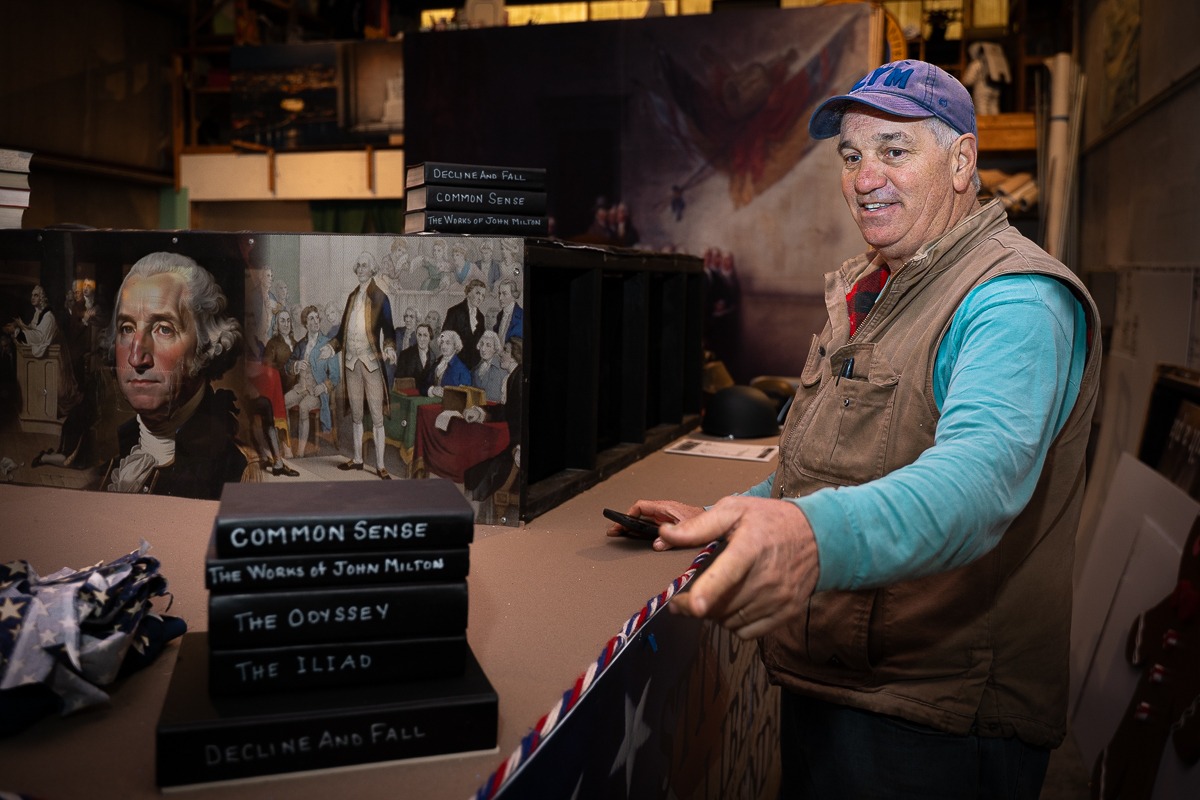
Inside a sprawling warehouse workshop in North Plymouth, an old pickup truck has been stripped down to serve as the foundation for a rolling scene from the American Revolution.
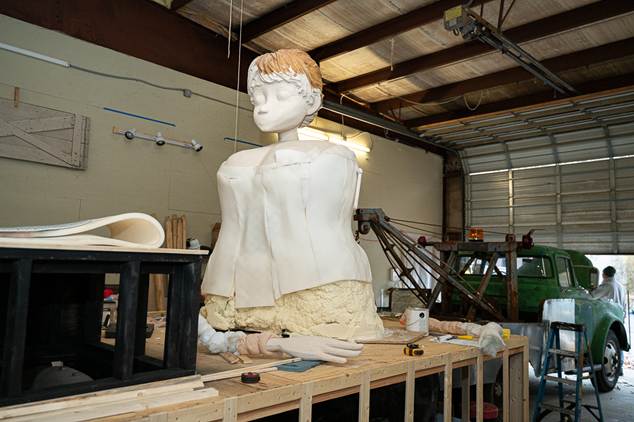
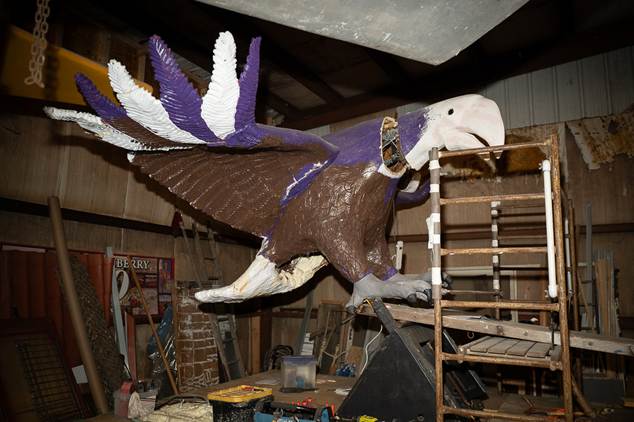
Nearby, a larger-than-life Dolly Parton is taking shape from bamboo and spray insulation foam. Paintbrushes, power tools and printed scenery are scattered among the unfinished projects. Airplanes from previous floats hang from the ceiling, and a red sports car sits among the works in progress.
Volunteers call the workshop the “float barn.” By Saturday, Nov. 21, its creations will be rolling through downtown Plymouth.
This is the behind-the-scenes world of America’s Hometown Thanksgiving Celebration, where volunteers work much of the year to produce a parade that lasts just a few hours. The celebration marks its 30th anniversary this year, coinciding with the nation’s 250th anniversary of independence.
Executive director and executive producer Olavo “Olly” DeMacedo, who serves as the organizer, conductor and cheerleader, is at the center of the experience. This year, he expects approximately 25 floats, eight of them new, along with 20 musical groups including marching bands and military musicians as well as a legion of historical reenactors.
“We meet in January to talk about what anniversaries are coming up that year, and then I design all the floats,” DeMacedo said during a recent tour. “I enjoy that. That’s why I do it. Every single float I kind of design and put it together.”
Jeff Tonnello and Cheryl Birch, longtime volunteers, along with scores of others, are there to put the design into reality.
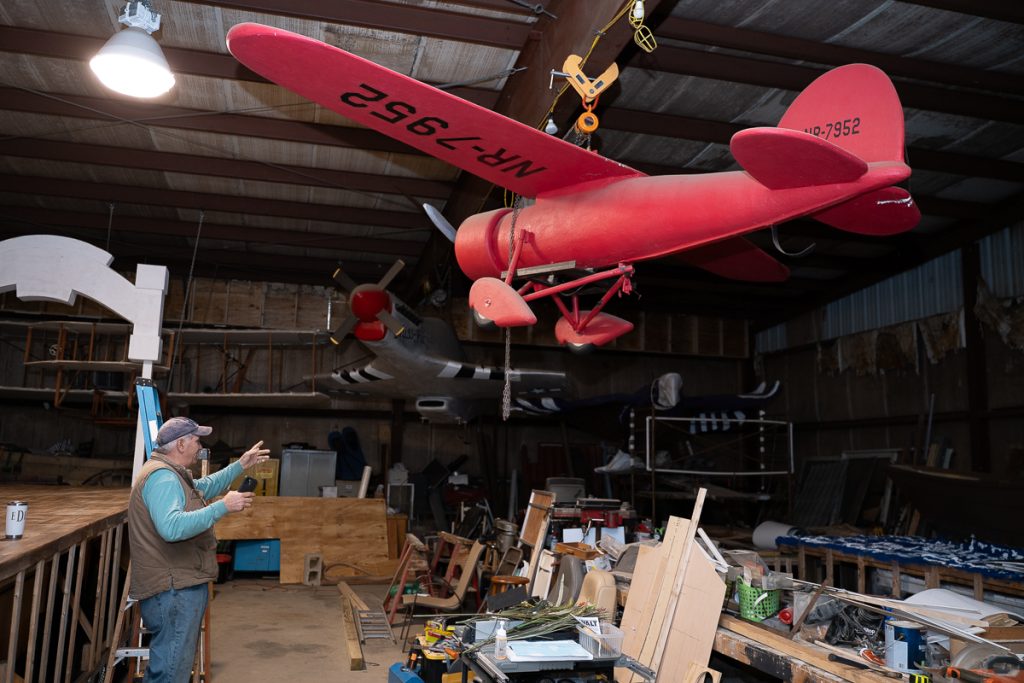
The floats begin with donated pickup trucks and buses, which volunteers strip down to their frames.
“We cut everything away, and then once we cut everything away, then we build on the frames of the old pickup truck,” DeMacedo explained. “The drivers are always hidden.”
Larger floats are built on bus frames, and overhead wires mark the 13-foot height restriction. The windows are eventually surrounded by decorative panels printed so that the person inside can see out, but spectators cannot see in.
“It’s see-through printing,” DeMacedo explained. A spotter walks ahead to guide the vehicle. “No one sees the driver from the outside,” he said.
The materials they use are surprisingly ordinary. DeMacedo began Dolly Parton’s figure with a simple frame, coated it and carved the singer’s features by hand.
“This is a bamboo frame with spray insulation foam over it,” he explained. “And once I foam it, I carve it.”
“I redid her face and mouth like three times because — to get it right,” he said. The hair was its own construction project: “We bought, like, nine small wigs to make one giant wig. Off Temu.”
“Add oversized eyelashes and moving arms, and Dolly will be ready to greet spectators. She’ll wave. Her arms will go up and down,” DeMacedo said.
Stacks of books will recognize Parton’s children’s literacy program. Nearby, volunteers were shaping another figure from foam: Mater, the tow truck from the animated movie “Cars.” The work is part carpentry, part sculpture, part mechanical engineering and part improvisation.
“We improvise everything,” DeMacedo said.
Tonnello, DeMacedo’s right-hand man and a parade board member, helps with the hands-on construction and with deciding with the board on which historical events to recognize.
“I can’t shake your hand, sorry. I’m greasy, dirty, and covered with diesel fuel,” Tonnello joked during the float barn tour. The description suited a place where volunteers strip down donated vehicles and disguise them beneath elaborate scenery.
“We look for specific anniversaries, so this is the 100th anniversary of Route 66, which is how we came up with that one,” he said. This year, the nation’s 250th anniversary has also shaped the lineup, he said.
All around it’s a family affair. Tonnello’s wife, Laura, photographs the floats and other parts of the celebration for its website.
“I actually put her up in a scissor lift to take photos,” he said. Many of the volunteers’ children who once rode on floats have grown into adult volunteers.
Another indispensable volunteer is Birch, a retired group-home program director from Plympton, who helps coordinate the float barn and create the decorative panels that transform truck frames into historical scenes.
“Cheryl kind of runs the float barn down here,” DeMacedo said.
Tonnello’s description of Birch was more emphatic: “She directs everything down here and keeps everyone task-oriented.”
Birch designs all of the panels that get printed onto foam boards, along with sewing, directing, painting and many other elements of the job.
“Sometimes I even have to use the saw, I do not like using a saw though,” she said with a grin.
The core crew numbers about 15 to 20, according to DeMacedo, although he said hundreds more volunteers participate as parade day approaches. Regulars include Tonnello, Birch, Jack Ferran and Ed McSpadden. The whole group gathers for breakfast at 6 a.m. on Saturdays before getting to work. DeMacedo spends his waking hours there, even returning after church on Sundays to continue building.
Before retiring, Birch routinely took the two weeks immediately preceding the parade. “And that was my vacation,” she said.
“These days,” she joked, “I kind of live here.”
Planning begins in January. Most floats take two to three months to build; some take longer, DeMacedo said. Work ranges from painting and carpentry to mechanical repairs. DeMacedo recalled doing a brake job on a bus the day before a previous parade. The work is demanding, but DeMacedo sees the relationships and the friendships as the real achievement.
“The relationships we create during this are more important than even putting on the show,” he said. “So the parade is kind of a — a byproduct of what I think is really real, which is the community that we have here who helps us do what we do.”
That community includes close relationships with sponsors, many of whom have been with them since the beginning.
“The whole thing with our parade is that we always tell a story about the history of America,” DeMacedo said.
Several new floats commemorate the nation’s 250th anniversary, including George Washington Crossing the Delaware, the Declaration of Independence and Dorchester Heights, where American artillery helped force the British evacuation of Boston in 1776. Another recognizes Parting Ways, Plymouth’s historic settlement associated with Black Revolutionary War veterans.
“They were fighting for freedom when they didn’t have freedom themselves,” DeMacedo said. “But that’s what the idea of freedom in America is all about.”
The procession recognizes Native American history and military service, appearing toward the beginning before longtime Mayflower and First Thanksgiving floats. For DeMacedo, the point is to encourage younger generations to learn about the nation’s achievements, sacrifices and difficult chapters, rather than merely watch a spectacle pass by.
“We cannot tell our story without telling their story first,” DeMacedo said.
The original parade began in 1996. DeMacedo joined as a volunteer around 1998 and initially resisted taking charge.
“I didn’t really want to take it over,” he said, but added he realized there was an opportunity to reshape the event. “I always loved history, so I said, listen, if I’m going to do the parade, I want to tell America a story.”
“And there’s obvious reasons why I would do that, because I immigrated here, I love this place. I want people to know about history,” he said.
DeMacedo’s devotion to that mission begins with his family’s experience. His grandmother left Cape Verde for the United States in 1948, traveling separately from her husband, who died at sea. A family friend delivered the news when she reached New Bedford. She could return to relatives in Cape Verde or remain in America alone. She stayed.
“I’m an extension of that incredible sacrifice,” he said.
DeMacedo immigrated at age 7. His family lived in crowded quarters in Dorchester, where he struggled with English and endured bullying.
“I can’t even tell you how brutally painful it was to be picked on as a little kid,” he recalled. “I look back now, it gave me a tenacity inside of me that I had to be OK.”
After high school, he earned a full four-year Division II basketball scholarship. When the college issued him three pairs of expensive high-top sneakers, he was overwhelmed. The memory remains connected to his family’s sacrifices and his gratitude for the opportunities he received.
“From that context, I’ve always been really grateful because I don’t feel like I deserve anything, but yet so much has been given to me,” he said. “The only thing I can do that I think is worthwhile is to tell the story of this great land that I live in, people who sacrificed incredibly for the next generation to do better than them.”
“I know it’s not perfect. It’s got problems. It’s got issues,” he said. “But America gives you the opportunity to make it right.”
One float acknowledges the sacrifice of military veterans and Gold Star families.
“They’re worthy of being noticed and never forgotten because the sacrifice is huge,” he said. “I always want to, in a way, say to them, ‘Thank you.’ And the only way I can say thank you is making sure that no one ever forgets.”
As the floats near completion, another crew transforms Plymouth’s waterfront into a parade route and television production site. Bob Costa, president of B.C. Tent & Awning has worked on the celebration for 25 years. Costa has watched the displays grow more ambitious, recalling a detailed float including a Huey helicopter and a “Jaws” anniversary float.
“They do an incredible job on a shoestring budget,” Costa said.
“It seems like just yesterday we started it, and now it’s 25 years later,” Costa said. “The setup was smaller then: The tents were limited. We didn’t have the grandstand.”
Preparations begin Monday, Nov. 16, he said, with the stage and grandstand. On Tuesday and Wednesday, crews install sound and WCVB Channel 5 broadcast tents. A 40-by-100-foot beer and wine tent is scheduled to go up Wednesday at Pilgrim Memorial State Park, 79 Water Street, near Plymouth Rock.
Costa said his relationship with DeMacedo illustrates a dedication to the personal aspects of the operation. In 2013, DeMacedo honored Costa’s father, a World War II veteran who had turned 100, before hundreds at the opening-night show.
“Olly has reminded me and us how lucky we are to live here, all the freedoms and opportunities we are afforded,” Costa wrote. “Olly’s passion to tell the story is infectious.”
Each step of the parade day operation is highly choreographed and coordinated with the team at WCVB-TV. DeMacedo said meetings with the station begin in July. “We meet with them weekly at this point and we have these timed by the steps, by the seconds,” he said.
The live broadcast demands precision. WCVB’s college football coverage begins at noon, so the procession must keep to a strict timetable. “We have to be right in cue with WCVB-TV,” Tonnello added. “They are committed to go right to college football at noon, so every step of the parade is coordinated with their schedules.”
Even with donated labor and warehouses, the celebration costs approximately $300,000 to $400,000 a year for materials, public safety, bands, reenactors, transportation and other expenses. Fundraising has been especially difficult this year, DeMacedo said. The parade is funded entirely by donations both large and small, and heavily relies on its sponsors, including major sponsor Rockland Trust, the town of Plymouth, and generous contributions that never appear on a balance sheet.
For three decades, the Sheehan family, owners of L. Knife & Son, has provided the float barn on its warehouse property in North Plymouth at no charge. DeMacedo singled out Jerry and Maureen Sheehan for their unending support.
“For 30 years, they have let us come here to the float barn and build,” he said. “They don’t give just this location; they give us the ability to exist.”
“Without this,” he said, gesturing around a work bay filled with paneled foam, wood scraps, metal scrap and all manner of things hanging from the ceiling, “there’s no parade.”
DeMacedo’s employer, Boston Sand & Gravel, has likewise allowed him the flexibility to manage the celebration. “I mean, they’ve been gracious. They allow me to do some things that most, you know, would not do,” he said.
Finished floats are stored free of charge in an old building on the grounds of the Plymouth prison, including replicas of the Winslow House and Hedge House, DeMacedo said. Between that storage space and the Sheehans’ workshop, organizers can build, preserve and reuse their creations without commercial rent, he added.
By parade morning, months of construction, fundraising and planning come together. Within a few hours, the spectacle is over. But for DeMacedo and the volunteers, the reward is long-lasting: the chance to make history resonate with the crowd.
“Looking to the future, but never forgetting the past, and making somehow a linkage between the two so people don’t make the mistakes of the past,” DeMacedo said. “And to remember the sacrifices that allow us to go to the future and beyond.”
Julia Marie Davis can be reached at julia@plymouthindependent.org.