
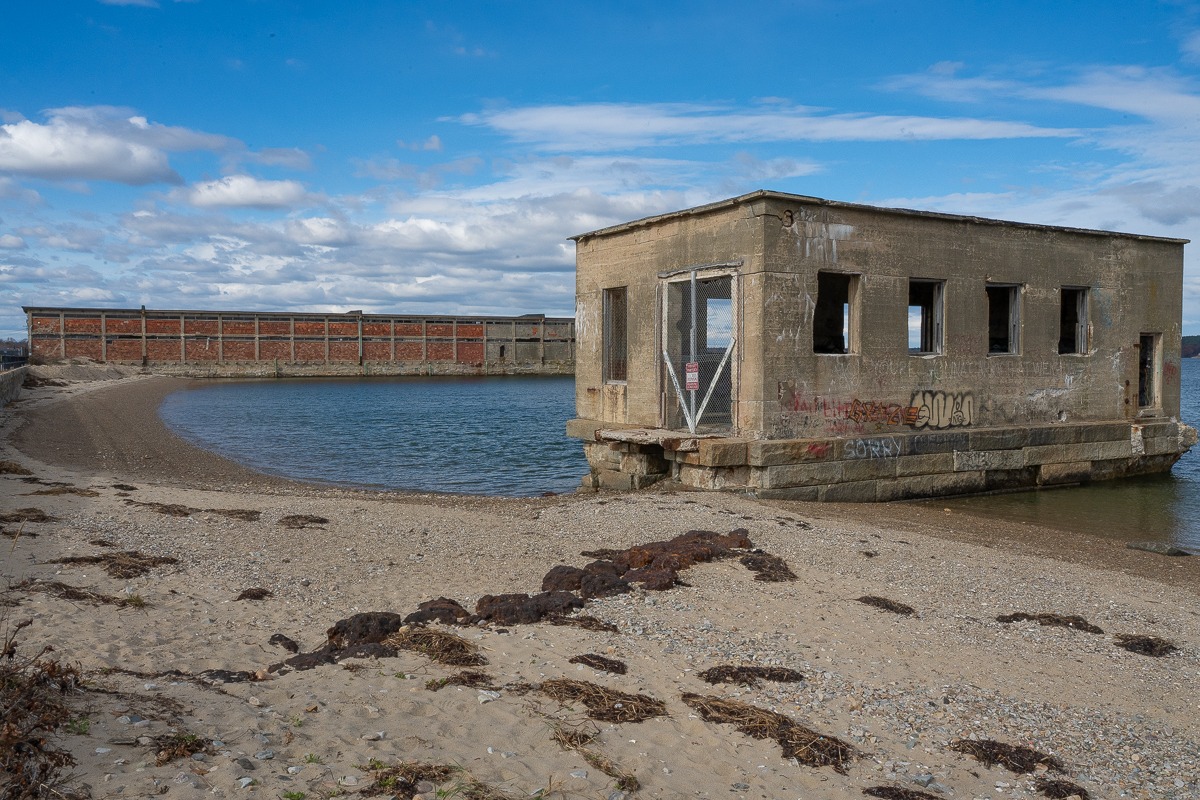
Two derelict buildings rise from the waves behind Cordage Commerce Center, standing like silent sentinels just off the shore in North Plymouth. The relics – with boarded-up windows and barely standing walls – are seen by some as annoying eyesores blocking the peaceful panorama of Plymouth Bay. Others appreciate their aesthetic assets, evoking echoes of oft-painted Motif No. 1 in Rockport.
One structure is located on a weathered wharf that extends some 400 feet into the sea. It features missing clay tiles from its siding and crumbling stone pilings. The other is little more than a few shattered walls with no roof, barely standing due to the regular pounding of an unforgiving sea.
These two relics remain a tangible connection to the town’s commercial past. They once stood like beacons for the countless ships that sailed up to Plymouth Cordage Company, the world’s largest rope manufacturer until its demise in 1966.
“The wharf is where all the supplies were delivered by ship,” said Lucille Leary, director of the Plymouth Cordage Company Museum, located inside the original factory in North Plymouth. “The wharf was huge. It used to be a single floor but then they added a second level.”
With just the shell remaining, the second structure was a pumphouse that sucked up thousands of gallons of seawater to help cool the furnace and provide steam to power the massive mills producing the rope, twine and line that kept a global economy churning. Made from natural fibers, cordage was essential for fueling the furnace of commerce and industry while enabling society to grow and prosper.
“Man’s civilization and social progress has been linked directly to the ropemaker… Rope, then, can justifiably be considered the first appliance developed by man’s ingenuity,” wrote master ropemaker David Himmelfarb of the U.S. Navy, as quoted by Tim Queeney in his seminal book Rope: How a Bundle of Twisted Fibers Became the Backbone of Civilization.
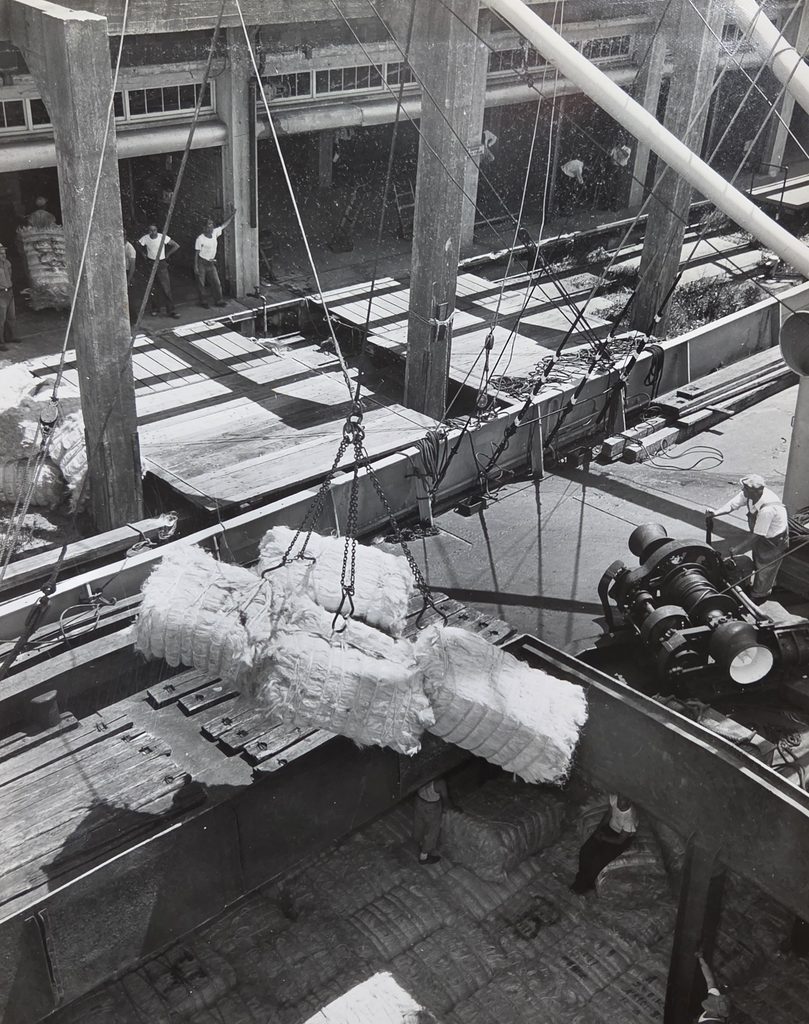
Stoking this fire required the delivery of thousands of tons of raw materials to the stone wharf in North Plymouth. Ships from around the world transported hemp, abaca (better known as manila), henequen, sisal and even cotton for the production of cordage. These plant-based fibers were spun into the long lengths of yarn that were then spun together to make rope.
Freighters hauled this cargo from faraway places like the Philippines, Mexico, Russia and other distant ports, unloading them at the North Plymouth wharf for sorting and storage in the warehouse. This location was a prominent feature along the waterfront, easily sighted by ships as they steamed past the Gurnet. The site was so visible eminent naval historian Samuel Eliot Morison claimed it might have been the actual first landing place of the Pilgrims.
“It was certainly the nearest land they could have reached in their shallop without running on mudflats,” he wrote in The Ropemakers of Plymouth: A History of the Plymouth Cordage Company, 1824-1949. “Anyone who enters Plymouth harbor in a small boat can see for himself that the ‘Cordage Wharf’ is much easier to reach than the wharves of Plymouth Town.”
Founded in 1824 by Bourne Spooner, the ropemaking facility initially featured a floating wharf where ships would tie up a short distance from land. Those vessels also carried the finished rope and line for transport to global customers.
In 1845, the Old Colony Railroad arrived, providing regular train service to Plymouth. Following that innovation, rope and line were sent by rail to Boston, where they were transported by ship to a waiting world. Raw materials continued to arrive in North Plymouth by ship.
“Product was shipped out by rail after train service starts,” Leary said. “We still have an invoice from 1857 that shows delivery of a shipment to Holmes Shipyard (one of the largest ship makers in the 19th century) in Kingston.”
Construction of a permanent wharf commenced in 1910 and was completed the following year. The channel to the wharf was also dredged so large ships drawing 26 feet of water could tie up there. The warehouse was then constructed, first as a roofless dock, then featuring two stories with indoor storage facilities.
“Early on, ships arrived every five to six weeks, many with sisal from Haiti and Mexico,” Leary said. “I’m sure they also got abaca and hemp delivered but not with any regular frequency. After World War II, from 1947 to 1948, 252 steamers brought fiber from Progreso in the Yucatan.”
For years, Plymouth Cordage Company used fresh water to cool the large boilers that produced steam to drive the machinery that made miles and miles of rope and line. Several ponds, including Russell, Sawmill, Stone and Spooner, provided the water, which also powered a waterwheel in the early days. However, a series of droughts – along with a major fire in 1885 – forced the company to rethink its hydraulic source.
In 1911, the pumphouse was constructed about 300 feet south of the stone wharf. Sitting just off shore in the cool waters of Plymouth Bay, the ropemaker now had access to an infinite supply of water for cooling its equipment, producing steam and fighting fires. Though highly corrosive, the overall abundance of salt water was an important factor for continued growth.
“There was a pipe that extended some 3,000 feet into the bay,” Leary said. “The pumphouse fed that water into Mill No. 2, where much of it was used to produce steam. That steam powered the entire plant and also was piped to a few local businesses in North Plymouth.”
In its heyday, the mills at Plymouth Cordage Company ran at breakneck speed. In 1948, workers cranked out more than 500,000 pounds of rope, line and twine each week. According to the company newsletter, “thousands of miles of yarn were spun daily” at Mill No. 1 that year. In 1957, the company produced 24 million pounds of rope – about a quarter of the nation’s total output, according to the New York Times.
Unfortunately, the firm was a victim of its own success. In the early 1960s, the publicly traded company had no debt and plenty of cash on hand – the perfect target for a hostile takeover. In 1965, Columbian Rope Company acquired a controlling interest in the Plymouth business, then began liquidating all of its assets and laying off employees, which had totaled more than 1,700 earlier in the 20th century. Soon, the large mill buildings were closed and windows boarded up.
Like the Phoenix of ancient Egypt, the large industrial site would reemerge – this time as a commercial center with shops and even Walmart when it first opened in Plymouth. Today, what’s left of the mill buildings houses a college, stores, offices, restaurants, apartments and even The Pier at Cordage Marina.
The grandeur that was Plymouth Cordage Company may be gone now but at least its memory lives on. When you walk past these crumbling ruins, think about a time when “rope” and “Plymouth” were virtually synonymous. As Fred A. Jenks, who chronicled the site’s history in Plymouth Cordage Notes, wrote in 1925:
“The great number of spindles at Plymouth make it necessary for us to go out beyond the boundaries of state and nation for a market and makes it imperative that, as a corporation and as individual workers, we maintain a standard that the world knows and trusts.”
Unfortunately, the firm was a victim of its own success. In the early 1960s, the publicly traded company had no debt and plenty of cash on hand – the perfect target for a hostile takeover. In 1965, Columbian Rope Company acquired a controlling interest in the Plymouth business, then began liquidating all of its assets and laying off employees, which had totaled more than 1,700 earlier in the 20th century. Soon, the large mill buildings were closed and windows boarded up.
Like the Phoenix of ancient Egypt, the large industrial site would reemerge – this time as a commercial center with shops and even Walmart when it first opened in Plymouth. Today, what’s left of the mill buildings houses a college, stores, offices, restaurants, apartments and even The Pier at Cordage Marina, a 53-slip dock right next to the pier building. In fact, that structure still gets used today. An oyster farmer uses it as a base for operations while other parts of it house storage.
“We hope to develop the pier building and pumphouse eventually with some water-type use,” says Kristin Ligouri, property manager of Cordage Commerce Center. “The owners are still working on the master plan for the waterfront.”
In the meantime, passersby can still gaze out to sea and think about a time when “rope” and “Plymouth” were virtually synonymous. As Fred A. Jenks, who chronicled the site’s history in Plymouth Cordage Notes, wrote in 1925:
“The great number of spindles at Plymouth make it necessary for us to go out beyond the boundaries of state and nation for a market and makes it imperative that, as a corporation and as individual workers, we maintain a standard that the world knows and trusts.”
Dave Kindy can be reached at dave@plymouthindependent.org.