
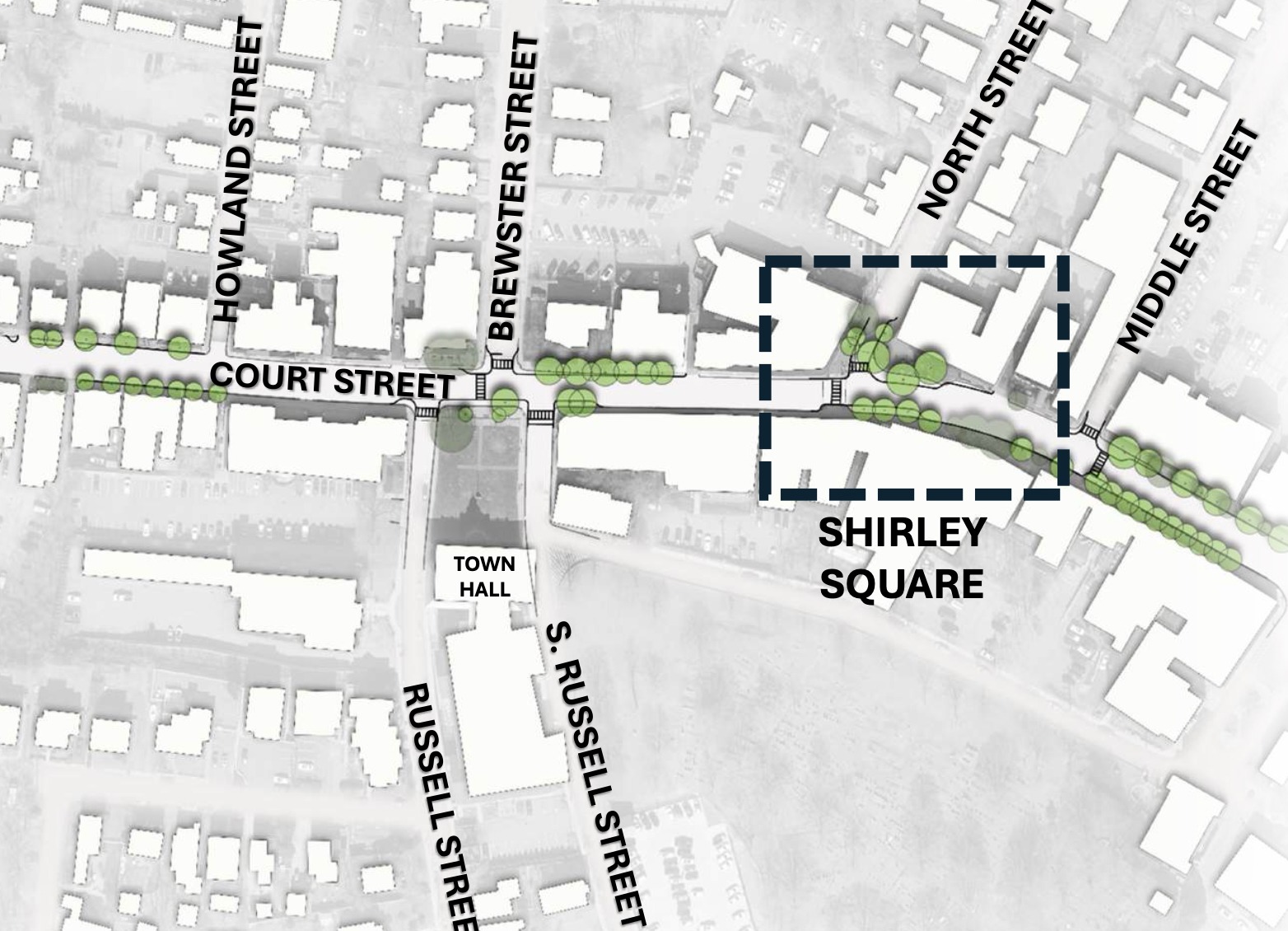
A planned transformation of Court and Main streets aimed at improving walkability, pedestrian safety, aesthetics, and climate resiliency will be delayed for at least a year after funding for the project fell through.
The work would have been largely paid for by a $3 million state grant that did not come through, said Michael Cahill, the town’s climate resiliency and sustainability planner.
In addition, federal funds that towns could draw on have dried up.
“There’s some challenges with federal funding right now,” Cahill said.
Because of those cuts in federal funding, there was more competition from cities and towns for the state’s Municipal Vulnerability Preparedness Program, which would have funded the downtown Plymouth grant. At the same time, that program itself went from funding $54 million in projects statewide last year to $29 million this year.
“So, about half the projects were lost,” Cahill said. Plymouth’s was one of them.
“We just missed out on getting funding for this round,” Cahill said, but he is optimistic that when the town re-applies, the grant will be awarded and the funds made available in July. That means construction could begin later next year. The original plan was to begin work this December.
Even with the $3 million in state money, Town Meeting would be asked to fund an additional $1.5 million.
The main goal of the project is to reduce the urban heat island effect downtown, which lacks many trees, and to improve the management of stormwater through rain gardens and permeable pavers that would allow the town to capture and treat water before it flows into the harbor. The project would also add raised crosswalks and bump-outs along sidewalks intended to slow traffic through downtown.
The delay is “a significant setback,” Select Board member Kevin Canty said in an email. “We were relying on that funding to accomplish the project as designed. Now that we haven’t gotten the grant it’s imperative that the Select Board promptly hold a meeting to review the Climate Action Plan again and identify what initiatives outlined therein the town wants to advance in the near term.”
Canty said that review must take place now while the town is building its annual budget for next year. If not, he said, it’s likely that no projects or initiatives outlined in the Climate Action Plan will make it into the fiscal year 2027 budget.
“And that’s unacceptable,” he said. “We are at a crucial stage in preparing Plymouth for the effects [of] climate change and making our community more sustainable. We don’t have the luxury of waiting another year to move forward.”
The town’s Climate Action Plan is an ambitious one, and it’s already well underway.
It came about when in 2022, the Select Board declared a climate emergency. That led to the creation of the Climate Action Net Zero Committee and the position Cahill now holds. It also triggered development of the Climate Action plan, which took a year-and-a-half to create and involved community leaders and town officials. Officials say it’s a roadmap to rebuilding Plymouth in a way that makes it more resilient to climate change.
Cahill said that despite the lack of state funding for the downtown project, some improvements can still be made.
“Although downtown resiliency is slightly delayed, there are numerous projects within this plan that are currently in the works or completed or ongoing,” he said.
Among them is something called the Community Choice Power Supply Program. Under a new four-year contract with Eversource that began this month, the town has secured electricity for 1.332 cents per kilowatt hour less than Eversource’s winter rate for this year, which Cahill said would save the average residential customer about $8 a month. The plan uses 100 percent renewable wind credits.
While any discount helps, residents last winter faced monthly winter utility bills of hundreds of dollars – with some topping $1,000 – and they are expected to be even higher for the upcoming cold weather season.
The town is sponsoring a Nov. 10 forum at Town Hall to educate residents on how they can save on their utility bills.
It has also received a $250,000 state grant to hire an energy advocate, Felipe Reese, for the next three years. He will coach landlords and tenants on how to improve energy efficiency. A 2020 study by Mass Save found that communities with high numbers of apartment dwellers had a lower participation rate in its energy efficiency programs.
At Town Hall, energy electricity monitoring devices are being installed to measure in a detailed way how much power is being consumed in real time by every electrical device in the building.
“Let’s say we want to look at the hallway lights and get real-time usage for how much energy they’re using [and] time of day that they’re on,” Cahill said. “It shows us with sensors how many people are walking through that area.”
Cahill said if the project is effective, the town would consider rolling it out in other buildings.
In addition, he said the town plans to install solar carports at the Department of Public Works, the library, Plymouth South Middle School, Plymouth South High School, and Plymouth North High School. A solar array will also be built at the Cedarville landfill.
The town has received a $294,000 state grant for a Coastal Resiliency Pilot Project – a flood insurance program through InnSure, a Boston nonprofit – to identify gaps in flood insurance downtown. The goal is to offer individual property owners the opportunity to bundle together into a discounted group policy negotiated by the town.
Nine percent of all buildings in Plymouth are at risk of a hundred-year flood. Because that means a one percent risk of a hundred-year flood every year, Cahill said, those buildings face a 39 percent cumulative risk of catastrophic flooding over the next 50 years.
The Oct. 18 Town Meeting approved spending an additional $32,715 from the Environmental Affairs Fund for the project.
And the town is already working on upgrading the Jenney Grist Mill dam, which in its present condition would overflow and flood 40 properties below it were there to be a catastrophic rain event.
Fred Thys can be reached at fred@plymouthindependent.org.