
Second of two parts
In late May, Plymouth oystermen Don Wilkinson and Sean Withington, receive the “seeds,” or spat — tiny juvenile oysters each no larger than a grain of sand — that will in two to three years become oysters ready for market. Shipped overnight from a supplier in Maine, the 2.4 million seeds arrive two mesh bags weighing just a few pounds.
Almost immediately, they are placed in an “upweller,” an aquaculture apparatus that functions as a nursery until the oysters are large enough to survive in mesh bags placed in cages in open water, a process that takes anywhere from one to three months. The upweller is a series of containers called “silos” with screened bottoms, placed into the bay through a large door cut into a floating wooden dock.
Nutrient-rich seawater is pumped through the silos and out the side of the upweller 24 hours a day, delivering a continuous supply of natural algae, called phytoplankton, and oxygen directly to the spat, urging them to grow faster. One of the upwellers Wilkinson and Withington uses floats right under the bowsprit of the Mayflower II by agreement with the Plimoth Patuxet Museums, which owns the Mayflower and has the rights to use the adjacent pier which is owned by the Commonwealth.
Wilkinson declines to say how big his oyster harvest has been over the years, but in 2014, according to data reported by the Massachusetts Division of Marine Fisheries (DMF) and compiled by the Standard Atlantic Fisheries Information System, 353,471 oysters were “landed” by Plymouth’s oystermen with a total “landing value” of $197,359. Landing value, also referred to as “ex-vessel value,” is the total revenue fishermen receive for their catch at the dock.
In 2019, just five years later, 2.5 million oysters with an ex-vessel value of $1.3 million were landed in Plymouth according to the DMF.
In each of the following years, Plymouth’s harvest was close to two million oysters with an ex-vessel value of approximately $1 million each year. The raw oyster that sells for about 55 cents at the dock to a wholesaler will – by the time it’s served at a restaurant – cost anywhere from $1.00 to $2.00 at Happy Hour and between $3.00 to as high as $6.00 during traditional dining hours.
Despite the growth of Plymouth’s oyster farming industry, the largest annual oyster harvests in Massachusetts are in Barnstable, Wellfleet, and Duxbury, well ahead of Falmouth and Plymouth which placed fourth and fifth respectively.
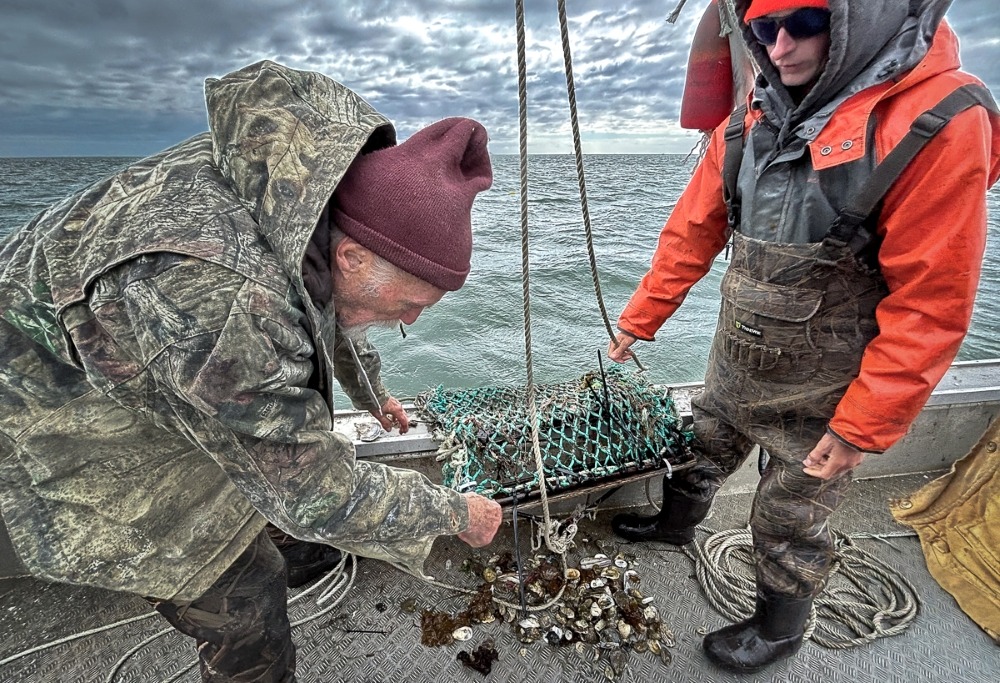
To appreciate the effort bringing these delicacies to our tables, I took to the water with Wilkinson on a recent day in early June. You have to work around the tides, low tide being the time to access the cages and attend to the crop. But on this day the easterly wind was so strong the water was high even at what should have been low tide.
Wilkinson wasn’t kidding when he told me, “the weather is [my] boss.”
Two days earlier a storm swept through the area with wind gusts topping 50 mph. Near the boat ramp the conversation among oysterman the morning I headed out with Wilkinson was the havoc wreaked by the storm. One of the oyster boats, owned by Bob Goslin, broke loose from its mooring and washed ashore. Damaged by rocks, it is out of commission for a while. In the meantime, Wilkinson is helping him get out to his leasehold so he can continue oyster fishing.
A Duxbury oysterman’s upweller broke loose and was discovered adrift by Bug Light and was intercepted by Plymouth Harbormaster Chad Hunter before it was damaged. Many oystermen removed the silos from their upwellers based on the forecast and kept them out of the bay in improvised quarters rather than risk the damaging winds. One lobsterman, who found all of his traps tangled together in an ungainly mess, was wishing he had waited to put them in the water for the season.
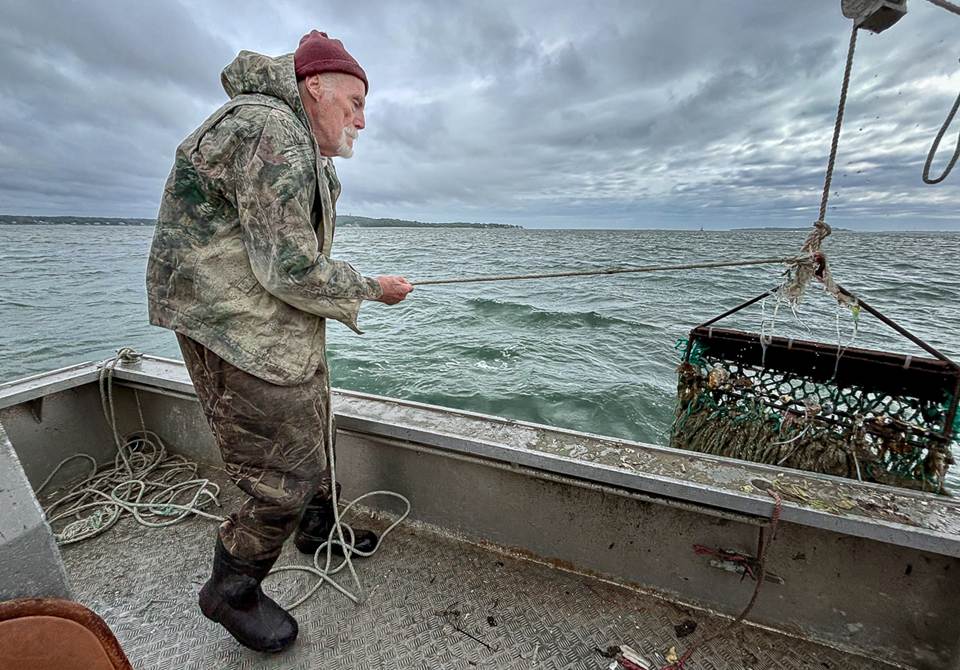
As we headed out on Wilkinson’s 24-foot skiff toward the aquaculture zone it was chilly in the low 50s, choppy, windy, and heavily overcast, and there were more signs of how vulnerable oyster farming is to the elements. One crew was righting cages blown over in the storm and marker buoys were scattered in different directions.
A kayaker’s paddle floated by which Brandon Eaton, 23, Wilkinson’s deck hand and apprentice retrieved.
Apprentice may not be exactly correct; both Wilkinson and Withington sing Eaton’s praises as born to the water with a tremendous work ethic, and as the future of oyster farming in Plymouth. As Withington told me, anyone can buy the equipment and get a leasehold in the water to farm, but mostly it takes “character” to be a successful oysterman and Eaton, who grew up in Cedarville, has it in spades according to Withington.
To my surprise, because he hadn’t mentioned it, Wilkinson also fishes for lobster and green crabs. The latter are voracious predators that can eat up to fifty mussels, clams, and oysters in a day. The green crab population is exploding as New England waters warm with climate change and they are gaining traction as a commercial shellfish, both eaten alone or used in soups and stocks.
When Wilkinson and Eaton show me how they dredge using a bag-shaped net attached to a wooden plank, several green crabs scurry around the deck when the net is emptied.
Plymouth-based Manomet Conservation Sciences (MCS) is playing a key role in studying how warming water in the bay is inviting an influx of green crabs and other warmer water species such as sea bass. MCS’s Director of Fisheries, Marissa McMahan, heads up the effort from an office in Maine where, among other things, she monitors the green crab population in New England waters.
Even in four layers, including a winter parka, it was chilly on this early June day, yet oystermen are out here all year long, sometimes for hours at a time, hauling and cleaning cages, sorting oysters by size, dredging for the more mature oysters they’ve broadcast in the mud flats, and bagging those ready for market, one hundred per bag.
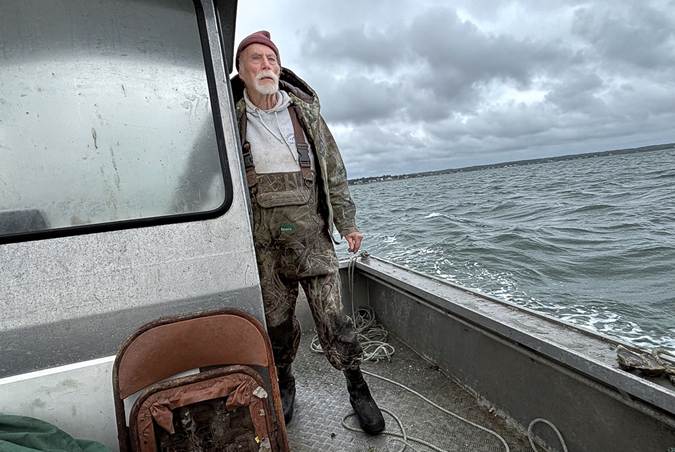
It takes a hearty soul to do that for up to five hours a day in rain, snow, wind, and frigid temperatures.
All told, we were only on the water for less than two hours, not representative of a typical oysterman’s workday. But it doesn’t take long to appreciate the many steps and many obstacles involved in successfully raising oysters.
It’s easy for us landlubbers to romanticize the life of a fisher, whatever catch he or she is pursuing, but few of us would tolerate the conditions, especially during a New England winter.
When the wind is blowing and the skiff has been bobbing continuously in the water for five or six hours, Wilkinson is slow to get his land legs back. It’s not the rain or snow or cold that bother him, he tells me as he steps out of his waders by his pick-up truck.
“It’s the wind; it’s the damned wind.”
For a more in-depth look at oyster farming in Cape Cod Bay, read Shucked: Life on a New England Oyster Farm (St. Martin’s Griffin, 2011) by Erin Byers Murray. Murray spent a year oyster farming with Island Creek Oysters of Duxbury.
Peter Zheutlin – a freelance journalist who has written frequently for The Boston Globe, The Christian Science Monitor, and many other publications – brings the perspective of a Plymouth newcomer to the Independent. He is the author or co-author of nine books, including the New York Times bestseller “Rescue Road: One Man, Thirty Thousand Dogs, and a Million Miles on the Last Hope Highway.” Zheutlin can be reached at pzheutlin@gmail.com.