
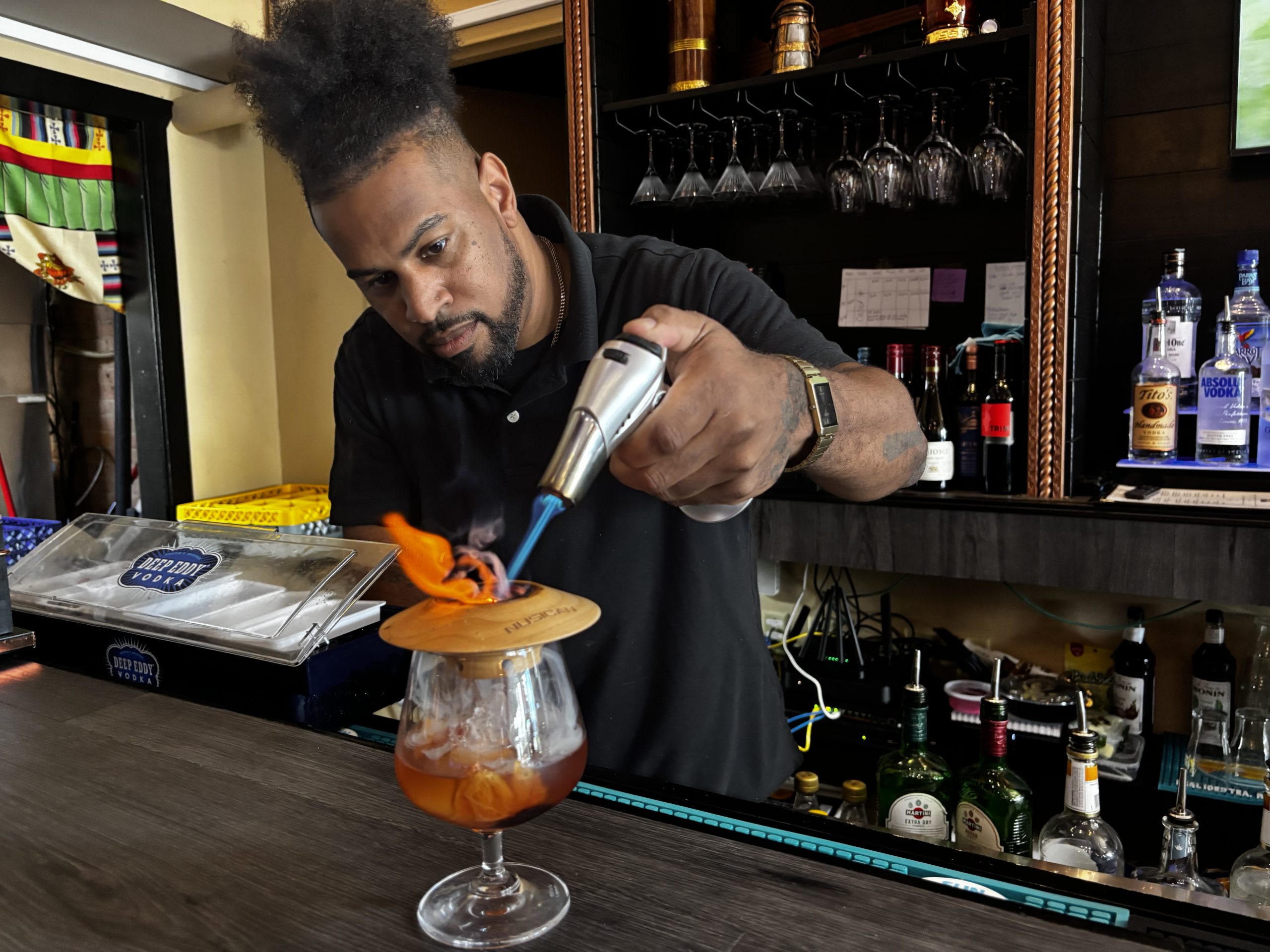
To hear Jim Doyle describe it, experiencing the subtlety of Nepali curry for the first time was revelatory. That was five years ago. Today, the restaurant that serves the dish has served him something more sustaining: A rebirth of sorts.
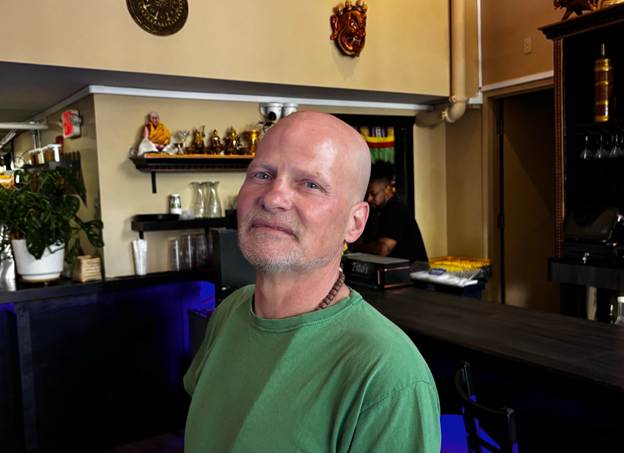
Doyle, 58, manages The Himalaya, which recently opened on Court Street. He’s running it for restaurateur Kaisang “KG” Ghale, whose portfolio also includes Lobster Hut on the waterfront and Momo Hut in North Plymouth.
This is no ordinary boss/employee relationship. The men’s lives have become interwoven in a way that transcends The Himalaya’s intriguing menu, a blend of American standards and an Asian cuisine that is at once exotic and comforting.
And yes, it kind of started with the curry.
“I did not know that it could be delicious until I had it at KG’s house about five years ago,” said Doyle, whose looks, wiry frame, and percolating energy evoke Red Hot Chili Peppers’ bassist Flea. “I always thought, ‘Oh, well, I’ll eat it,’ but I would never say, ‘Gee, I’m in the mood for curry.’ Mostly because it was so heavily spiced that all you could taste was the seasonings.”
In 2021, Doyle was in a vastly different place. He’d worked in the restaurant industry, done a stint as a journalist, and taken on a series of technical editing jobs “for a bunch of major corporations,” including CVS, EMC, and toymaker Hasbro.
But a once promising career track turned into a ditch.
“I was an almost hopeless alcoholic,” he said on a recent afternoon during the lull between lunch and dinner seatings. “I decided that I was either going to get sober or die on the course I was on. I entered myself into treatment, and I ended up at the Anchor House on Cherry Street in Plymouth. It’s a six-month working program for men. They told me, ‘You have to get a job.’”
Anchor House’s outside-hour restrictions kept him from taking a position that required the time-suck of a Boston commute, so Doyle turned his job search local. There wasn’t a demand for technical editors in town.
Eventually, he felt the call of the sea – or rather, the call of seafood, thanks to a friend who graduated from Anchor House and had worked at Lobster Hut.
“He mentioned that it’s a family of Buddhists, and my ears perked up,” Doyle recalled. “I said, ‘Oh, I can do Buddhism.’ He introduced me to KG. That was May 18, 2021.”
Despite Doyle’s fragile state – “I was a mess, I could barely think straight for quite a while” – Ghale saw a man emerging from a life-threatening chapter with scars and determination.
“He took me under his wing, realized that I work hard, and gave me three raises in a year without me asking for one of them,” Doyle said.
Those pay bumps, accepted with gratitude, were signs of something deeper. About 18 months later, Ghale “asked me to close the door to his office so he could talk to me,” Doyle said. “I thought, ‘Oh, what did I do?’” He said, ‘I just wanted to tell you that in the past year, you’ve become more than a good employee, more than a good friend. I think of you almost as a member of the family.’ He put his hands on either side of my head and touched our foreheads together. We both cried a little.”
It was, Doyle said, “The first time anybody gave a damn about me since I stopped caring about myself years ago.”
Ghale, as those who know him understand, considers making such connections a foundational part of living. He’s as understated as Doyle is animated.
“We only live once, one short life, and while we’re here, we’re supposed to do the right thing,” he said in a phone conversation.
“I am very proud of him,” Ghale said of Doyle. “They always try to give me credit, but who you are today comes from your own actions.”
Doyle, however, is eager to assign credit.
“KG is the only restaurant owner I’ve ever known who never yells and throws things and harasses the staff,” he said. “He’s just calm and compassionate. It took me a good year to realize when he was actually upset because it barely shows. I used to get upset at vendors who dropped the ball, on his behalf. I would say, ‘Why aren’t you mad at them?’ And he ‘d say, ‘Well, what good will that do?’ This was a new concept to me. I never realized that my emotions were a choice I was indulging in.”
By the time Ghale unveiled his plans to open The Himalaya, Doyle had mostly moved on from Lobster Hut and was working at the Anchor House as a medication specialist. The decision to leave was not difficult.
“I gave my notice, trained my replacement, and came running,” he said. “I spent the winter playing general contractor. We renovated the space to the way KG wanted it. This is a labor of love for me.”
Doyle has “pretty much done everything we had to do,” said Ghale. “We have ups and downs, like we all have, but he’s been great. He’s been very helpful.”
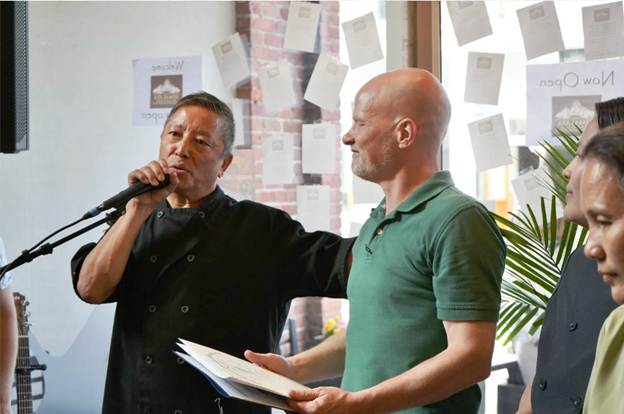
Ghale’s journey to success warrants a separate article. Or maybe a Netflix series. He offered the “long story short” version, which will have to do for now or else we’ll never get to The Himalaya’s food. Like many Tibetans – including the Dalai Lama – his family fled to Nepal to escape China’s occupation of Tibet and its violent campaign to subsume the country’s culture.
He came here in 1999 on a 10-month work visa, starting as a dishwasher at the now defunct Hearth ‘N Kettle restaurant inside the John Carver Inn. Every 10 months, he had to return home, reapply for another visa, and make the expensive journey back. In 2002, his wife came with him. Seven years later, they applied for green cards so they could stay permanently. (Today, they and their children are U.S. citizens.)
“At that time, I was working at the Lobster Hut as a second job, 40, 50 hours a week,” he said.
There was also an overnight job stocking shelves at Stop & Shop, and another part-time gig at a Dunkin’ Donuts. Sleep was a luxury.
“In 2010, we got our green cards legally and the Lobster Hut asked me if I wanted to be in charge of the kitchen. Of course I did – that’s kind of a dream coming true, you know? Then one day, the owner [Bert Hinderschneid] walked in with a box full of business cards. It says my full name, and at the bottom it says ‘manager.’ I guess that was his way to tell me that ‘you’re the general manager here now.’ I was like, ‘Yeah, OK, that’s pretty cool.’”
A few years later, Hinderschneid’s health was deteriorating. He made a proposal.
“He said, ‘If something happens to me, you’ve got to run this place,’” Ghale said. “I’m like, ‘Huh? I thought I’m already running it?'”
When Hinderschneid died, Ghale became the owner. Next month, he’ll mark his 11th anniversary helming the popular tourist spot. The idea to open another restaurant, one that showcased the food of Nepal and Tibet, simmered on “the back burner” until his three children were grown. With the youngest well into her twenties, he finally carved out the time.
”He’s done nothing but work hard and be a good man,” Doyle said, “and things have really gone his way.”
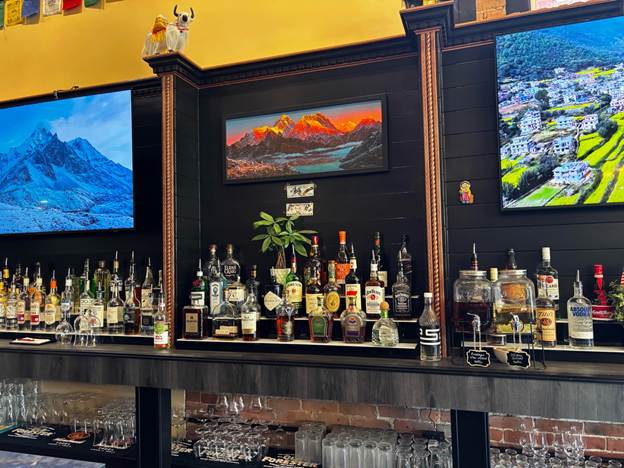
The evening after my afternoon conversation with Doyle, I returned to The Himalaya to find the place buzzing. Two large TVs – with the sound muted, thankfully – displayed stunning hi-res scenes from the Himalayan range and the villages dotting its foothills.
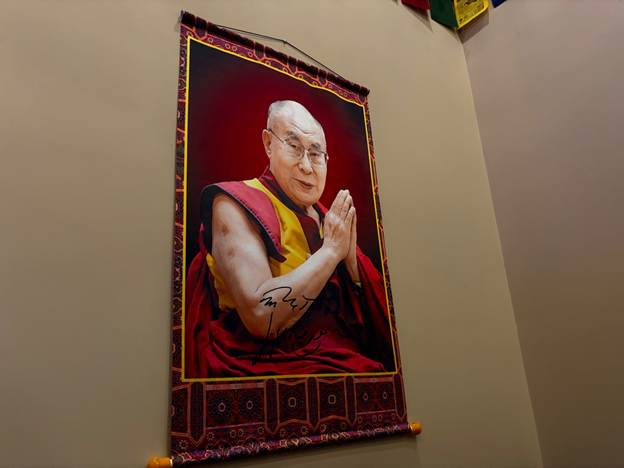
The restaurant’s layout is similar to that of the previous occupant, Korean restaurant Kogi, which moved down the street to an equally appealing space. The bar has been remade and neatly organized. The color scheme is more dramatic, accented by underlighting. Tibetan prayer flags hang on a wall, as does an autographed image of the Dalai Lama and a scroll that reads in part, “Walk the path of your own heart.” The ambiance is somehow meditative and electric.
At dinner time, the air is tinged with aromas unfamiliar to many Americans. That’s one of the reasons The Himalaya offers basic fare – like “two eggs any style,” French toast, and chicken tenders for the kids – alongside Nepalese and Tibetan dishes prepared by chef Tenzin Thongdol, Ghale’s brother-in-law.
Omelets and burgers might convince a timid passerby to walk through the door, get acclimated, and then try something more adventurous, like traditional momos. The handmade steamed dumplings are stuffed with meat or vegetables and served with house-made bone broth. They’re a staple.
The chili paste is bold but doesn’t burn. MSG is banned from the premises.
Another dish, Phing Sea, is a combo of beef, peas, and noodles with tingmo (a steamed bun). The stir-fried noodles are sublimely seasoned, as is the fried rice – they’ll cleanse your palate of any lingering aftertastes inflicted by greasy, oversalted “Chinese” takeout. This is real food.
Doyle describes the menu’s range with a geographical reference.
“If you think of India and China on the map, Nepal is that country between the two of them, where the Himalaya Mountains are, where Mount Everest and all of its little friends are,” he said. “And so the food represents kind of a fusion of Nepalese and Tibetan, and to a lesser extent, Chinese and Indian dishes. It uses a lot of the same seasonings, such as cardamom, cumin, and garlic. The difference between us and Indian food and authentic Chinese food is that we don’t use any artificial preservatives. They only use enough seasonings to bring out the natural flavor of the ingredients rather than to overwhelm them with sticky, goopy sauces.”
“People are commenting you can really taste the cleanliness of the food,” he added.
As Ghale walked through The Himalaya one evening last week, he appeared mostly unrecognized in a room filled with people savoring the flavors of his distant homeland. A smile stretched across his face, like the coda to a lengthy tale. Ghale’s decades-long dream has come to fruition. But to him, its meaning transcends business.
“The restaurant is just a path,” he told me in an earlier interview. “Everything else is all about connecting with other human beings: How can I help? That’s my question upfront, you know?”
Mark Pothier can be reached at mark@plymouthindependent.org.