
First of two parts
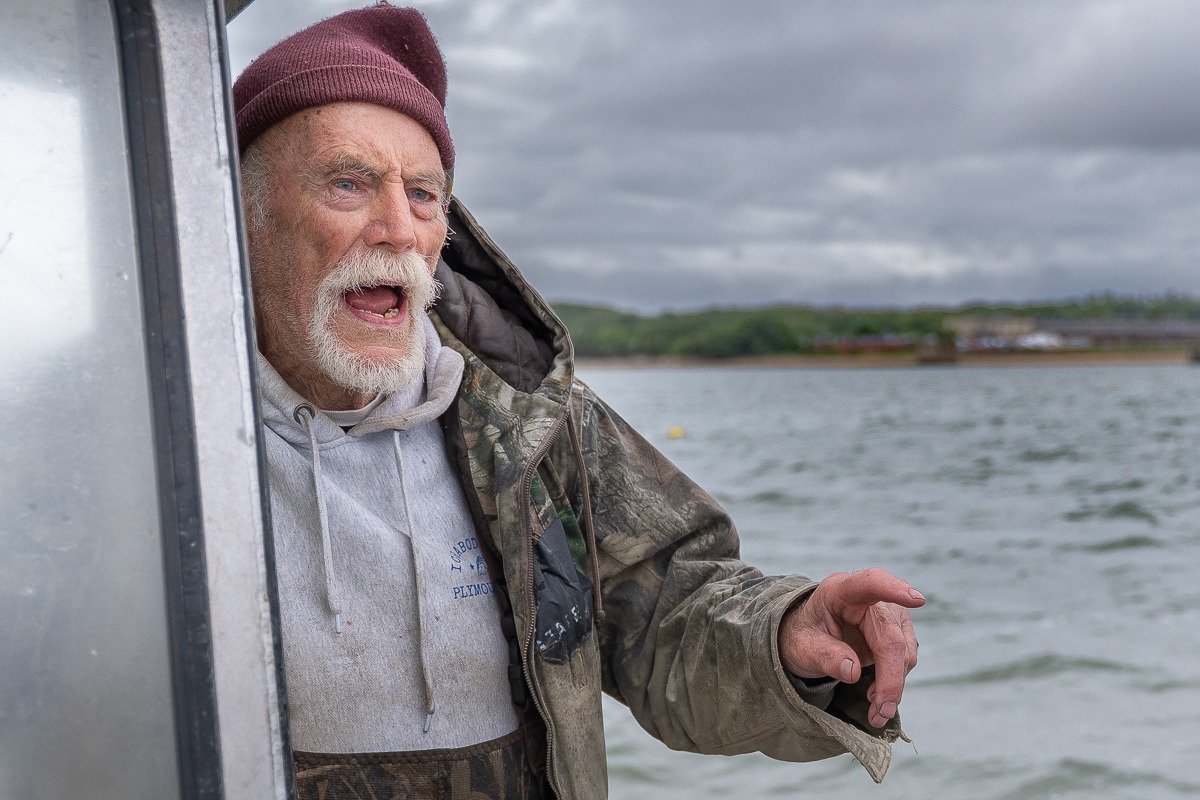
Oysterman Don Wilkinson of Plymouth looks the part.
The towering 83-year-old has been raising oysters in Cape Cod Bay for 16 years now and has the rugged, wizened look you might expect in a man who has spent many hours on the water in all kinds of weather. Piercing pale green eyes, a shock of tousled white hair and a beard to match, and a long, lean face with prominent cheek bones that give him a passing resemblance to the actor Clint Eastwood.
Today, Wilkinson’s oysters are shipped overnight to New York, Chicago, San Franciso, and even Disney World in Orlando where they appear on menus under the name of the precise spot in Plymouth where they are grown and harvested, Ichabod Flat. The flat itself is called Ichabod’s Flat. An oyster taken from Plymouth waters today can be eaten near the Magic Kingdom tomorrow.
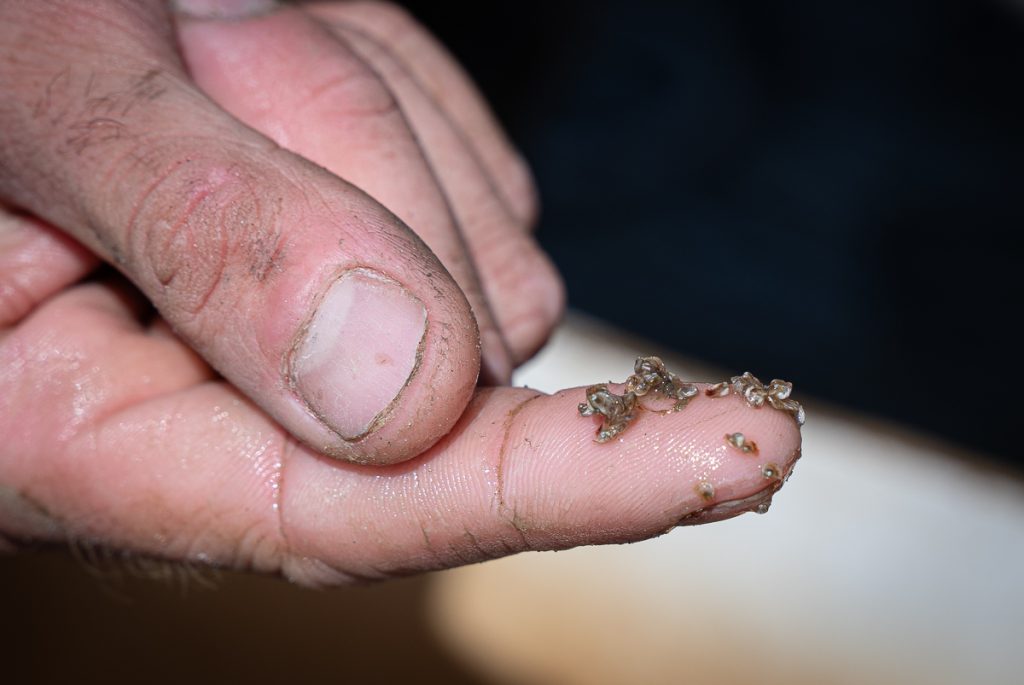
Plymouth’s oyster industry has grown substantially, with some lean years in between, since 2010 when Wilkinson, a former social worker and guidance counselor in the Rockland, MA public schools, bought his first “seeds,” the tiny juvenile oysters also known as “spat.” They grow in about two years from 1½ to 2 millimeters to 2½ to 3-inch oysters ready for harvest. Only about 20-40% of the seeds will reach maturity.
Wilkinson gets his seeds from suppliers in Maine, typically sold by the hundreds of thousands or even the millions. Even two million seeds can easily fit in a one-gallon plastic bag. Farm-raised oysters don’t reproduce in sufficient numbers to be self-sustaining, so new seed is an annual expense.
“There were only three of us oyster farming here when we started in 2010,” Wilkinson tells me over lunch at Dillon’s Local, a place he describes as the unofficial headquarters of Ichabod Flat Oysters.
Today, according to Harbormaster Chad Hunter, the town has issued 34 permits for oyster farming in an aquaculture zone of roughly 100 acres just a few hundred yards offshore near Cordage Park. The zone was created by the town around 2013 to allow for more orderly utilization of the area by dividing it into assigned parcels leased at a nominal cost to oystermen. Three deputies in Hunter’s office serve as “shellfish constables” who enforce the town’s aquaculture regulations.
The ebbs and flows of the harvest are attributable to natural causes, such as harsh winter weather creating what Wilkinson calls “the enemy” of oyster farming: ice. When the ice is thick, says Wilkinson, you can’t access the cages where the oysters grow, and the oysters themselves can be crushed. Even when surface ice is absent, ice crystals can also decimate the crop.
“When the water is below 40 degrees ice crystals form inside the oyster shells,” explains Wilkinson. “It’s not uncommon to have a brief warm-up in January. The ice crystals can start to move around with the wind and puncture the meat, and they die.”
Wilkinson didn’t grow up near the water; he hails from Greenfield, MA in the north-central part of the state. But, drawn by a love of the sea, he “washed ashore” in Plymouth in 1974, as my fellow Plymouth Independent columnist Bill Fornicairi would say, and has been here ever since.
In 1978, he started harvesting mussels thriving naturally in Plymouth’s chilly waters. His very first day, he harvested 18 bushels of mussels and sold them to Gordon Howland, the proprietor of long-defunct Mayflower Seafood.
Wilkinson soon met brothers Sean and Michael Withington, and the three started harvesting wild mussels together, as many as 100 bushels a day. In 1983, they secured a “grant,” a section of seabed in the town waters to raise mussels, but climate change and the associated warming of Cape Cod Bay devastated the mussel population. They realized it wasn’t going to be a viable business. The decimation of mussel population had knock-on effects demonstrating, yet again, the interconnectedness of the natural world.
“Plymouth was on the flyway for great numbers of ducks that fed off tiny mussels,” says Wilkinson. “That’s no longer the case because the mussels could not survive in warmer waters.”
When the mussels disappeared, Wilkinson went back to a land-based job as a social worker and as a counselor in the Rockland public schools. Sean Withington, 72, was also a social worker and he and Wilkinson would end up sharing a clinical practice for many years.
Years later, in 2010, the three men joined forces again and sought to renew their grant, this time to raise oysters. The town and the state approved, and they secured grants, each obtaining a 3.75-acre grant, in the town’s soon-to-designated aquaculture zone.
“I knew nothing about oyster farming,” says Wilkinson, “but I said, ‘why not?’”
The Withingtons now operate an oyster farming operation that, along with Wilkinson’s, function as a cooperative under the Ichabod Flat brand, though the Withingtons still sell some of their product separately under the brand names Clark Island Oysters and Plymouth Rock Oysters.
When you peruse the flavor profiles of oysters on a restaurant menu, you’ll see words such as “briny,” “sweet,” “creamy,” meaty,” “earthy,” and so on, a distinctive vocabulary not unlike the one attending to wine. But unlike wine – with a flavor influenced by both the type of grape and what’s called terroir, the soil and other environmental factors giving different wines distinctive flavor profiles – Wilkinson says an oyster’s flavor profile is completely dependent on the waters in which they grow, merroir, or “taste of place.”
The flavor is influenced by salinity, temperature, tides, currents, and the types of algae the oysters feed upon. Wilkinson, who seems less enthusiastic about eating oysters than farming them – he dislikes shucking them – describes Ichabod Flat oysters as “salty, briny,” and indeed they are among the saltiest I’ve ever sampled.
But oysters are more than a popular delicacy at the American table; they play an important role in keeping local waters clean. A single mature oyster can filter up to 40-50 gallons of water a day, says Wilkinson. They draw water into their shells by beating microscopic hairs, or cilia. As water flows across their gills phytoplankton and organic matter are extracted, and suspended sediment is trapped. The result is clarified water and a reduction of algae blooms.
One reason Wilkinson and the Withingtons formed a cooperative is that in order to succeed commercially you need a constant supply which means a lone oysterman has to be on the job 52 weeks a year. If wholesalers and restaurants are going to carry your product, they prefer a consistent supply for their menus. By joining forces each can take time off.
Environmental factors such as weather, the size of the grant, and an oysterman’s entrepreneurial zeal all affect how much he or she can earn oyster farming, but according to ZipRecruiter the average annual salary for an oyster farmer around Plymouth is about $55,000. Wilkinson says that’s in the ballpark for an established oysterman, but in the first few years or so an oysterman won’t break even. There are start-up expenses, equipment mainly, and it takes at least two years for an oyster to grow to marketable size. Because the work is arduous, many oystermen hire extra hands, another expense.
“All of us have other jobs or sources of income,” says Wilknson.
He relies on Social Security, but others work in real estate, construction, and other trades. There’s even a funeral home director among Plymouth’s oystermen. But once established, if you do it well, Wilkinson adds, “it can be profitable enough to be worth your while.
“You have to love to be out on the water,” says Wilkinson describing what appeals to him about being an oysterman. “Oystermen, like lobstermen, tend to be a very independent lot who want nothing more than to be left alone and not have anyone telling them what to do. You are your own boss.”
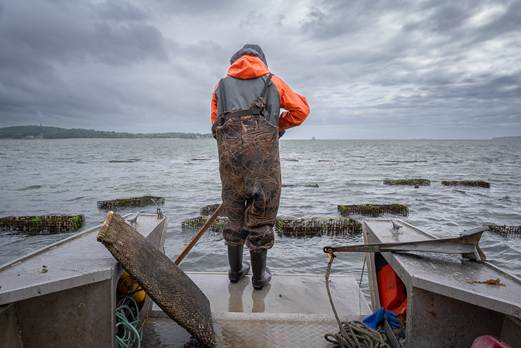
He hesitates a moment, then adds, “Well, nature is your boss.”
At 83, Wilkinson has no immediate plans to give up the ship, though the physicality of the job is getting more difficult.
“It kept me young,” he says, “but lifting cages is the hardest part now. They can weigh 60 pounds with the fouling,” a reference to the marine growth that clings to the cages.
“Oystering is something you really need to learn by experience,” adds Wilkinson. “There’s an old saying: you’re not an oysterman until you’ve killed a million oysters.”
Tomorrow, Independent Correspondent Peter Zheutlin heads out on the water with Don Wilkinson for a firsthand look at oyster farming in Plymouth.
Peter Zheutlin – a freelance journalist who has written frequently for The Boston Globe, The Christian Science Monitor, and many other publications – brings the perspective of a Plymouth newcomer to the Independent. He is the author or co-author of nine books, including the New York Times bestseller “Rescue Road: One Man, Thirty Thousand Dogs, and a Million Miles on the Last Hope Highway.” Zheutlin can be reached at pzheutlin@gmail.com.