
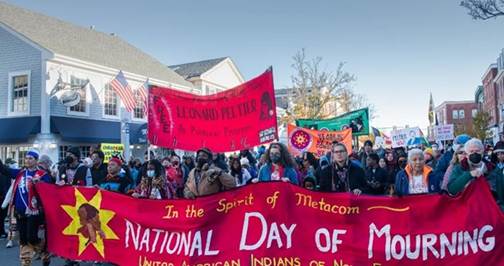
The stalemate between the town and the United American Indians of New England ended Tuesday when a judge handed each side a partial victory.
Plymouth Superior Court Judge Brian Glenny ruled the town is not required to provide a stage for the group’s annual National Day of Mourning protest Thursday, as demanded by the Native American group.
But in his 10-page decision denying the group’s request for an injunction against the town, Glenny also said the town may not require the group to obtain insurance for the event — which had become a major point of contention.
The judge wrote that since the town’s mobile stage is no longer operable, the longstanding agreement to make its “showmobile” available does not mean the town must provide another one.
“Therefore it can no longer be consideration in the interpretation of the agreement,” he wrote.
There is barely a mention of a stage in the agreement, the judge wrote, so “Plymouth has no obligation under the agreement to provide a stage for UAINE.”
Glenny did rule the 1998 agreement remains “binding and valid” in most other respects.
“The town cannot require permits, insurance, financial bond or any indemnification by the town,” he wrote.
The latest high-profile standoff between the town and UAINE erupted after the Select Board voted unanimously behind closed doors on Nov. 10 to authorize town officials to request the group get an insurance policy as the town does for all other events on town property.
UAINE leaders portrayed the move as another affront in the centuries-long persecution of the Native Americans and a violation of a settlement agreement reached after police confronted protesters at the 1997 National Day of Mourning protest, pepper-spraying marchers and arresting 25.
The group’s lawyer described the event in court papers as a “solemn, spiritual and highly political day” where participants “mourn Native ancestors…the genocide of Native people and the theft of native lands.”
It takes place Thanksgiving Day — Nov. 26 this year — beginning with speeches and prayers at Coles Hill, followed by a march through downtown Plymouth. Thousands of people from around the country have attended in the past.
The town has provided a stage ever since the 1998 settlement, in which town officials agreed to make its mobile stage available. The agreement also said the group would not have to go through the normal permit process in order to have the event.
“The town remains committed to supporting the National Day of Mourning,” Select Board Chair Deb Iaquinto said in a statement released after the ruling. “The town has tried to work collaboratively to support UAINE’s rights to free speech and assembly.
“However, the town erecting a stage was never promised or mandated under the original 1998 agreement,” the statement said.
The insurance requirement had sparked angry protests from the group’s supporters who accused the town of trying to derail the event.
They spoke out angrily at last week’s Select Board meeting and held a protest outside town hall.
Last year after the group filed suit and another judge hinted he would rule against the town, Plymouth dropped its demands the group get a permit and insurance.
But this year, the town insisted the group obtain insurance and indemnify the town to protect it if anything goes wrong.
Olly deMacedo, who organizes the town’s Thanksgiving Parade, offered last week to provide a stage and insurance, in an effort to quell the controversy. But as of earlier this week, the group and its co-leader, Mahtowin Munro, had not accepted the offer.
After the court hearing Monday, Munro told reporters she had not accepted the offer for the stage because she believed it was “Plymouth’s responsibility under the agreement.”
“This offer was not coming from Plymouth,” she said. “The town should make arrangements with him, not us.”
In a statement issued late Tuesday, UAINE said it disagrees with Glenny’s “preliminary finding about the town’s obligation to provide a stage.
“Settlers frequently break their agreements with Indigenous peoples. In fact, the US has broken every single treaty it signed with Native Nations,” the statement read.
“The Town’s vote remains an outrageous choice that absolutely no one was forcing Plymouth to make,” the UAINE statement continued. “Contracts do not end on the day they are signed—each party maintains a duty to engage with the other in good faith and to deal fairly. Plymouth has not done so and UAINE is continuing to review the ruling and evaluate its legal options.”
Andrea Estes can be reached at andrea@plymouthindependent.org.