
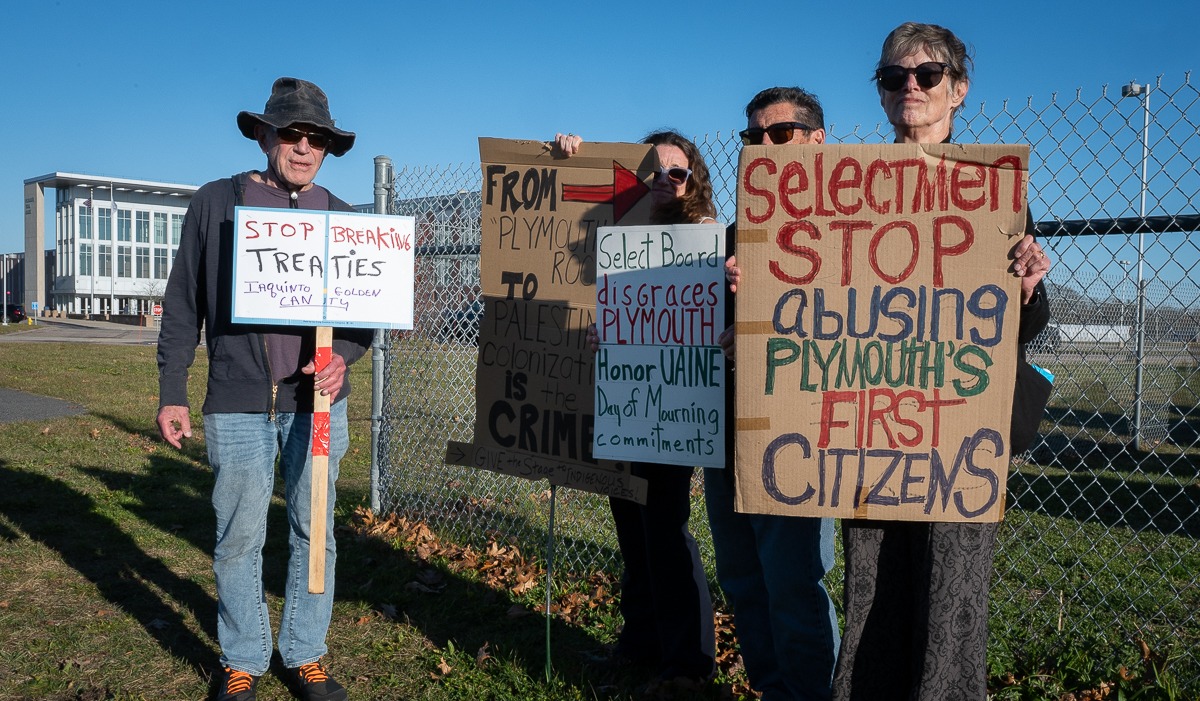
An ongoing standoff between a Native American group and town officials over who is responsible for logistics behind Thanksgiving Day’s traditional National Day of Mourning protest is now in the hands of a judge.
With only two days left before the protesters meet atop Coles Hill, Plymouth Superior Court Judge Brian Glenny heard arguments on both sides of the yearlong dispute, then took the matter under advisement.
He did not say when a ruling might come, but lawyers said the judge understands “time is of the essence.”
Either way, leaders of the United American Indians of New England said the protest will move forward as planned.
“I can assure you we will be there Thursday,” said Mahtowin Munro, co-leader of UAINE, after the court hearing.
The most recent chapter in the dispute started when the Plymouth Select Board voted unanimously and behind closed doors on Nov. 10 to force UAINE – the organizers of the annual event – to obtain insurance and indemnify the town in case of an emergency.
UAINE leaders were incensed, arguing the requirement was breach of an agreement reached after the last time there was an emergency at the event in 1997. That’s when a clash erupted after police confronted protesters, using pepper spray and arresting 25.
The fallout prompted a lawsuit and resulted in a 1998 out-of-court settlement in which the town agreed to provide its mobile stage and facilitate the event going forward.
The event, which recognizes the millions of Native Americans who suffered and died after the arrival of the Pilgrims, has been held every year since 1970.
Select Board members argued the settlement agreement does not mention insurance, nor does it require the town to provide a new stage. The stage it has provided in the past is no longer functional, town lawyers argued.
Backlash against the Select Board for the unanimous vote was swift and harsh, with many residents appearing at its Nov. 17 meeting to rebuke the board members and demand the town pick up the insurance tab – which according to experts amounts to several hundred dollars.
One of several letters to the editor of the Independent called the Select Board’s decision “a step sideways onto the wrong side of history.”
After the backlash, two board members – Richard Quintal and Bill Keohan – changed their votes in executive session on Nov. 17, according to Quintal. However, the majority held.
Monday’s court hearing was a continuation of a lawsuit UAINE filed against the town last year after town officials first demanded the group seek a permit and obtain insurance for the protest. The town backed down last year after another judge suggested he was leaning in favor of UAINE’s arguments.
In court, lawyers for the two sides sparred over their differing interpretations of a 1998 agreement between the parties.
UAINE argues the new Town requirements violate the 1998 agreement, while the town says the agreement never required it to provide insurance or a mobile stage, which the town has provided as a courtesy for the past decade out of gratuity, the town’s lawyers said.
“Based on the plain language of this agreement, there is no requirement that the town needs to set up a stage,” Stacey Verde, a lawyer for the town, told the judge.
The town’s lawyers also pointed to UAINE’s refusal to accept an offer to provide a stage and the insurance from the longtime director of the America’s Hometown Thanksgiving Celebration, Olly deMacedo.
Daniel Guenther, one of UAINE’s lawyers, told the judge there is more at stake than who pays the bills. He said the group seeks a binding agreement from the town to avoid future disputes over the meaning of the 1998 settlement agreement.
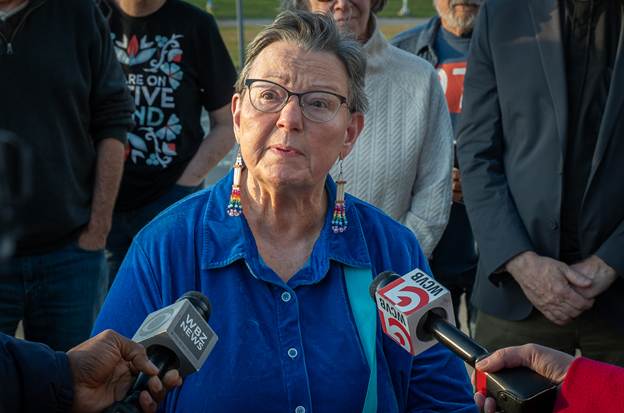
The stage is “Plymouth’s responsibility under the agreement,” Munro said of deMacedo’s offer. “This offer was not coming from Plymouth … the town should make arrangements with him, not us.”
Much of the hearing focused on one word in the agreement, which says that Plymouth “agrees to make available to UAINE its ‘showmobile’ for use during the National Day of Mourning speeches.” Since the agreement was signed and until 2014, the town used its own showmobile, or mobile stage, for National Day of Mourning demonstrations.
But it eventually became dilapidated and was deemed unsafe to use, Guenther told the judge. Until 2025, the town provided an alternative stage for the protest without objection.
“It’s unclear why, in 2025-2026, it’s suddenly a burden, or impossible, or something they won’t do anymore,” Guenther said.
The town’s lawyers said its “gratuitous offer” to provide a stage “changed with the times.” Specifically, the town would be liable if anything went wrong on the stage it provided. Arranging a stage that is not owned by the town also requires more town resources, which are bound by Town Meeting decisions and the town’s budget.
“The town purchasing a showmobile is not something they can do,” said the town’s attorney Kathleen McKay.
Glenny questioned whether the language in the agreement – namely “its showmobile” –mandated the town to provide any stage for the gathering indefinitely, even if it didn’t own one.
“It sounds like something they will provide should they have it, not that it will go out and buy one,” he said.
McKay and Verde told the judge the group could rent a 10-by-10 stage for less than $1,000. They argued the group had the means to do so because it had raised more than $31,000 over the past several years.
“They are just looking to hold the town responsible for something, even if it’s not provided in the agreement of 1998,” McKay said.
Multiple members of the Select Board attended the court hearing Monday, including Select Board Chair Deb Iaquinto, Kevin Canty, and Bill Keohan.
Plymouth Town Manager Derek Brindisi said the town will abide by and is “happy to support” the judge’s ruling.
“We don’t want to be here in court,” Brindisi told reporters outside the courthouse. “We want to have a working relationship … there are many ways [UAINE] could have solved this problem without having to invoke the town into liability.”
Guenther said a ruling “could come at any time. We expect to hear something before Thursday.”
Emily Spatz can be reached at emily@plymouthindependent.org.