
After nearly 25 years of working mostly behind the scenes, the Plymouth Foundation ran into a public buzzsaw on Hedges Pond Road last year. Perhaps “chainsaw” is the better metaphor.
The clear-cutting of trees across 30-plus rolling acres and the ongoing removal of sand and gravel to level the site for a business park incensed many Cedarville residents, environmental activists, and members of the Wampanoag Tribe. They fought unsuccessfully to stop the project and continue to question the wisdom of the town’s relationship with the private, nonprofit entity that prepared the land for development then sold it off to a builder.
For its part, foundation leaders seemed blind-sided by the invective hurled at an economic development plan for the Cedarville parcel that had twice been endorsed by unanimous Town Meeting votes.
So just what is the Plymouth Foundation? How and why was it established? What has it been doing for the past two decades and who’s in charge?
The foundation’s official name is the Plymouth Regional Economic Development Foundation, Inc. It was formed in 2001 under Massachusetts General Law Chapter 180, which sets the rules for private nonprofit corporations established “for any civic, educational, charitable, benevolent or religious purpose.” There are many such entities across the state.
The foundation’s Articles of Organization says its purpose is to “aid in the economic development of the Town of Plymouth and neighboring communities in Plymouth County, to provide programs that will retain or increase local tax revenues, to retain and provide new employment opportunities and improve the skills of the local labor force and in general to foster trade and commerce in Plymouth and its neighboring communities.”
The foundation is governed by a 13-member volunteer board of directors which includes standing seats for Plymouth’s Select Board chair, town manager and director of planning and development, or their designees.
Current board members include Derek Brindisi, town manager; William Hallisey, owner of Shiretown Glass & Home Center; Lee Hartman, the town’s planning and development director; Jay Kimball, owner of Woods Seafood; Brian McCowan, a vice president at North Easton Savings Bank; Jack Meehl, a retired banking and finance executive; Matt Muratore, former state representative; Amy Naples, executive director of the Plymouth Area Chamber of Commerce; Kevin O’Reilly, operations manager at the Triple M cannabis dispensary and a member of the town’s Zoning Board of Appeals; Liana Patton, attorney and Town Meeting member (serving as the Select Board chair’s designee); developer Rick Vayo, president of Megryco Inc.; Charlie Wall, retired president of Massasoit Community College; and Dee Spencer Wallace, a lecturer at Northeastern University.
While it is a private corporation, the foundation serves as the town’s out-sourced economic development office. It works under a memorandum of understanding with the town that was extended in February 2025 for another five years by the Select Board.
Under the terms of the MOU, the foundation “will engage a full-time Economic Development Director to oversee the Town’s economic development opportunities and priorities.” It calls for the director to “develop and administer a comprehensive economic development strategy for the town, develop and administer programs to attract new businesses and expand existing businesses, provide small business counselling (and) manage economic development efforts for the town.” That person is Stephen Cole, the foundation’s executive director and only paid employee. He was hired in 2019.
The town makes annual payments to the foundation to help cover its “programming and personnel.” This year that totals $152,298, but the figure can escalate annually for inflation, subject to town appropriation.
The foundation was organized by a group of town residents and officials, the Plymouth Area Chamber of Commerce and the Plymouth Industrial Development Corp., the now-dissolved nonprofit entity that built the industrial park off Cherry Street in North Plymouth and enabled the sprawling Colony Place mixed-use commercial development.
That group wanted the foundation to carry forward what was seen as the PIDC’s successful model of a private, nonprofit entity, helping the town recover from the economic loss of the Cordage Company, which was its largest employer for generations.
The PIDC was incorporated in 1962 with a 50-year charter. Its business model was to acquire open land, carve out roads, and install utility lines with the aim of selling off lots for industrial or commercial uses. The PIDC was funded by private donations and several large state and federal grants.
Money the PIDC realized from the sale of commercial lots helped fund continued expansion of the industrial park. (Source: “History of Success: Plymouth Industrial Development Corporation” by Michael Gallerani, a former economic development director for the town of Plymouth.)
The direct link from the PIDC to the foundation was the late Edward Santos, who was recently memorialized with a Community Service Garden at the Plymouth Public Library. For decades, Santos was a leader of the PIDC, then a founder and long-time officer of the new foundation.
The PIDC helped bankroll the foundation, contributing start-up money and matching annual support from the town to pay for operating costs. The PIDC also financed the foundation’s first major real estate project – buying a large tract of undeveloped land off Hedges Pond Road from the town to create a business park.
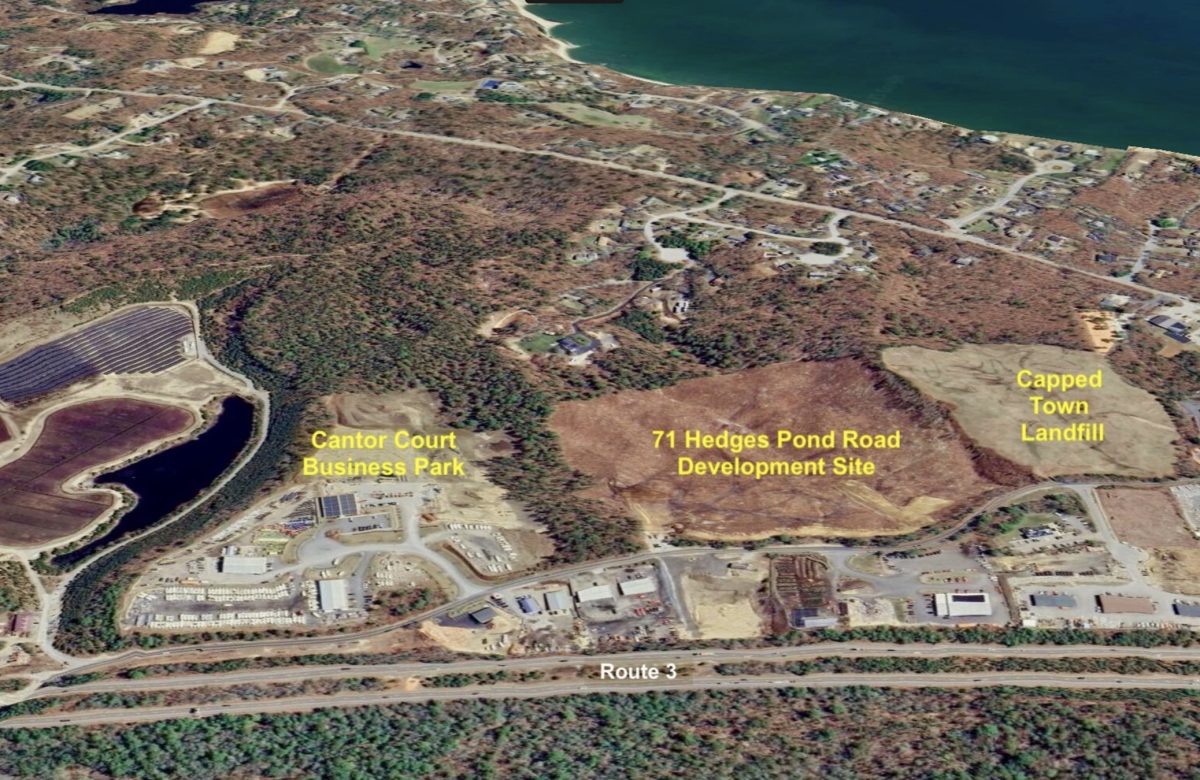
If that idea sounds familiar, it should. But it’s not the ongoing 71 Hedges Pond Road project. Instead, it was a prequel of sorts, with the foundation buying the land next door, previously listed as 103 Hedges Pond Road, to develop what became the Cantor Court business park.
The large tract of town-owned land on the east side of Hedges Pond Road was initially earmarked for expansion of the adjoining Cedarville landfill. But when environmental regulations changed, making it difficult to build new landfills in Massachusetts, the town considered other uses. Some land went into conservation and the acreage with frontage on Hedges Pond Road was considered for economic development. The foundation was tapped to develop that land to increase the town’s commercial tax base and create jobs for local residents.
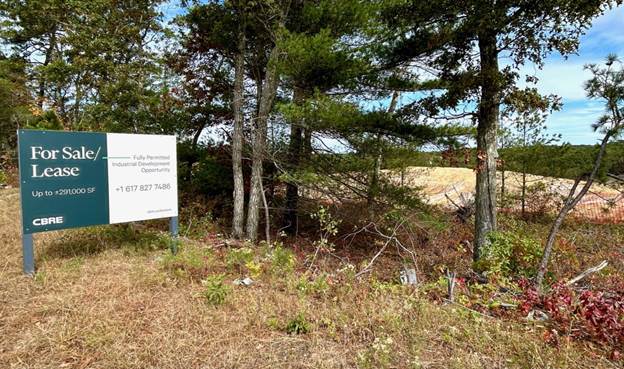
In the fall of 2003, Town Meeting voted to rezone 23 acres off 103 Hedges Pond Road from residential to commercial. It also voted to sell the land to the foundation. The purchase was finalized in 2005 with the foundation paying $500,000, which it argued was fair market value based on appraisals at the time. (The PIDC loaned the foundation $450,000 to make that deal.)
Unlike the current project at 71 Hedges Pond Road project, where the foundation did some preliminary engineering, legal and marketing work, but then sold the land to a private developer to build the business park, at 103 Hedges Pond Road the foundation did more of the physical development work. It hired a contractor to level the site, removing a total of 570,000 cubic yards of sand and gravel.
Over the course of four years, the foundation netted $1,240,198 from the sale of sand and gravel, according to its filings with the IRS. After the site was leveled and ready for the road and utilities, the foundation sold the parcel for $1.3 million to Tonka Truck LLC., which went on to build out the business park. (The total assessed value of the commercial property at Cantor Court is $5.2 million, which is yielding $66,279 in property taxes this year.)
The net proceeds from the first Hedges Pond Road project funded what can be thought of as an endowment of approximately $2 million for the foundation. That money remains invested and the foundation uses the earnings to pay for some of its ongoing programs, including matching the town’s annual contribution for salary and overhead expenses of the foundation.
The foundation’s fund balance grew significantly this year with the sale of 71 Hedges Pond Road to the developer Standish Investment Group. The foundation paid the town $1 for the land and eventually sold it for $3,450,000, with the understanding that $2 million of the proceeds be paid back to the town to fund traffic improvements in Cedarville. That financial arrangement was part of the agreement in 2018 and 2019 when Town Meeting rezoned the land for commercial uses and tapped the foundation to facilitate the project.
While the two Hedges Pond Road projects were high-profile, they represent a fraction of the foundation’s work. Since 2001, the foundation has commissioned several in-depth economic studies of Plymouth to evaluate existing conditions and identify opportunities for growth. It has secured millions in state and federal grants for the town and developed programing to support those priorities.
Larger grants include $1.7 million in 2012 to extend Commerce Way and the sewer line further into West Plymouth to enable development of the Market Basket plaza (and associated commercial lots, known as Cranberry Crescent).
A $2 million grant in 2015 helped expand town wharf to support the commercial fishing fleet and to accommodate summer cruise ship traffic. (The foundation also takes credit for recruiting the first cruise ship to come to Plymouth in 2012, which leveraged the expanded summer schedule of cruise ship visits.)
Recently the foundation secured a $300,000 federal planning grant to fund the town’s Holtec master plan process. The money will be used to evaluate what should be done with the 1,500 plus acres that will become available when the decommissioning of the power plant reaches certain milestones.
At the town’s urging, the foundation helped to create the Plymouth Growth and Development Corporation (PGDC) to manage and improve parking in the downtown and North Plymouth commercial areas. The foundation also launched the Plymouth Downtown Waterfront District to help businesses in that area promote themselves and coordinate initiatives.
Looking to diversify the town’s economy, the foundation has embraced the “blue economy” to grow both traditional waterfront/ aquaculture industries and new technologies, such as marine robotics.
To that end, the foundation created an annual Blue Future Conference, now in its fourth year, to position Plymouth as an emerging center for these industries. The conference includes a special session for local high school students to introduce them to career opportunities in the blue economy. This year’s conference featured Bill Nye the Science Guy.
In the coming year, the foundation is planning to launch a new commercial facade improvement program to help businesses downtown and on the waterfront. It is also close to announcing a new co-working space to support working professionals and budding entrepreneurs.
Read Michael Cohen’s companion piece on the Plymouth Foundation here. More on the foundation’s current programs is available here.
Michael Cohen can be reached at michael@plymouthindependent.org.