
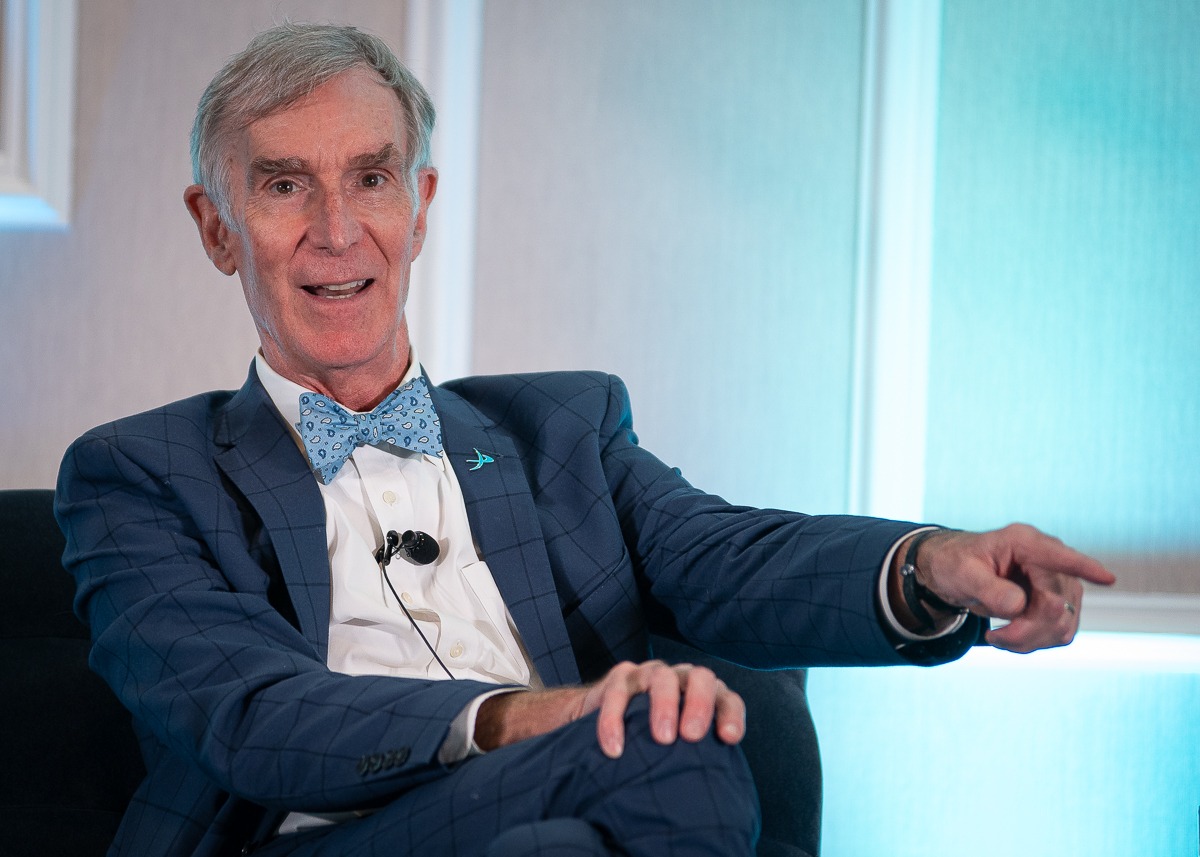
Bill Nye, known for the long-running public television series “Bill Nye the Science Guy,” told attendees at the 4th annual Plymouth Blue Future conference Thursday that science is under siege.
“People are attacking science for reasons that are deeply tribal within us,” said Nye, who was the keynote speaker at the conference, held at the Hotel 1620 Plymouth Harbor. “If you don’t understand the other side, you say to yourself the other side’s wrong about everything, and that’s what’s going on right now.”
Nye said science education is more important than ever to counter the denial of climate change that is rampant in Washington, D.C., mostly among Republicans.
“So, we have these guys in government now: ‘Oh, climate change isn’t real,’” he said.
The Blue Future conference at the brought together 200 attendees from nonprofits such as the New England Aquarium, educational institutions, oyster farms, financial institutions, and tech companies.
Alexandra Staiuski was there representing Greensea IQ, a Vermont company that for the last five years has had offices in Cordage Park. It makes autonomous underwater robots.
“We test all of our robots right in our backyard, right in Cordage Park, in the ocean back there,” Staiuski said.
About 35 of the company’s 88 employees now work in Plymouth, she said.
Steve Cole, executive director of the Plymouth Foundation and the organizer of the conference, said its goal is to establish Plymouth as the Massachusetts hub for ocean-oriented businesses and nonprofits.
“We have strengths in areas like aquaculture, robotics, AI,” Cole said.
Another goal, he said, is workforce development, which means moving beyond tourism as the main driver of the economy and toward higher-paying jobs. It has long been a knock on Plymouth’s economy that many residents are forced to commute to Boston for work because local businesses don’t pay enough to support living here.
Thursday’s panel discussion topics included climate resilience and marine technology.
The conference continues Friday with an emphasis on persuading students to imagine themselves as starting their own businesses in the “blue,” or ocean-based, economy, Cole said.
“The point of day two, Future Works, is largely intended to encourage middle-school students, high-school students, when they think about their career pathways, to think about the types of problems they could solve,” he said. “Most kids who are graduating high school, they’re looking at going to college or getting a job. Very few of them know that they can create their own job.”
Fred Thys can be reached at fred@plymouthindependent.org.