
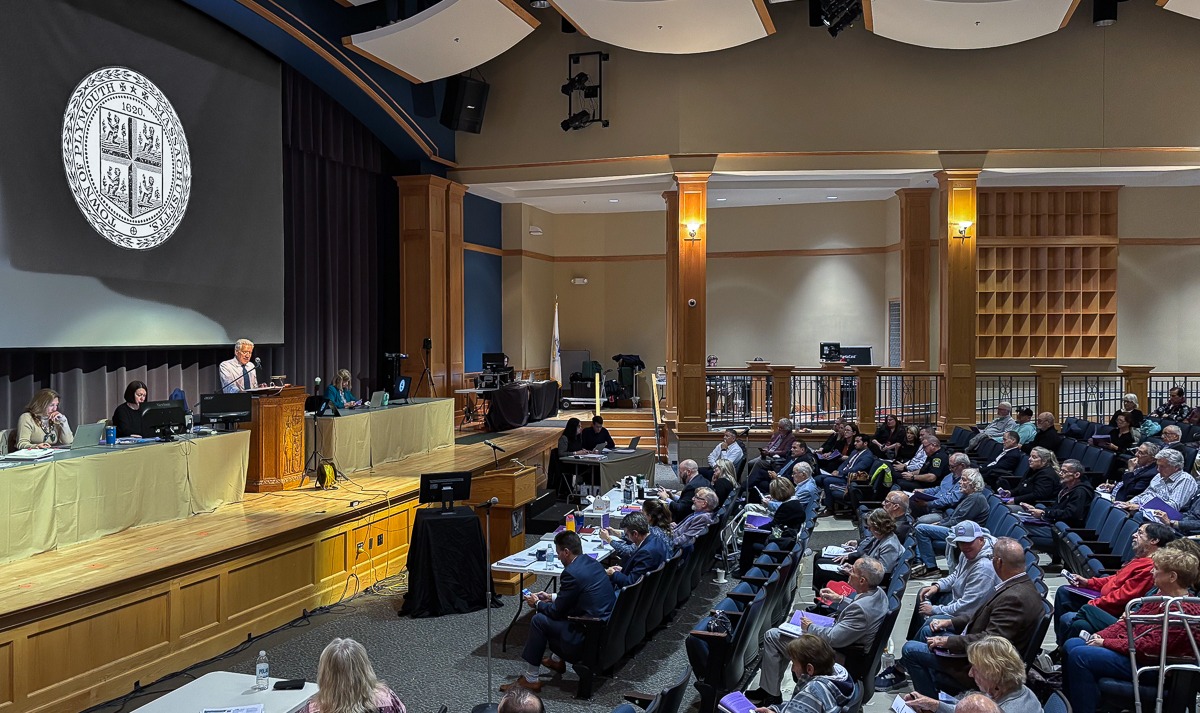
Select Board Chair Deb Iaquinto opened fall Town Meeting with a warning to members about a five-year budget forecast projecting growing deficits starting in the fiscal year beginning July 1, 2028.
Her opening statements followed a presentation from town officials earlier in the week about the need to rein in a budget growing faster than expected revenue, a scenario they said will either call for increasing the property tax levy limit or considering painful cuts.
In her opening remarks, Iaquinto urged the 162 members of Town Meeting to heed the budget warnings as “a call to action, not a reason to panic.”
They didn’t panic, opting to pass the articles presented to them – including some with hefty price tags.
For example, a plan to make downtown more climate resilient and pedestrian-friendly will cost $6 million before the state reimburses half the cost.
“I thought there’d be a little more pushback on some of the articles that I felt like people could perceive to be nice to do versus need to do, but there was really none of that,” Iaquinto said in an interview Monday. “Everything kind of just went through.”
She said it is going to take some time for Town Meeting members to understand how serious the town’s financial situation is. She wondered if it was because the projected deficit for fiscal year 2028 is only $136,000.
“We need to do the work of educating Town Meeting and start talking about these things,” Iaquinto said.
The Select Board, which Iaquinto leads, also did not turn down any requests for spending this fall. She pointed out that the fall Town Meeting is light on capital spending requests compared to the spring Town Meeting, which she predicted will bring much greater scrutiny to spending.
Iaquinto’s concerns followed a rather dire presentation to the Select Board last week from the town’s Finance Director Lynne Barrett about the five-year budget forecast.
While Barrett said the 2028 fiscal year will see “close to a balanced budget,” growing deficits will likely balloon to $4.7 million in fiscal year 2029.
Barrett said at the current rate, annual deficits would grow to $26.6 million by fiscal year 2032 if spending cuts are not made and new sources of revenue are not generated.
“The numbers definitely look frightening,” Barrett said. But she cautioned that they are assumptions based on historical trends in yearly increases in expenditures and revenues.
The major cause for concern is how the tax-base growth has slowed in recent years. Revenues have not increased as fast as they used to, in part because development has slowed as Pinehills and Redbrook near completion, Barrett said.
Fiscal year 2028 is also when the town is projected to reach its levy limit.
The levy limit matters because under the state’s Proposition 2½, the town is limited in how much it can raise the property tax levy before it must ask the voters for approval. The increase is capped at 2.5%, under the law.
The levy limit is calculated using the sum of the previous year’s levy limit plus taxes on new growth, such as buildings and home additions or remodeling.
For the town to tax more than that amount, residents would have to approve a Proposition 2½ override. If the town has what is called excess levy capacity, meaning that the limit on the property taxes it can raise is higher than the taxes it does raise, it has a financial cushion.
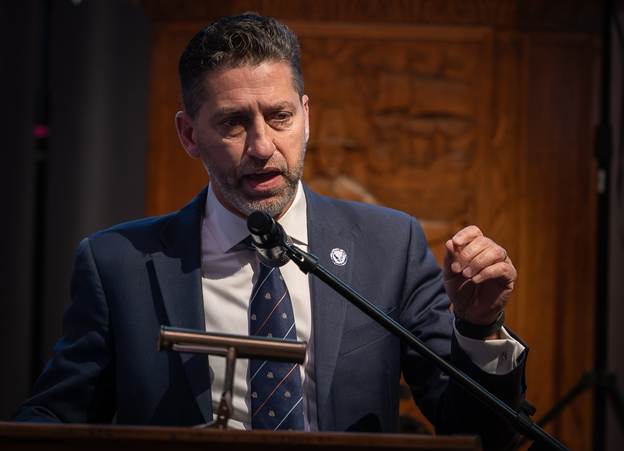
Town Manager Derek Brindisi said in an interview it could come down to a difficult choice: Ask the voters for an override to raise more taxes or start making cuts.
“If an override is not on the table, well, the only other thing we can do at that point is service cuts,” Brindisi said. “That would be significant service cuts to public safety, public education, public works, and a lot of the other services that our residents have enjoyed over the past many decades.”
“The town has historically used the levy capacity as a safety net when it came to balancing the budget,” Brindisi said.
He pointed out that last year, the town had only about $300,000 in excess levy capacity, down from about $8 million four and five years ago.
Barrett projected revenues would increase by 3.75% in fiscal year 2028, but only by 3.61% by fiscal year 2031.
Expenses, on the other hand, are projected to increase by 3.79% in fiscal year 2028, and by up to 5.48% by fiscal year 2032.
“Those are signs the town is facing financial challenges,” Brindisi said.
Brindisi said there is a lot the town can do in the immediate future to cut costs and increase revenue, and he and Barrett have been working on solutions. They implemented a hiring freeze. In June, they switched health insurance providers, saving $300,000, Brindisi said. They are working with unions to cut prescription drug costs.
“I don’t believe we’re in front of a fiscal cliff,” Brindisi said. “I think we have fiscal challenges, but we’re paying close attention to those, and plan on solving those.”
Salaries account for 50% of the budget, while health insurance and pensions make up 24%, and increases in health insurance and pensions eat up half of the annual revenue increases. The other big drivers of cost increases are fuel and utilities, Barrett said in an interview.
“We knew that this was coming,” Barrett said. “We’re now at the time when we really need to start trying to make some of these hard decisions.”Fred Thys can be reached at fred@plymouthindependent.org