
Town officials told their bosses on the Select Board Tuesday the town has doled out nearly $40 million in taxpayer-funded project grants over the last 23 years without the proper oversight and preservation restrictions.
Although they took no vote, the board members who spoke supported Town Manager Derek Brindisi’s controversial position to withhold future grant payments until proper restrictions are in place.
The disputed grants were given on the condition the recipients would record deed restrictions to ensure the projects funded are preserved in perpetuity, and in the case of historic preservation, the buildings’ integrity is preserved.
“Without the restrictions, the money that was appropriated could be lost because there is no protection,” Brindisi told the board at what was described as an informational update for its members.
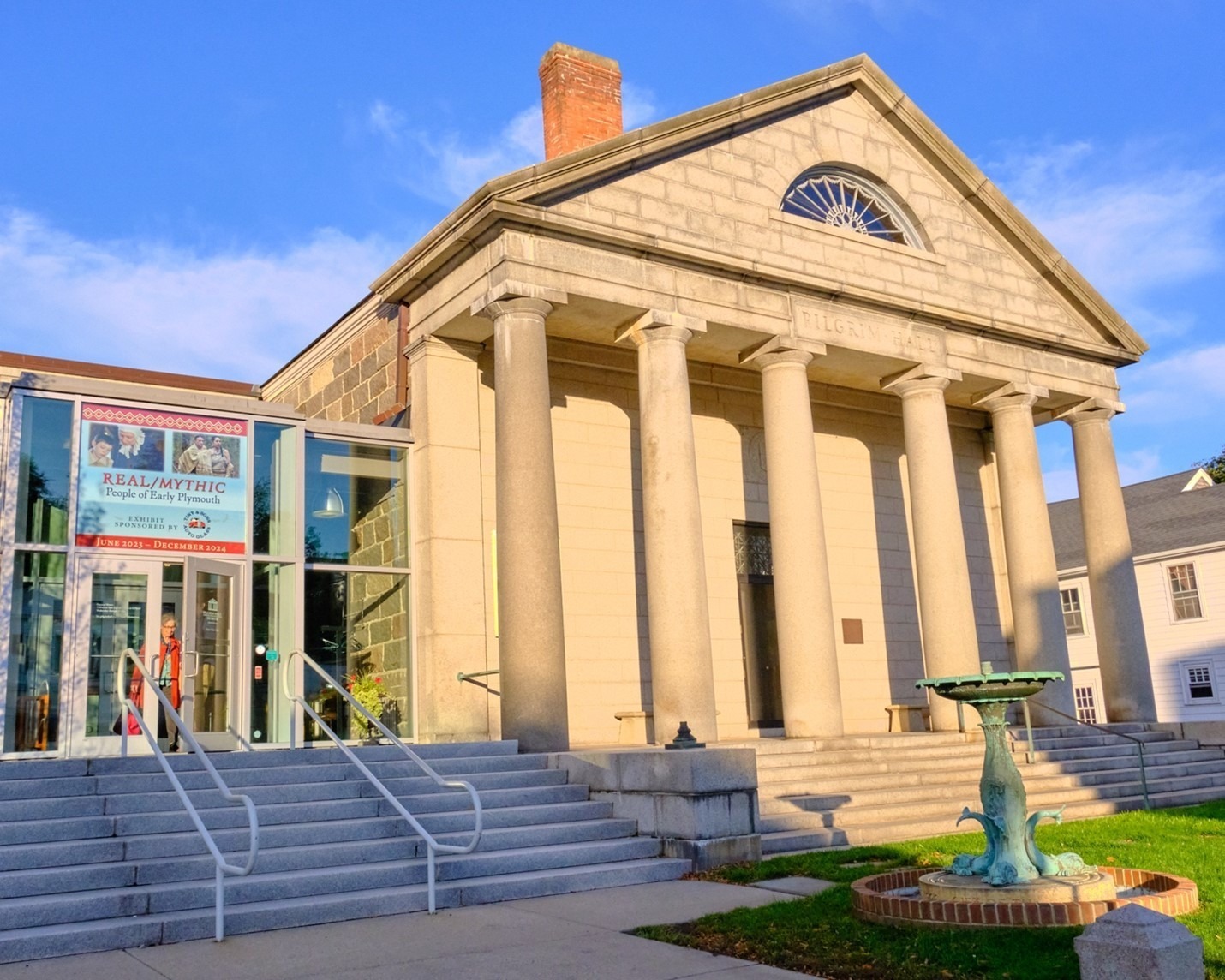
Brindisi has come under fire from the Pilgrim Society and some Town Meeting members since he announced last month he is withholding the final payment of a $3.6 million grant for a new roof and other improvements at Pilgrim Hall Museum. Town officials are demanding the Pilgrim Society, which owns the building, file the required deed restriction to preserve the building in perpetuity – a bureaucratic process that can sometimes take more than a year to complete.
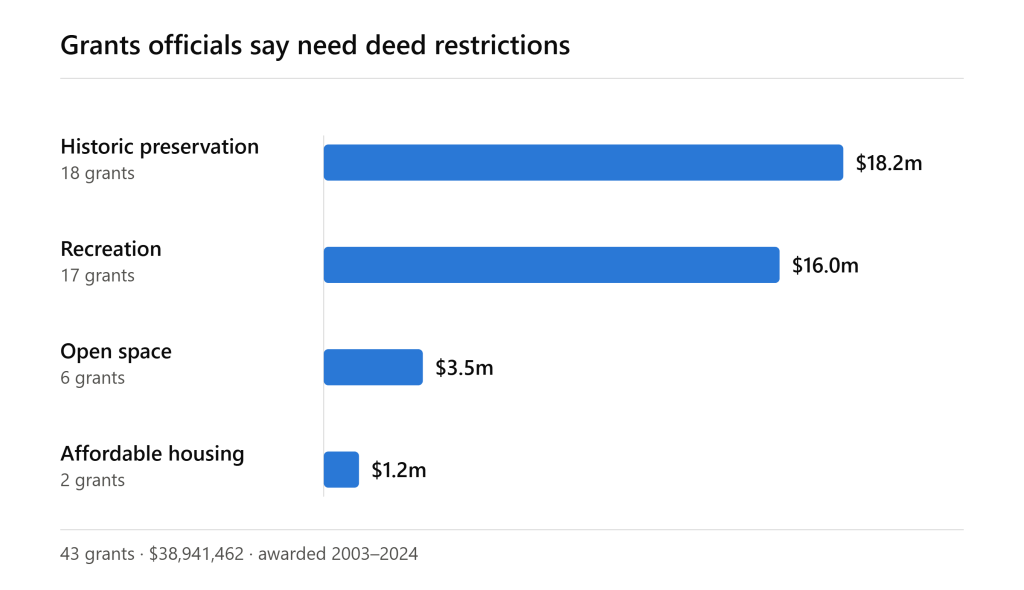
The museum is caught up in what Brindisi described as a “systemic” oversight failure at Town Hall involving all Community Preservation grants dating to 2003. He provided board members the complete list – including 43 grants totaling more than $38.9 million.
Most of the projects listed have already been finished. Town officials said they are working to complete the work of recording the restrictions.
View Full List of Disputed Grants
Donna Curtin, the museum’s executive director, pushed back at the meeting, which sometimes became heated. She said the Select Board was misled by town officials regarding the necessity of the deed restrictions because the museum had already recorded three other deed restrictions dating back to 1996.
Curtin, a Town Meeting member, said the Massachusetts Historical Society makes it clear to historic preservation organizations that once a preservation restriction is placed on a property in perpetuity, none other is required.
Others in the audience agreed.
“If a restriction is recorded once and the property is subsequently in receipt of subsequent monies, there does not have to be a subsequent restriction recorded with every subsequent infusion of money,” attorney Richard Serkey, a Town Meeting member, told the Select Board. “The money should be disbursed.”
Select Board member Kevin Canty shot back that a new historic restriction is required when changes are made to the building. Canty said because Town Meeting called for a restriction, a new one should have been recorded.
He said the grant agreement between the town and the Pilgrim Society also required a new restriction. But a review of the grant agreement by the Independent revealed that it allows the Select Board to accept a previously recorded agreement.
When the Independent pointed this out to Canty in an email, he stuck by his position.
“Town Counsel has reviewed the Town Meeting vote, the entire grant agreement, and the opinion of Bond Counsel, and determined that a new historic preservation restriction is required,” he said. “It also makes no sense that a 1996 Historic Preservation Restriction, which protected the roof as it was designed at that time, would be able to protect a new roof with a new design that involves substantial changes from what was there in 1996. The new work requires a new restriction.”
In all, Town Counsel Kate McKay said, staff found similar problems with 43 grants for 27 projects, including those involving historic preservation, open space improvements, affordable housing, and recreation facilities.
The state’s Community Preservation Act allows towns to grant funds raised through a property tax surcharge for open space, recreation, affordable housing, and historic preservation.
Town staff is working to place preservation restrictions on the projects.
One historic preservation project that raised concerns is the Mayflower Meetinghouse. Because the Mayflower Society is planning work to make the building more accessible, some worry historic preservation work already paid for will be undone.
Community Preservation Committee coordinator Kristin Ford told the Select Board she first realized the problem existed in August 2025, when the Mayflower Society was planning work to build a museum in the basement and change the façade of the building to make it more wheelchair accessible.
She said the Mayflower Society immediately started working on the required deed restriction, but it took close to a year to hear back from the Massachusetts Historical Commission, which must approve such limitations.
Lea Filson, president of the Mayflower Society, did not immediately respond to a request for comment.
Ford said she sent out a similar notice last year to the Pilgrim Society with the second-to-last payment for a $3.6 million grant to repair the roof and conduct other significant restoration work.
She said she reminded the Society it had to file an additional historic preservation restriction before it could receive final payment. A draft has been sent back and forth between the town and the Pilgrim Society and is now before the Massachusetts Historic Commission for approval, she said.
Whether the Society needed to file another restriction on the building when it had already recorded three, the first one as far back as 1996, is in dispute. Curtin, the museum director, reiterated to the board members her assertion to the Independent last week that no additional deed restrictions are required.
She also said delaying the final payment on a project already complete will disrupt operations at the museum and delay other badly needed projects.
Select Board member Bill Keohan urged the board to pay Pilgrim Hall the nearly $370,000 for which it has yet to be reimbursed.
“That’s irresponsible to what was voted on at Town Meeting,” Canty objected.
The new policy of the Community Preservation Committee, adopted in July, is not to recommend grants to Town Meeting unless the town or a nonprofit has recorded a preservation restriction.
Jennifer Harris, a Town Meeting member and vice chair of the Pilgrim Society and Pilgrim Hall Museum, pointed out that the Massachusetts Historical Society understands emergency situations such as a leaking roof require faster grant-making.
“Requiring a one-year to two-year process before you are even allowed to receive the funding concerns me,” Harris said.
Fred Thys can be reached at fred@plymouthindependent.org.