
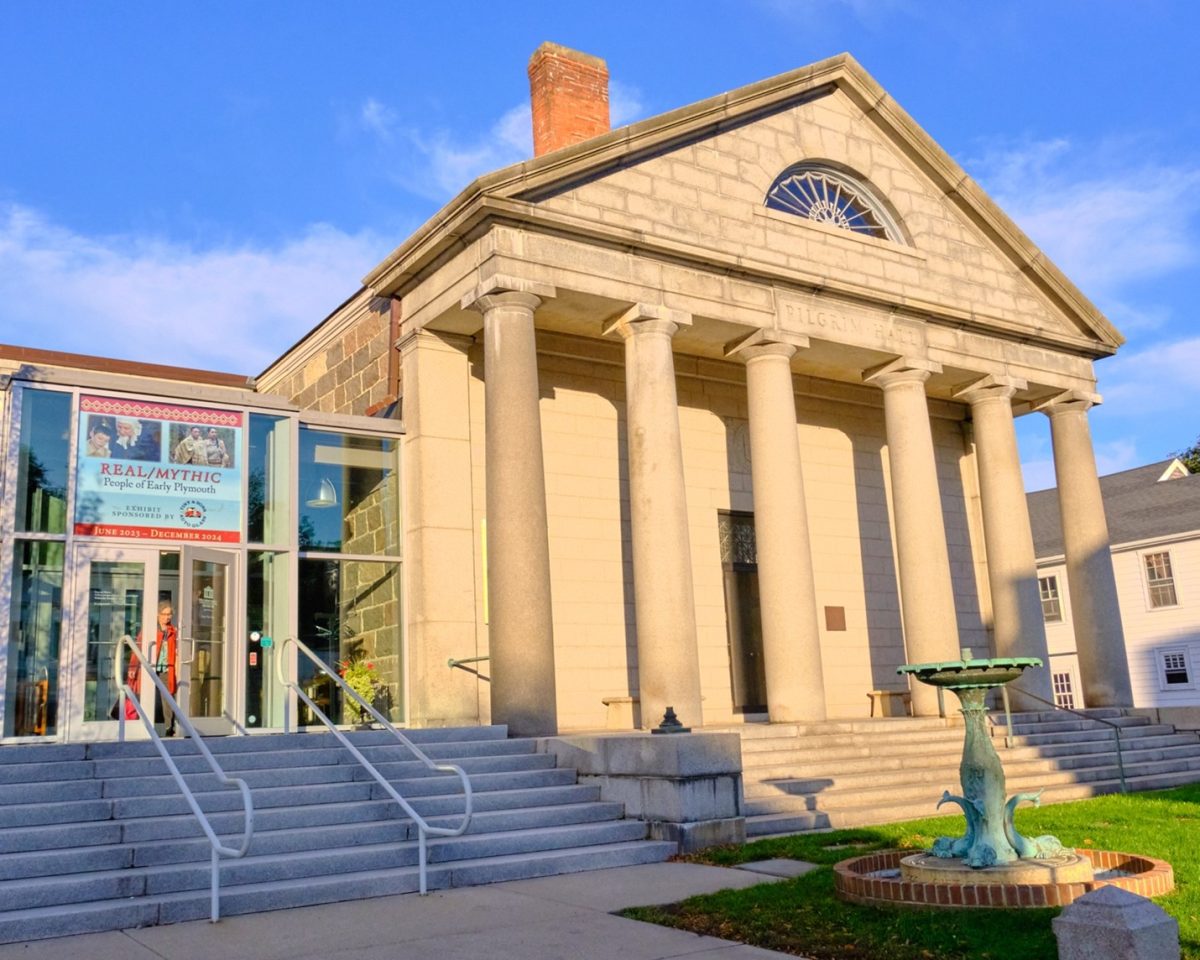
The leader of Pilgrim Hall Museum says claims the museum has not done everything required to preserve the historic integrity of the downtown building are misguided and untrue.
In an interview with the Independent on Wednesday, the museum’s executive director pushed back on allegations made last week by Town Manager Derek Brindisi, who said the museum operators are among dozens of historic grant recipients who have failed to record necessary historic preservation deed restrictions.
Such deed restrictions are designed to ensure the historic integrity of buildings in perpetuity,
Brindisi said he will withhold the final installment of a $3.2 million Community Preservation grant awarded to the museum in 2023 for badly needed roof repairs, a new air conditioning system and lighting in the great hall.
He said the failed oversight was “systemic” and vowed to hold up funding until all the deed restrictions are in place. In the case of Pilgrim Hall, the final installment being withheld amounts to $370,000.
Donna Curtin, the museum’s executive director, declined to comment on the controversy last week.
But on Wednesday, Curtin broke her silence to say Brindisi’s analysis is incorrect and an historic deed restriction on Pilgrim Hall have been in place since 1996.
“We’ve already provided documentation of the permanent protection of this building in the form of three previously recorded preservation restrictions,” Curtin said.
“If you have a permanent deeded restriction on the building, you don’t have to have a second permanent deeded restriction on the building that provides no additional protection,” she said.
A review of public records shows the Pilgrim Society, which owns the building, has filed three historic preservation restrictions preventing any major alterations to the building outside of needed repairs.
The first, agreed to between the Pilgrim Society and the Massachusetts Historical Commission, was recorded in 1996. It is effective in perpetuity and requires permission from the state commission for any alterations which are not of a minor nature, part of ordinary maintenance and repair, or which involve structural stabilization.
The other two, also in perpetuity, were recorded in 2009 through the town’s Historic District Commission in exchange for two Community Preservation grants totaling $440,000.
Curtin said the position of the Massachusetts Historical Commission, which oversees historical preservation statewide, is that one deed restriction is enough. To require a new deed restriction for each new grant – a bureaucratic process sometimes taking up to a year – is redundant.
Michael Steinitz, the director of the Massachusetts Historical Commission’s Preservation Planning Division, who is in charge of overseeing historic preservation restrictions, did not respond to a request for an interview.
Brindisi, contacted by telephone, insisted a new deed restriction must be filed with each new publicly funded grant.
“Pilgrim Hall Museum is just one of many nonprofits that continues to try to think that the old way of doing business is appropriate, and [it] is no longer appropriate,” Brindisi said.
He argued the Town Meeting article appropriating the funds requires the Pilgrim Society provide a historic preservation restriction.
But the grant agreement between the town and the Pilgrim Society suggests a previously recorded preservation restriction is sufficient.
“Whereas the Town Meeting has voted to provide the Community Preservation Act, G.L. c. 44B funds from its historic resources account in the amount of $3,200,000 (the “Grant Funds”) for the preservation, rehabilitation and restoration of Pilgrim Hall Museum and to authorize the Select Board to accept a historic preservation restriction (or documentation of a previously recorded HPR)…” the grant agreement states.
Brindisi cited language of the grant agreement between the Community Preservation Committee and the Pilgrim Society, which states final payment would be made upon completion of the project and when a historic preservation restriction was recorded with the Registry of Deeds.
Officials in Brindisi’s administration have not provided a list of up to 40 projects since 2000 they say are missing the necessary deed restrictions.

Curtin said the town’s failure to reimburse Pilgrim Hall for the last installment, money Pilgrim Hall has already spent on the restoration, prevents it from moving ahead with the rest of the restoration using its own funds. The museum has planned to use the funds, once it is reimbursed, to redesign the exhibits in the great hall.
The Pilgrim Society is working on the fourth deed restriction required by Brindisi, but that will take time, as it must be approved by town counsel, the town’s Historic District Commission, the Massachusetts Historical Commission, and the Select Board.
Curtin said the Massachusetts Historical Commission understands that this process can take months, and grant recipients might not be able to wait for a deed restriction to be recorded to start work.
“There are failing roofs,” Curtin said. “These old buildings need our help, and they might not be able to wait a year-and-a-half or longer to get a restriction recorded.”
Fred Thys can be reached at fred@plymouthindependent.org