

As the Nov. 3 election nears and early voting is in full swing, local political candidates are campaigning on everything from affordability to school busing.
There are three local races on the ballot, two for state representatives and one for state Senate. In all three races, Democratic incumbents are running for re-election against Republican opponents.
The Independent reached out to all six candidates to discuss the issues and their reasons for running.
There are also nine statewide questions on the ballot, on issues ranging from government transparency to gun control. For a rundown on those issues, go here.
For information on how to cast a ballot, go here.
To listen to a recorded video of the League of Women Voters candidates forum featuring all the state representative candidates, go here.
State Senate, Plymouth and Barnstable district
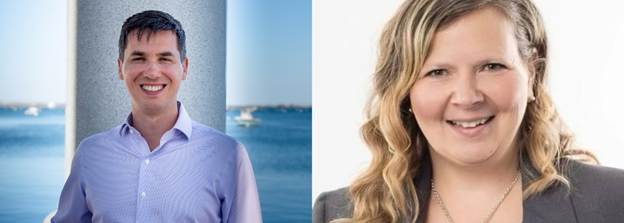
State Sen. Dylan Fernandes, 36, a Falmouth Democrat, is running for re-election to a second term. The district includes Plymouth, Falmouth, Kingston, Pembroke, Plympton, Sandwich, Mashpee, and Bourne.
Fernandes said he is proudest of saving the Pocasset Mental Health Center, in Bourne. The center provides long-term inpatient care for people with some of the most severe mental health episodes.
“Something that’s really important to me personally and also just important for the people in our district to get the mental health care access that they need in what is a geographically isolated area where people struggle to get services,” he said.
Fernandes filed an amendment to the budget for fiscal year 2026, which ended June 30, to appropriate $4.8 million for the 16-bed inpatient center to keep it open. Gov. Maura Healey had proposed closing it but backed off in the face of public opposition.
Fernandes said the biggest problem residents of the district face is a lack of affordability.
“Housing is by far the most glaring,” he said. “It’s got to the point where people who grew up in the community and love it really can’t afford to live in it and the people who helped build the community can’t afford to live in it.”
Another challenge for Plymouth, he said, is that it is not getting its fair share of state funds. He said he has been working to increase how much Plymouth gets in unrestricted general government aid, funding for roads and bridges, and school funding.
Plymouth has been shortchanged in the funding it gets for school buses because the state aid formula does not take into account how many miles a town’s buses have to travel, which is a problem for the state’s largest town by area.
Fernandes successfully pushed to have a commission reviewing school funding to consider the miles a town’s buses travel. The commission is due to issue its final report in 2028.
He pushed successfully to have the formula for allocating funds for roads and bridges revised so that part of it is based on how many road miles a town has. This fiscal year, which began July 1, Plymouth received an additional $783,000 for roads and bridges based on mileage over its regular allotment of $1.6 million.
He also pushed to create a new formula for unrestricted general government aid. Currently, towns get aid based on the results of a formula frozen in 2011 that allocates funds based on what they received the previous year, according to a Boston Globe op-ed Fernandes wrote in July. Under the outdated formula, Plymouth, with a per capita income of $49,000 a year, earns a third of what Medford, with a per capita income of $55,000 gets, even though both towns have roughly the same population and Plymouth has four times as many road miles.
“So, Plymouth’s at a massive disadvantage,” Fernandes said. “Plymouth gets the short end of the stick.”
Fernandes proposed legislation that passed the Senate that would create a new local-aid formula. The bill did not pass the House, but Fernandes said he would push again in the next session if he is re-elected.
Fernandes is running against Bourne School Committee Chair Kari MacRae,who turns 53 on Oct. 28.
MacRae declined to be interviewed.
MacRae ran against then-state Rep. Mathew Muratore for the Republican nomination for state Senate in 2024. She lost to Muratore, who went on to lose the general election to Fernandes.
MacRae sued six towns over the primary election results, alleging election officials failed to properly vet the identity of early voters. Months after the general election, she dropped her lawsuit.
“We need to end the right-to-shelter law,” MacRae said in a 2024 interview with the Independent, referring to the state law that obligates Massachusetts to offer shelter to those in need.
MacRae said then she supported President Donald Trump.
“Of course I do,” she said.
As a member of the Bourne School Committee, MacRae has opposed teaching students about gender identity.
“There are certain things that should not be taught in schools,” she said. “We shouldn’t be teaching children that they can choose to be a boy or a girl.”
She has also opposed allowing transgender girls to play on girls’ sports teams.
In 2021, MacRae was fired from her job as a math and business teacher at Hanover High School over her social media posts, including a TikTok video in which she opposed teaching about gender identity and “critical race theory.”
MacRae sued the Hanover Public Schools in federal court, alleging it violated her First Amendment right to free speech. In September 2023, U.S. District Judge Denise Casper dismissed MacRae’s case. She appealed to the 1st U.S. Circuit Court of Appeals in 2024, which upheld Casper’s ruling.
MacRae appealed to the U.S. Supreme Court, which in 2025 declined to hear her case.
State representative, 12th Plymouth district
The 12th district includes downtown Plymouth, North Plymouth, and parts of West Plymouth as well as Kingston, Plympton, and parts of Halifax, Middleborough, and Pembroke.
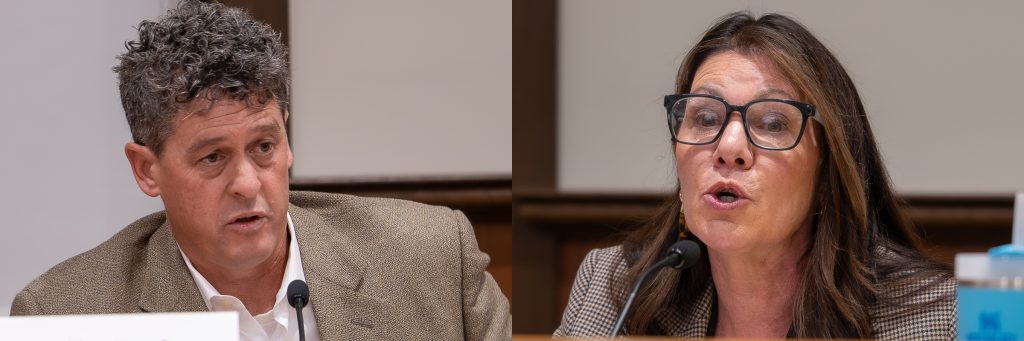
State Rep. Kathleen LaNatra, 59, a Kingston Democrat, is running for re-election to a fifth term.
LaNatra said one of her proudest accomplishments is her sponsorship of the first boater safety law in Massachusetts. Signed into law in 2025, the measure requires motorboat and Jet Ski operators to carry a boater safety certificate showing they have passed a 10- to 12-hour course.
The Hanson-Milone Boater Safety Act is named after David Hanson and Paul Milone. Hanson, a Kingston firefighter, was 20 when he was killed in a boating accident off Plymouth in 2010. He had never had any training in boating, LaNatra said. Milone, the late Weymouth harbormaster, was a passionate advocate for boater safety legislation. LaNatra said she worked with harbormasters across Massachusetts to get the law passed.
LaNatra said when she learned that the main opposition came from the Massachusetts Marine Trades Association, she worked to persuade them to support the law.
“They wanted to save lives, but they just had different ideas, and we all came together,” LaNatra said.
She said she is proud of pressing the Massachusetts Department of Environmental Protection to forbid Holtec from discharging wastewater from the former Pilgrim nuclear power plant into Cape Cod Bay.
She also cites her work increasing statewide reimbursement by 50% to towns for roads and bridges.
As she has knocked on doors campaigning, she said, the issues people raise most are the cost of housing and energy. She expressed hope that an energy bill will make its way out of a House-Senate conference committee before the end of the year.
She said she finds many families where children in their 30s are still living with parents, or parents are living with their children.
LaNatra said in the next session, she wants to focus on a bill that would address the well-being of first responders who are exposed to traumatic incidents such as the Lindsay Clancy case in Duxbury. The murder trial of the former nurse ended in a hung jury in September. She, now paralyzed from the waist down following at attempt on her own life, has acknowledged killing her three children during a state of depression.
LaNatra introduced similar legislation in 2023 that died in committee.
She faces Republican Plymouth lobsterman Eric Meschino, 55. In 2024, LaNatra defeated Meschino with 53% of the vote to his 47%.
Meschino declined to be interviewed.
In a 2024 interview, he said he has always wanted to be a lobsterman, and had no ambition to seek office until 2022, when he first ran against LaNatra. He said he was motivated by the burdensome government regulations on lobstermen aimed at protecting right whales.
“I started seeing regulations that seemingly made no sense to me,” Meschino said. “They know it’s not this fleet that killing these whales.”
As an example, he pointed to his line, 7/16 of an inch thick. Most lines found around entangled whales, he said, are twice as thick. In addition, he said, those lines float, whereas his lines sink.
“We’re the low-hanging fruit,” he said of fishermen. “We don’t have a lot of money to defend ourselves.”
The National Oceanic and Atmospheric Administration has associated some lines found around entangled right whales with their deaths.
“I generally believe these people have the best of intentions,” he said of advocates for whales. “They’re trying to do the right thing, but they’re misguided in who they’re going after.”
As a result, he said, large areas of ocean are off-limits to lobstermen. Unless he goes out to Stellwagen Bank in winter, he said, he must have all his gear out of the water by Feb. 1 and cannot go back until May 16.
“This is America, right?” he said. “You just work as hard as you want to live the life you want, but now I can’t even go to work.”
Meschino said he wants to go to Beacon Hill so that his voice can be heard on what he considers fishing overregulation but also on other issues, such as driver’s licenses for undocumented immigrants, which he opposes, and the millionaires’ tax – it’s hurting small businesses, he said – and overtaxation in general.
At an Oct. 22 League of Women Voters forum, Meschino said he would like to see small modular nuclear reactors in Massachusetts.
“Maybe put some over at Pilgrim,” he said, referring to the site of the former nuclear power plant in Manomet.
Meschino grew up lobstering with his father. He put himself through junior and senior years at Boston College High School and went on to Boston University before dropping out after two years. He got a job on an offshore fishing boat, the Hannah Boden, captained by Linda Greenlaw. After two years, he decided offshore fishing was not for him, and went back to school, then Wall Street and Philadelphia, before coming home to New England, fishing offshore for a few years until his father retired and he took over the lobster boat.
State representative, 1st Plymouth district
The 1st Plymouth encompasses all of Plymouth except for downtown, North Plymouth, and parts of West Plymouth.
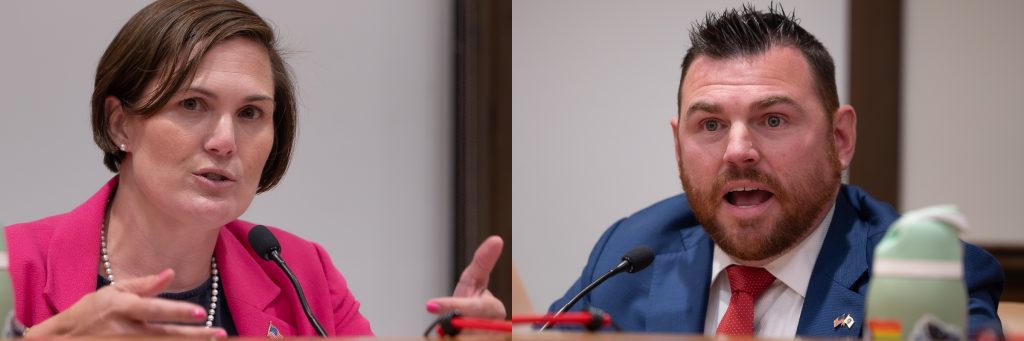
Democrat Michelle Badger, 42,is running for re-election to a second term.
Badger said she is proudest not of a single piece of legislation, but of her service to constituents.
“We’ve helped 400 individuals and families cut through the red tape,” she said. “The No. 1 thing is making sure people can stay in their houses. They get their unemployment. Or at least we get an answer for them from whatever area they’re looking for – Mass Health. It’s making sure that people in our community get the assistance they need.”
She is proud of working with Fernandes and LaNatra to obtain more than $3 million in earmarks for Plymouth, including $1.5 million to renovate State Pier.
She also cites her work with LaNatra on a section of the state budget that would study out-of-district transportation for public school students. It would ask the Department of Elementary and Secondary Education to create a formula to help a district calculate those costs.
Typically, students whose program requires special education, students who are without homes, and students who are in foster care are transported in vans, which are more expensive than the larger yellow buses.
Because the number of students without homes can fluctuate overnight, the schools sometimes must scramble for van transportation and have had to pay as much as $600 to $900 a day to transport each student.
She cites affordability as the biggest issue Plymouth faces.
“Our housing prices are through the roof,” she said. “Energy costs are through the roof. We have seniors who are stuck in their home because they can’t sell it and get something smaller or we’ve got families who can’t afford to buy a starter home.”
Badger said an energy bill that is in a House-Senate conference committee could address some energy costs. The bill would lower surcharges on utility bills that fund Mass Save, a program that funds home weatherization, and streamline permitting of small residential solar arrays.
If re-elected, Badger said she would focus on getting more transportation funds for Plymouth public schools. She and LaNatra co-sponsored a bill that would set up a grant program to help districts pay for things like buses, fuel costs, and driver salaries. The bill is sitting in the Joint Committee on Education and has not been voted on by the full House. If it does not pass before the end of the year, it would have to be reintroduced next year.
Badger is running against Select Board member David Golden, a Republican.
Golden has served on the Select Board for two years.
He did not respond to a request for an interview, but on social media and candidate forums he has said his first bill would be to dissolve the Massachusetts Department of Public Utilities. He also said he wants to strengthen state laws limiting the amount local government can increase property taxes.
“Like many families here in Plymouth, I know it’s getting harder,” said Golden, then 40, in a Facebook video posted in February announcing his candidacy.
“Higher utility bills, rising taxes, and Beacon Hill policies that put Boston first and communities like ours last. That’s not right, and it’s why I’m stepping up.”
Golden ran unopposed when he was elected to the Select Board in 2024, when just over 13% of registered voters cast ballots. In September 2025, he replaced Kevin Canty as chair of the board in a stunning move made possible by the support of Bill Keohan and Dick Quintal, who were unhappy with Canty’s leadership. Golden and Canty continued to clash in the following months over how and when topics were placed on meeting agendas.
As chair, Golden said in a February interview, he worked to accommodate the concerns of his colleagues. During his tenure, the board’s meetings sometimes lasted five hours.
“We’ve had some really late nights as a Select Board, but that’s because we’re putting everyone’s items on the docket, making sure that even when I disagree with an issue, I’m putting it forward so that everyone in the community feels heard,” he said.
By a unanimous vote, Deb Iaquinto was elected to succeed Golden as chair in May.
In June, Golden joined Iaquinto and Canty to vote 3-2 to clear the way for a housing developer to buy 138 acres of formerly protected land in Cedarville. Canty and Golden held personal and political ties to the developer, but both voted in favor of the project and neither recused themselves from the vote or the negotiations, which were conducted out of public view.
In July, Golden clashed with Keohan, calling Keohan an “f-ing coward” after Keohan voted against euthanizing an aggressive dog. He later apologized to the board.
If elected, Golden promises to introduce legislation to dissolve MassSave, the state program designed to cover homeowners’ insulation expenses.
“MassSave is a fundamentally flawed program,” he said. “I think it costs people more than it gives in benefits.”
He also promised to introduce legislation requiring utility rate increases to be approved by the Legislature, instead of the state Department of Public Utilities.
“I think that true public accountability should be through elected officials,” he said.
At the Oct. 22 League of Women Voters forum, Golden said he would support Governor Maura Healey’s proposal to suspend the state gasoline tax. A House committee recently took Healey’s proposal out of the supplemental state budget.
Golden lives in Manomet with his wife and 8-year-old daughter.
Prior to his election to the Select Board, he was a member of the Cultural Council, served on the Board of Health and the Manomet Village Steering Committee, was a Town Meeting member, and chaired the Memorials Advisory Committee and Charter Review Committee.
He works for a company that provides property appraisals and software for municipalities.
Fred Thys can be reached at fred@plymouthindependent.org