
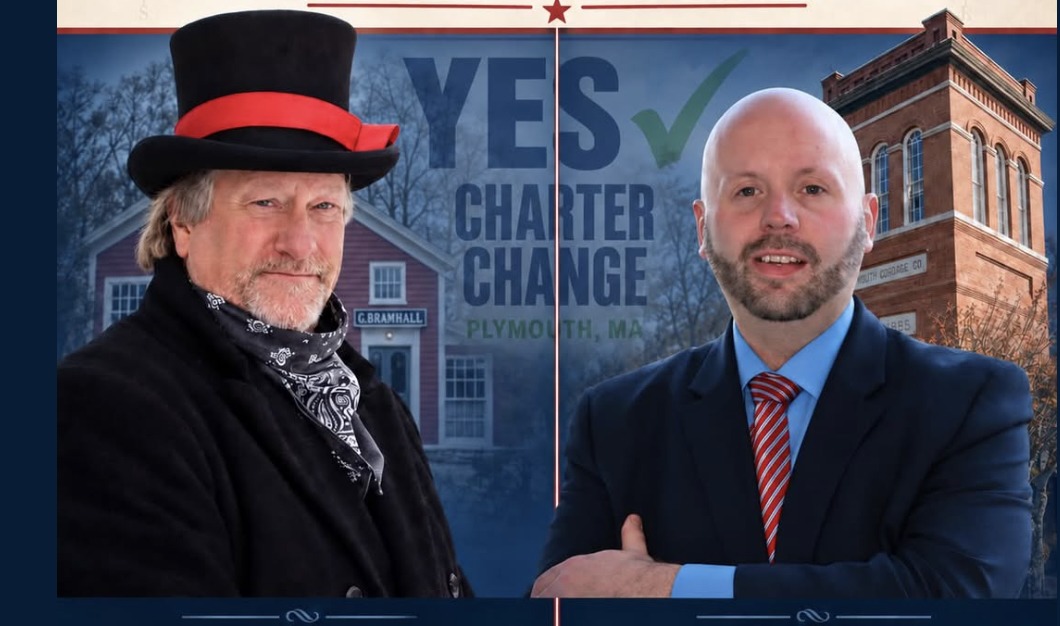
Wrestling Brewster is all about revamping Plymouth’s form of government to better suit the town’s present and future. That’s why he’s running for a seat on a 9-member charter commission voters will likely be asked to elect next May – a crucial step toward putting proposed changes before voters, who would get the final say.
So what’s with the “ye olde Plymouthean” outfit Brewster sports in a photo promoting his candidacy?
He says the picture is from his time as president of the Old Colony Club, the downtown social organization for “gentlemen” that dates to 1769.
“We had an event up at the Forefathers Monument where we were firing our cannons. That’s why I was wearing the top hat,” said Brewster who is a descendant of the Mayflower Brewsters. “I thought it was a good picture.”
His wife had a different opinion.
“She thought it was a bad idea,” he said. “I did it anyway. It’s fun.”
Call it charter commission humor.
But Brewster and others pushing for remaking the structure of local government are quite serious about their mission.
“Our form of government is not keeping up with our needs,” he said. “We’re asking 162 Town Meeting members who are volunteers to make decisions on a $350 million budget.”
Worse, he said, that legislative body has no control over how wisely money it signs off on is spent. He cited the 2023-24 redesign of the Stephens Field waterfront recreation area as an example.
“Town Meeting approved one set of plans. Then the plans changed,” Brewster said. “Town Meeting didn’t get a vote on those new plans or where that money was going.”
It’s time, he said, for Plymouth to have “a full-time government.”
“Our legislative body meets twice a year,” Brewster said, “and the five people in office right now on the Select Board can’t even talk to each other. It’s a circus every Tuesday night. You cannot run a government that way with 70,000 people.”
He’s open to a mayoral or town council form of government and is eager to entertain other ideas.
“Anything but Town Meeting,” he said.
Plymouth has debated the efficiency of its government for decades as it’s grown from a smallish town into something resembling a smallish city. Over the years, there have been repeated attempts at revising the charter, which is the town’s foundational governing document. Some efforts produced significant changes, such as in 1991 when the ineffectual position of executive secretary was replaced with a so-called strong town manager. Others were incremental or confusing.
The last meaningful attempt at sweeping changes took place in 2002, when voters rejected a plan to replace Town Meeting with a mayor and council by a 52 to 48 percent margin. The same proposal was on the ballot in 2003, but the momentum for a big overhaul had waned and it went down to defeat by 10 percentage points the second time around.
In 2023, a less progressive charter reform platform called for – among other things – expanding the Select Board from five to seven members, creating a legislative oversight committee, and allowing a third Town Meeting session to be held annually. Proponents said the measures would improve efficiency and create more checks and balances – while keeping the representative Town Meeting format intact. But voters didn’t know what to make of the densely worded language on the ballot and rebuffed the charter commission’s recommendation in a two-thirds “no” landslide.
One underlying problem with some past reform campaigns was the make-up of charter commissions. Voter interest in electing commissioners was low, and the slate of candidates sparse. Many people on the ballot leaned toward minor revisions – essentially preserving the status quo – which from the start limited the range of recommendations likely to come from the commission.
Backers of the current charter reform effort say the climate is different today. Residents are frustrated by the slow-crawl machinations of a volunteer legislative body (Town Meeting) that convenes every six months, as well as a Select Board riddled by infighting. The town, they say, has outgrown its government. As Plymouth’s population has increased, so too has the number of voting precincts and Town Meeting members, further diluting accountability. Following the 2020 census, the number of representatives was increased by 27, from 135 to the current 162.
Last month, a grassroots group called Yes on Charter Change officially launched its campaign with a well-attended rally at Cordage Park. Another event is scheduled for Monday, Sept. 14, on Long Beach at Sandy’s restaurant.
Among those attending the Cordage event at the Three V Sand Bar in August were Select Board Chair Deb Iaquinto, former state representative Matt Muratore – one of the movement’s leaders – former state senator Therese Murray, and Select Board member Kevin Canty.
In an email, Canty said the town is “at a tipping point,” with more residents finally ready to support overhauling how it’s run. He cited two primary reasons.
“Plymouth is gaining about 750 to 1,000 people a year population-wise, and has been for years now, with most of them being folks moving here to retire (or in preparation for retirement),” Canty said. “That’s a demographic that votes in higher numbers than other demos, and because they’re transplants, they’re not nostalgic about our Town Meeting. Many of them come from other communities where they didn’t have Town Meeting, or they had already moved on from Town Meeting during their residency, or the Town Meeting form of government they left wasn’t working well.”
Also, Canty said, “More people than ever before that are involved in town government realize that town government isn’t working. And historically they’re the biggest group of supporters for the current form, so if more of them are flipping and more new voters are moving here…then I think the time for change is upon us.”
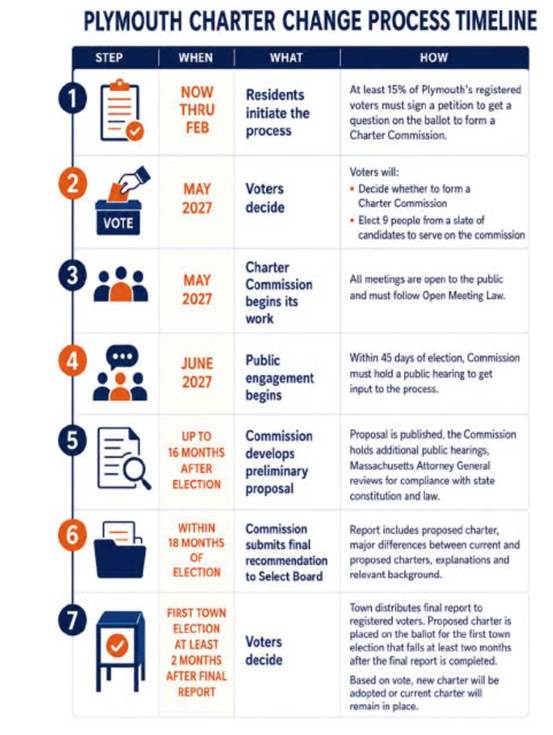
To establish a charter commission, the Yes on Charter Change group must collect at least 8,500 signatures of registered local voters to put the question on the ballot next May. It has until Feb. 1, 2027, to do so.
Voters will be asked to approve the commission and at the same time select nine members to serve on it.
But governmental change, if it happens, won’t be swift. It could take commissioners a year and a half to hold public sessions and come up with a proposal, which would then go before voters in another townwide election.
“It’s really important to get that across to people that this is the first step,” Brewster said. “If you want major change, make sure you’re voting in people that want major change. The only way to get that accountability is, I’m sorry to say, to go away from Town Meeting.”
Mark Pothier can be reached at mark@plymouthindependent.org.