The Yes on Charter Change group’s campaign to scuttle the Town Meeting form of government in Plymouth launched its public signature drive Wednesday night.
About 150 people, including several current and former town officials, turned out for the event at Three V Sand Bar on the waterfront at Cordage Park in North Plymouth.
“It’s amazing to see this many people come out on a summer night,” said Select Board Chair Deb Iaquinto, who spoke at the rally in support of changing the town’s form of government.
While still in her first term on the Select Board, Iaquinto addressed the question of why she is seeking to change town government so quickly.
“You might say isn’t this the woman who just busted her butt to run this form of government? Yes. Now I have a front row seat and I see the challenges we face,” Iaquinto said. “Our Town Meeting is 400 years old and Plymouth has clearly outgrown it. We need to be able to make timely, coordinated, strategic decisions every day, not just twice a year.”
Town Meeting is Plymouth’s legislative body. Nine members are elected by voters in each of the town’s 18 precincts, for a total of 162 members. The body has jurisdiction over the budget, zoning regulations, real estate dispositions, and other bylaws. It usually meets twice a year, in spring and fall, which is insufficient to handle the volume of important issues that must come before Town Meeting, change advocates say.
In other forms of municipal government across Massachusetts, the legislative body can be an elected Town Council or City Council, which typically meet twice a month. The executive power can rest in an elected mayor or an appointed town or city manager.
Several efforts over the years to move Plymouth to another form of government have fizzled. The latest was in 2022, when voters created a Charter Commission, but the elected commissioners ultimately decided to keep the current form of government.
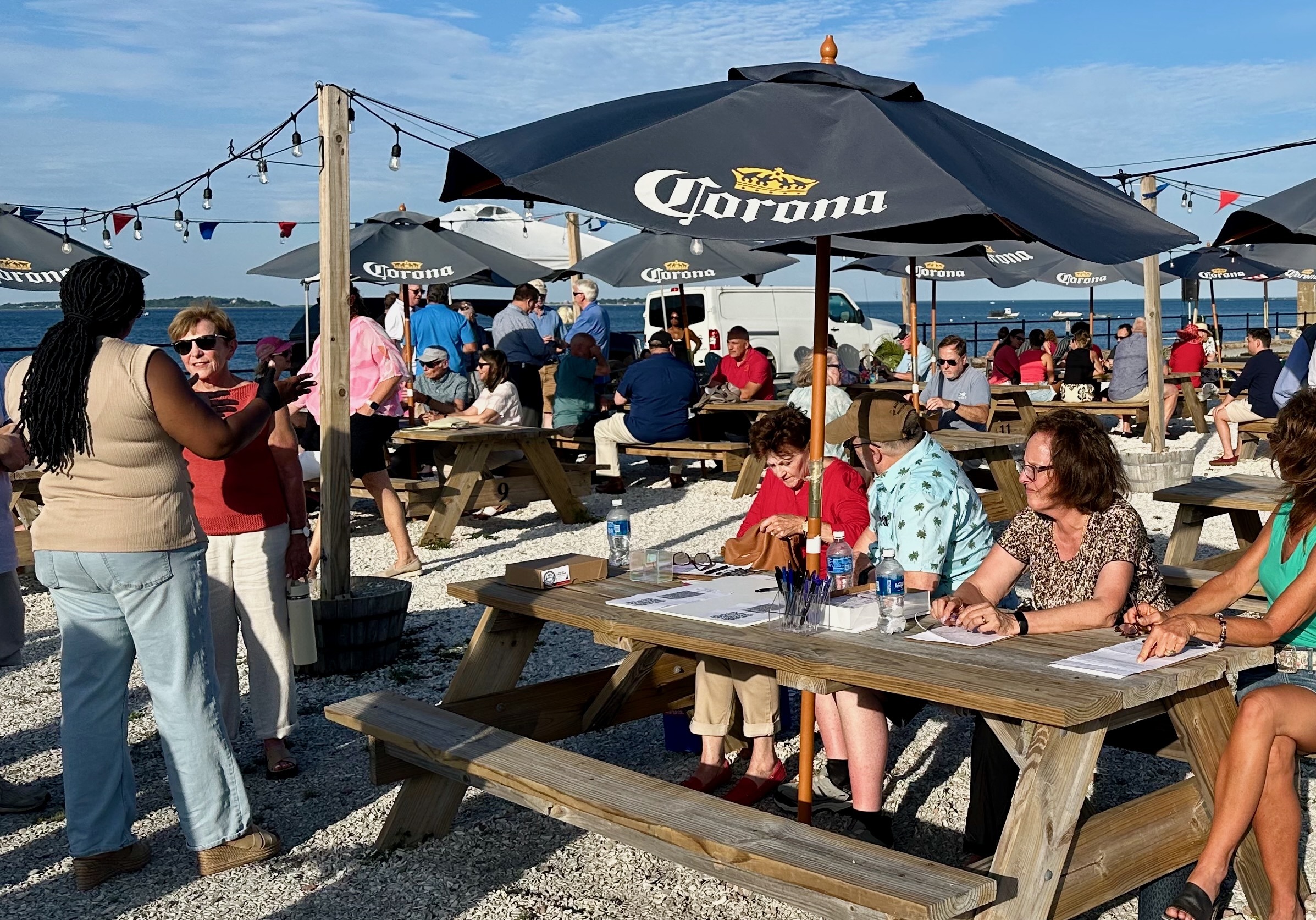
While town elections and ballot questions are non-partisan contests, former State Rep. Matthew Muratore, a leader of Yes on Charter Change, said he was pleased to see a diverse bipartisan group of people at Wednesday’s event, that spanned the political spectrum.
“We are seeing support from just about everyone we talk to. People realize we need a change,” he said.
Among those in the crowd Wednesday night was former State Senate President Therese Murray, who is a member of the charter change organizing committee. “Deb said it eloquently,” Murray said. “Our system is antiquated. The government has to be more responsive to the taxpayers.”
Select Board member Kevin Canty also attended to show his support for a mayoral and town council form of government. “Our current government promotes complacency and the status quo. That’s not cutting it,” Canty said. “We need a full-time professional government.”
Planning Board Chair Steven Bolotin, who recently led the multi-year effort to craft the Comprehensive Plan for Plymouth’s future, also supports creating the commission to consider changing the way town government works.
Town Meeting member Steven Lydon, who also sits on several town boards, said he sees the difficulties of the current system from the floor of Town Meeting and is ready for change. “I’ve been here more than 40 years and the town has grown so much. Our government can’t handle it. It’s not efficient,” he said.
Also attending to show support last night were former State Sen.Vinny deMacedo, former Police Chief Michael Botieri, former Fire Chief Ed Bradley and former Select Board members Charlie Bletzer, Belinda Brewster, Betty Cavacco and Sergio Harnais.
Not everyone at the rally was clamoring for the end of Town Meeting. Everett Malaguti III, who has served on many town committees over the years and currently sits on the Advisory and Finance Committee and the North Plymouth Steering Committee, attended the rally, but he wants to see incremental change. “I’ve always been a die-hard supporter of Town Meeting. I’m not in favor of a mayor,” he said. “But I think Town Meeting needs to evolve and change.”
Malaguti would like to see a smaller Town Meeting, with perhaps 3 to 5 representatives from each precinct rather than the current 9. “I think with fewer members, people would actually get to know their representatives, and there would be more competition for those seats, and that would be a good thing.”
Like several people in the crowd, Tamao Buffalo-Ellis, who lives in South Plymouth and sits on the Plymouth for All and the Distinguished Visitors committees, said she attended the event Wednesday night to learn more about the issue.
“I do think there needs to be a change. What that will look like, I’ll have to wait and see,” she said.
Supporters of Plymouth’s Town Meeting rally around its history, reaching all the way back to the Mayflower Compact of 1620, which organized the local government as a “civil body politic” to “enact, constitute, and frame, just and equal laws” for the colony. They argue the current system is quintessential democracy, with many people able to participate in town government, rather than concentrating power in a select few.
The Yes on Charter Change group needs to collect 8,500 signatures of registered voters in Plymouth to get the Charter Commission question on the ballot for the May 2027 town election. The deadline to file signatures with the Town Clerk is Feb. 1, 2027.
If the issue makes it to the ballot, it will be a two-part question. Voters will be asked whether or not to create the commission, and also to choose nine people to serve on that commission should the question pass.
Muratore, who is a business partner with Plymouth Independent board member Patrick Flaherty, said his group will work both to gather signatures to get the Charter Commission on the ballot, and to support a slate of candidates running for the seats on the commission who want to see something other than the current form of government. If a Charter Commission is established, any changes it recommends would then have to be ratified by voters at a subsequent town election .
“Our role is to get it on the ballot. Then it’s up to the commission and the people of Plymouth to decide what kind of government they want,” Muratore said.
Michael Cohen can be reached at michael@plymouthindependent.org.