
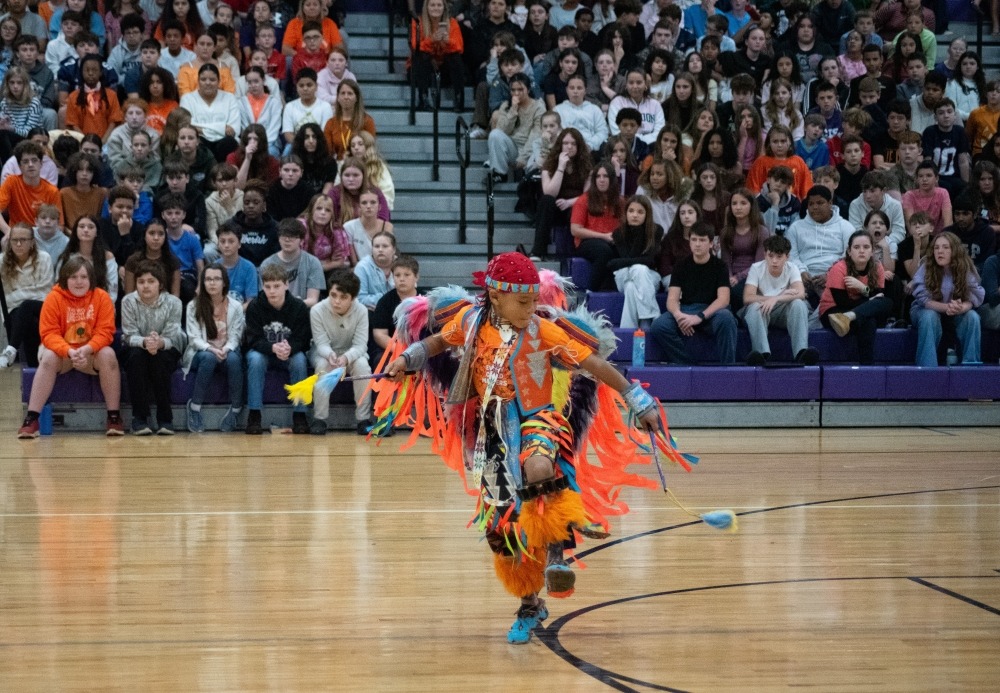
About 600 middle schoolers got out of classes Wednesday to see traditional Wampanoag dance and culture – along with the tragic history of abuse for thousands of kids their age – at an hour-long assembly in the gym at Plymouth Community Intermediate School.
The assembly was organized to coincide with Orange Shirt Day, an annual day of remembrance for tens of thousands of Indigenous children forcibly removed from their families as part of assimilation programs since the early 1800s.
Before the dancing and music, the leader of the assembly, Cameron Greendeer, asked how many in the bleachers were aware of the tragic story of the residential schools where Indigenous kids were stripped of their culture, language, and families.
“Oh, that’s a lot of hands. Your teachers are doing great,” said Greendeer, a member of the Ho-Chunk Nation of Wisconsin and the Mashpee Wampanoag Tribe.
“It’s not just about a shirt,” said Greendeer. “It’s actually about what happened to many children, just like yourself, your age.”
He described it as a “tough history” to imagine.
“But we have to be honest with it so we don’t repeat that history,” he added, asking the audience if they agree. The students yelled a resounding, “yes!”
Soon, the gym came alive as performers in colorful regalia presented traditional dances and songs to honor victims and survivors of Indigenous residential schools.
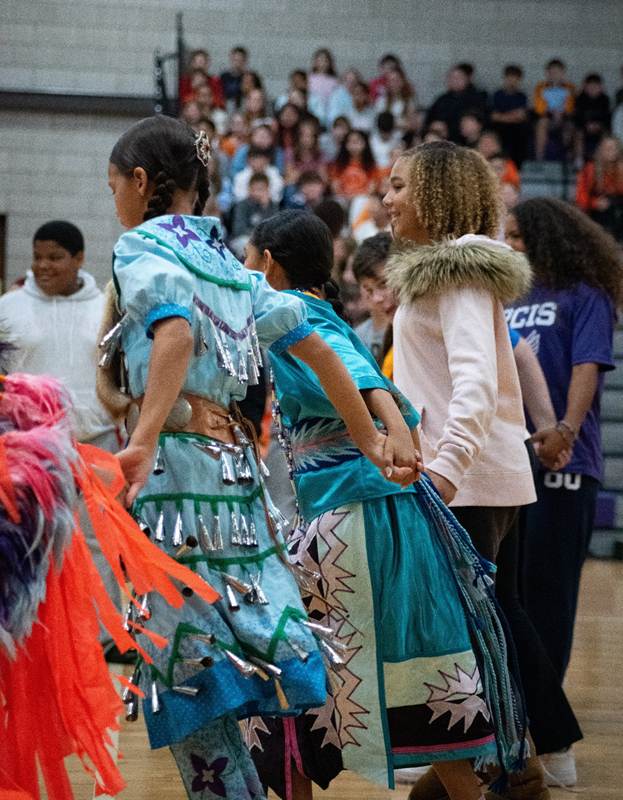
Students, many wearing orange shirts, learned about the uniqueness of Native cultures, and some even got to join a “round dance” at the end of the assembly, holding hands with performers and dancing in a circle.
“It was really good,” said seventh grader Aubrey Bryant, 12, who sat in the front row of the bleachers next to two friends. “All their dances are really special to them.”
Greendeer’s group, called the Neeshla singers and dancers, included his four children, Addie, Juliette, Lila and Emilia, as well as his brother, David, and David’s two children, Maple and Quill.
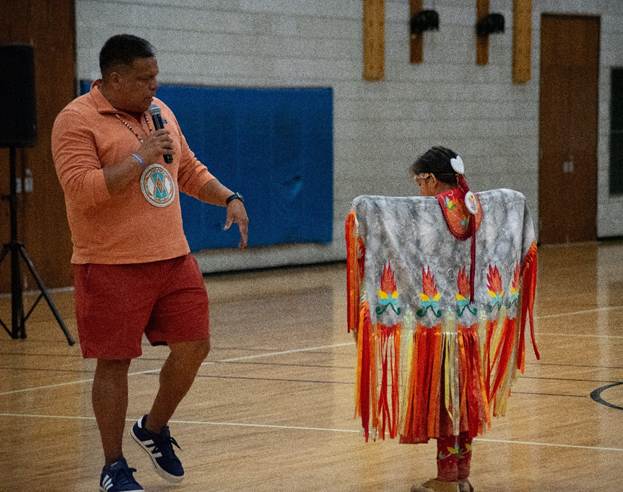
For about half the assembly, the brothers sang and played a traditional drum while their children, themselves elementary and middle school students in Mashpee, performed several group and individual dances. In between performances, Greendeer explained the significance of each dance and highlighted different aspects of Indigenous culture.
“It’s important for kids to be knowledgeable of all aspects of culture and tradition,” said PCIS Principal Brian Palladino, who wore an orange tie and watched the performance alongside students. “There’s life outside of Plymouth.”
From the early 1800s and well into the 1900s, Native American children were forcibly abducted by government agents and sent to schools hundreds of miles away from their families. There, many were beaten, starved, and abused in an attempt to assimilate them into American culture. Thousands died or never returned to their homes.
The assembly was funded by a $5,000 grant from the Massachusetts Cultural Council aimed at strengthening community connections to the Wampanoag Tribe.
The grant also funded several other events over the past year to immerse students in the Mashpee Wampanoag community, said Laura Hapgood, a seventh-grade math teacher who applied for the grant.
Last October, seventh graders went on a field trip to the Waquoit Bay National Estuarine Research Reserve, and in the spring, a member of the Herring Pond Wampanoag Tribe hosted an after-school event where students made cornhusk dolls.
On Wednesday, the kids were focused on Greendeer and his family.
He explained that the performers’ intricate regalia were handmade by their mothers and can take six months to a year to make.
“A lot of our dancers have beadwork, just tiny little pieces of these things,” he said. “There are thousands, literally thousands of them that we have to put on one by one by one. So, blood, sweat, and tears go into these regalia.”
When Greendeer took questions, one student asked how often the performers practice.
“It’s an everyday thing,” Greendeer said, explaining that he, his brother, and their kids have been singing and dancing their entire lives.
As the performance ended, excitement flooded the gym as Greendeer said he would choose students from the bleachers to join the performers in a round dance. He chose about 25 eager kids.
Twelve-year-old Teagan Gagnon said she learned that in some Native cultures, the drum is considered a living thing.
“It’s history that’s not in the books,” Greendeer said after wrapping the powwow drum into a quilt at the end of the assembly. “History is due to repeat itself if it’s not taught.”
Emily Spatz can be reached at emily@plymouthindependent.org.