
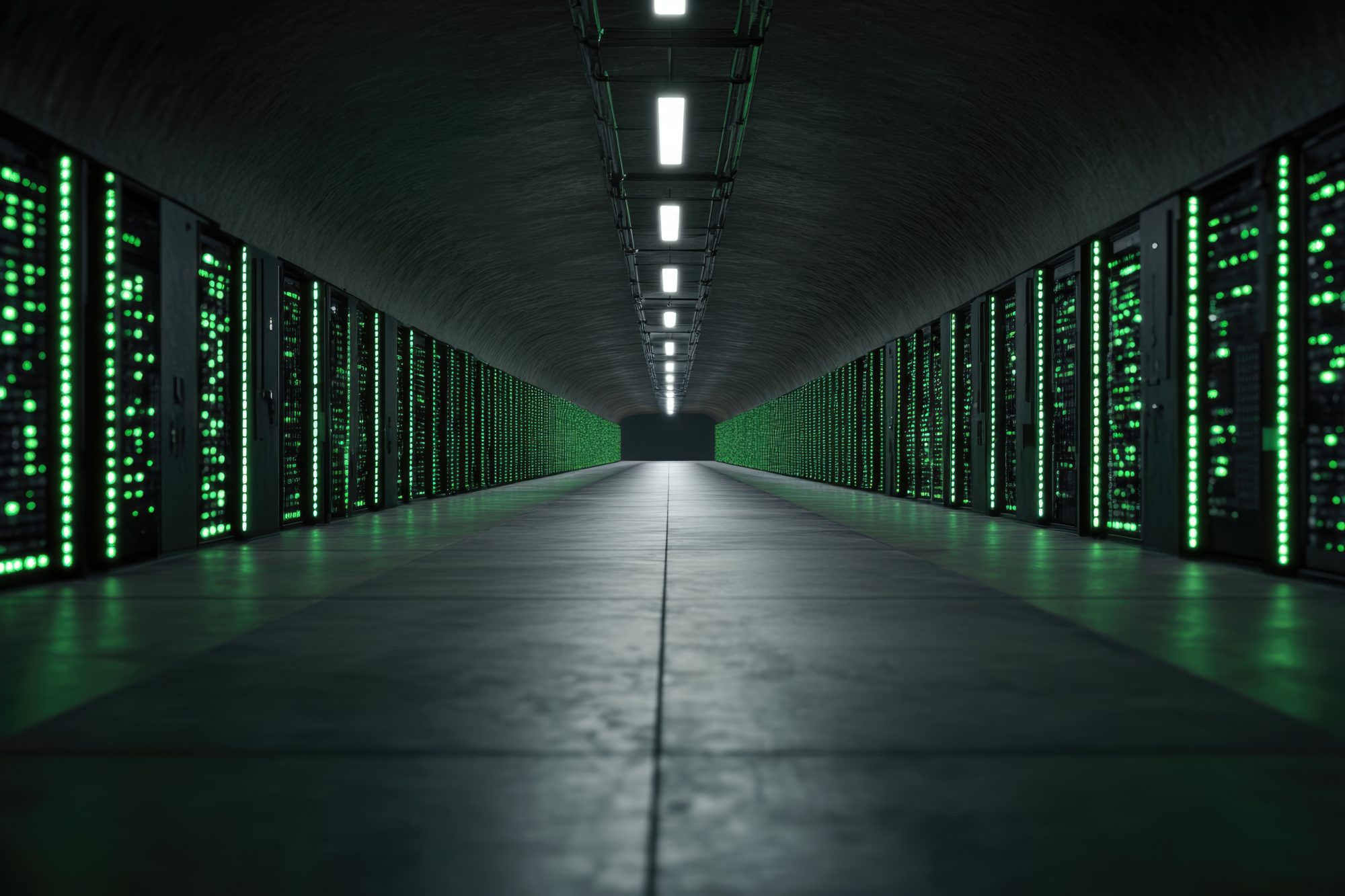
To their backers, data centers dangle a tantalizing golden ticket to financially strapped communities: the promise of hefty tax revenues to plug gaping budget gaps.
Critics condemn them as landscape-chewing behemoths that consume massive amounts of electricity, generate noise, and guzzle water.
Frank Mand puts himself somewhere in between those positions, at least for now. That may come as a surprise to those aware of the Planning Board member’s longtime mission to protect Plymouth’s environment, notably through his affiliation with the Southeastern Massachusetts Pine Barrens Alliance.
Mand is skeptical of the benefits of having a data center in town but says he needs to learn more about the pros and cons before cementing a position. He’s watched with alarm as data centers have spread across the country at breakneck speed.
It’s a high-stakes race to meet the demand of an artificial intelligence revolution that offers the potential for seismic advances in medicine and other fields, along with one whopper of a potential downside: an existential threat to humanity.
According to the website US Data Center Map, as of October there were 3,172 operating centers nationwide. Four hundred are under construction, with another 1,199 in the planning stage. Data Center Census, an independent website, says a typical building is 250,000 square feet (about 38,000 square feet larger than the Walmart Supercenter in Plymouth).
But some facilities are much bigger – so vast they make Amazon warehouses look like mom-and-pop stores by comparison The Stratos Center in Utah, for example, would cover 40,000 acres – that’s about 47 Central Parks.
No one has proposed building a data center in Plymouth. Mand, realizing the town doesn’t have regulations in place to deal with them, decided to take pre-emptive action. Earlier this year, he proposed a one-year moratorium on the complexes, which are essentially warehouses stacked with rows of humming computer servers. The Planning Board recommended a Town Meeting warrant article to that effect and in October the legislative body approved it without discussion by a 149-0 vote.
Pending state approval, hitting the pause button buys time – until the fall of 2027.
“Where we’re at now is that the moratorium’s passed, but we don’t have any sort of a path forward,” Mand said in an interview. The next step, he said, is to create “some kind of a citizen committee” that can study the issue and propose a set of rules to put in place before a company or developer advances a plan to build a data center in Plymouth.
“I use the metaphor ‘the eye of the needle,’” he said. “The regulations have to be so strict and so refined and so protective that the likelihood of a data center coming would be very low because it just would be not what (a company) would want … I don’t even know if something that truly protects the environment and reduces noise, doesn’t use too much electricity, and doesn’t cost the town a lot of land is even a reality.”
But if “all those things were in place,” Mand added, he could conceive of Plymouth hosting a modest-size data center, with the emphasis on “conceive.”
With A.I. advances accelerating at a pace inconceivable just a year ago, officials here and across the country are scrambling to assess the pros and cons of data center plans that can morph from theory to reality seemingly overnight.
“Plymouth has shown its stripes as the rube in the country that always is looking for that solution that’s going to solve all our problems,” said Planning Board member Frank Mand, who came up with the idea for a one-year moratorium on data centers.

In October, Westfield’s Planning Board refused to issue a permit for a data center that was in the final stretch of the approval process. Earlier this month, Dedham Town Meeting approved its own 12-month moratorium. Other cities and towns in Massachusetts are considering similar moves. And nationwide, voters in the midterm elections expressed alarm over the centers’ proliferation, even as an increasing number of people rely on A.I.-powered tools daily.
Locally, the subject has taken on heightened urgency with news of plans for a center in Sutton, a central Massachusetts town with a population under 10,000. The proposal by New England Patriots owners Robert Kraft and his family is anything but modest. It calls for a $16 billion, 10-building campus on 383 acres. Operating it at full capacity would gobble 900 megawatts of electricity, or about 7% of the power used statewide on a sweltering summer day.
The proposal, which Sutton officials had been quietly discussing for a year, has caused a furor among most residents. A minority view it as a way out of a burgeoning fiscal crisis, one not unlike the financial challenges facing Plymouth in coming years. Once fully operational, the Kraft data center could pay a staggering $27.8 million in annual taxes. Sutton’s entire budget is $40 million.
Mand said Plymouth has an unfortunate history of looking for a single answer to a broad set of challenges. He cited its embrace of the troubled Pilgrim nuclear power plant; “Hollywood East,” a far-fetched 2008 scheme to put a $300 million movie and television production campus on the site of the Waverly Oaks Golf Club; and four years ago, a similarly suspect idea to build a horse racing track and casino on county land.
“Plymouth has shown its stripes as the rube in the country that always is looking for that solution that’s going to solve all our problems,” he said. “But usually, these things come with so many other problems.”
Planning Board Chair Steve Bolotin credits Mand with calling attention to the data center issue. He is also quick to note that Plymouth – contrary to popular belief – does not have wide-open tracts of land to accommodate the kind of giant center that would fill town coffers with tens of millions of dollars. As for the Holtec land, a 1,600-acre site frequently mentioned by people advocating for a Plymouth data center, the town does not own the property, nor does it have the money to buy it, an estimated $50 million or more. Also, it’s not for sale.
“We have a total of 376 acres of undeveloped commercial land left,” Bolotin said. “That is aggregate, not any single site. So, no large-scale data center could come here because there’s nowhere to put it.”
In a phone conversation, Bolotin recited a list of questions that need answering before a data center of any size comes up for consideration. For starters, a complex that called for more than 100 megawatts of electricity would demand costly infrastructure improvements by Eversource, the utility company.
“How would that impact our residents?” he said. “Does that cause an increase in our bills or a decrease? Who would pay for them? These are things we need to understand. Another issue is water…How much water would a data center use for cooling? That would be important. And do they create heat plumes? Are those significant? We’ve also heard of issues regarding the potential for noise.”
Realistically, Bolotin said, a local data center would likely not come close to 100 megawatts, which would lessen environmental concerns, but also mean less in taxes, and only add a few dozen “living wage jobs.”
Even a small center can meet with resistance, however, as illustrated by a battle in Salem, where a facility described in a Boston Globe story as “drugstore size” was rebuffed by city officials.
The intent of the Plymouth moratorium is to “hit the brakes so we’re not dealing with it after the fact once a proposal is on the table,” Bolotin said. “More to the point, so we’re also not dealing with something that – as we have faced with certain residential projects – are things that we cannot prevent because the laws have already allowed it.”
Bolotin and Mand acknowledge coming up with rules to protect the town while not running afoul of a developer’s rights will be complicated and nuanced. And they are aware those with opinions on either extreme will be the most vocal as the process plays out.
“On any given day I can find someone who will say that any data center of any type is the greatest evil that mankind has ever seen,” Bolotin said, “and I will equally find someone who will say that these are the greatest salvation for mankind’s future. I don’t buy either of those arguments. The irony is the people who are yelling and screaming about data centers are posting it on a place that has required its systems to run through a data center.”
Mark Pothier can be reached at mark@plymouthindependent.org.