
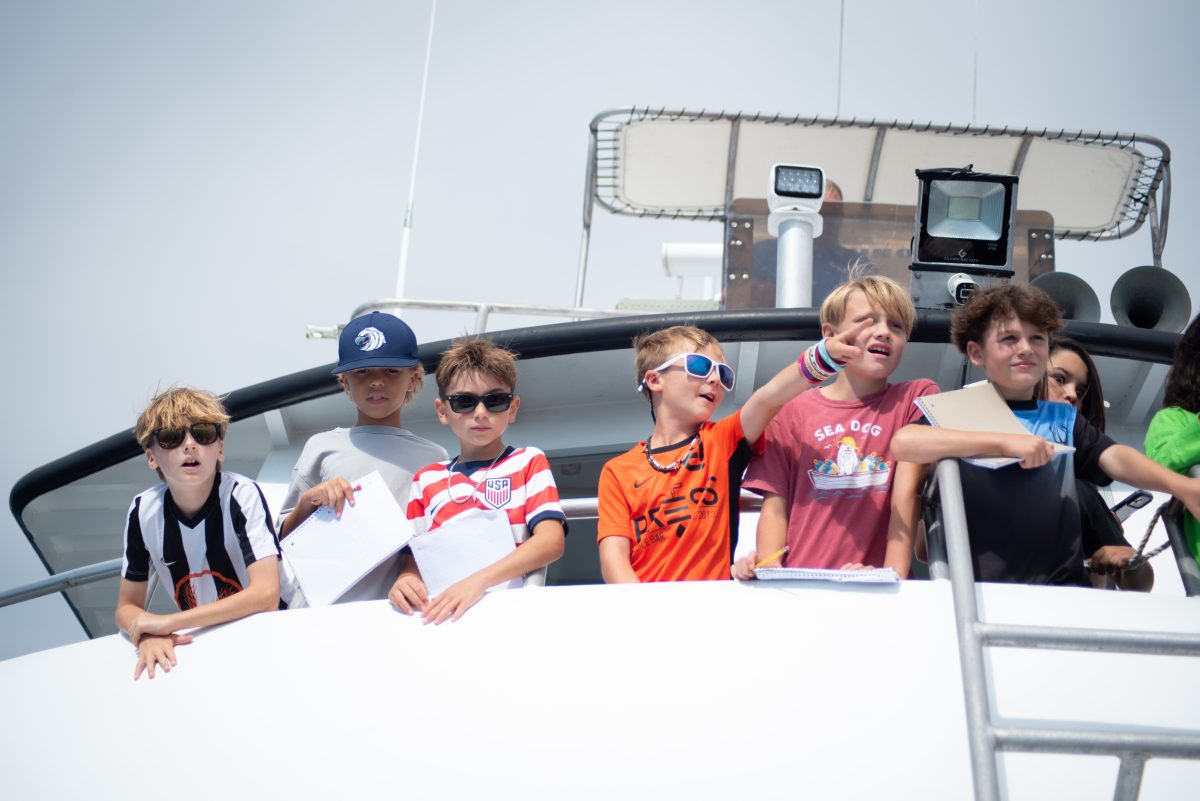
A group of about 100 fifth-grade children milled about the boat with notebooks and pencils, writing notes and sketching their observations as they watched dozens of whales swim just feet away in the federally protected Stellwagen Bank National Marine Sanctuary.
“Whale breath stinks,” said 10-year-old Zamara Moore, adding to the list of things she and her friends learned Friday morning in their first up-close encounter with some of the largest animals on earth.
“Breach! Breach! Breach!” chanted the excited kids, rushing to one side of the boat, and then the other, to see the rarely witnessed spectacle of humpback whales launching their enormous bodies from the water as if on cue.
It was the “maiden voyage” of what organizers with the Stellwagen Educational Foundation hope will become an annual and expanding educational program for kids in Plymouth Public Schools.
The trip was funded entirely by corporate sponsors and private donations, years after the district eliminated similar field trips due to budget cuts.
The goal, said Amy Estes, a local artist, author, environmental advocate, and founder of Stellwagen Educational Foundation, is to bring those field trips back to Plymouth students. The foundation is dedicated to giving kids opportunities to experience marine wildlife in their local habitat, with hopes of fostering a lasting connection to the natural world.
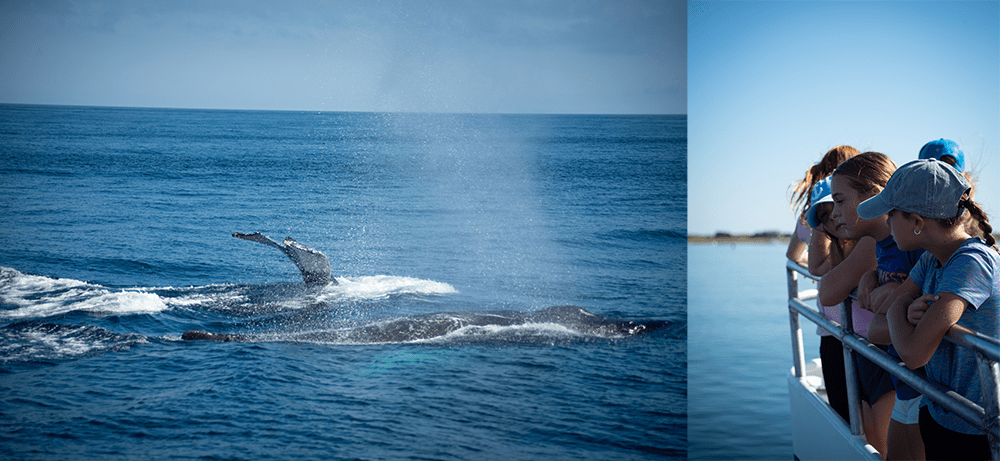
As humpback whales approach the boat, students look on in wonder. (Photos by Emily Spatz)
“I think it’s a great thing, education right in the backyard,” said Joel Nickerson, president of Pilgrim Innovative Plastics, one of the sponsors. He was aboard the boat with his 9-year-old granddaughter Emily. He said he plans to support the trips every year.
In addition to Nickerson’s company, sponsors included the diving systems company Avelo, with Estes also contributing proceeds from her art and book sales. The Stellwagen Foundation partnered with Captain John Boats to operate the trip.
Whale-watching trips were once a staple of the Plymouth Public Schools curriculum, but budget shortfalls forced the district to cut them, said Allison Riordan, science curriculum coordinator for the district. The trips were eliminated before she assumed her role in 2008.
“It was a no-brainer to give kids this opportunity,” Riordan said, explaining that Estes had reached out to her a year ago with the idea. “The district would not have the money for this if not for corporate sponsorships.”
By all accounts, it was a successful day.
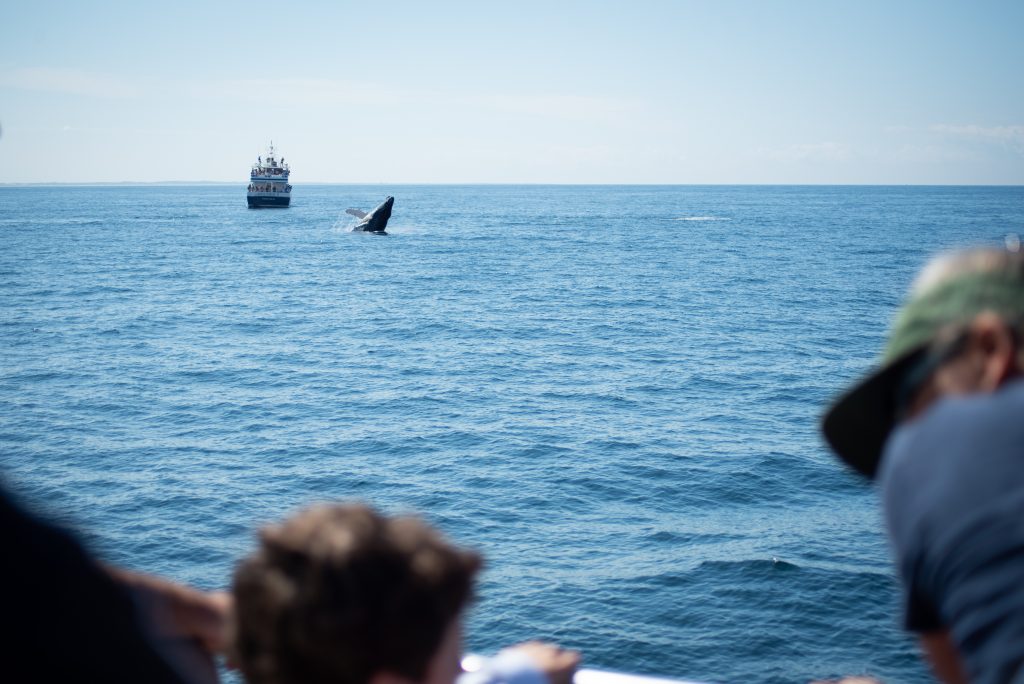
A whale breaches in the distance as students cheer it on. (Photo by Emily Spatz)
“Whales are really essential to the health of the ocean,” Estes said. “When kids get excited about things, that’s how you get them to want to protect things.”
As the boat departed the harbor at 10 a.m. with a few blows of the horn, Lindsay Hirth, naturalist for Captain John Boats and educator at Stellwagen foundation, told the kids, “Once you get on my boat, you’re a scientist.”
During the approximately 90-minute trip to the sanctuary, Hirth passed out a worksheet instructing students to write down observations and questions about their surroundings. Morgan Thomas, 10, said she wanted to know why whales are so big, while her friend Cameron Hartnett, also 10, said she wanted to know how they can live underwater.
Scarlett Clifford, 11, said teachers told her class about the field trip on one of the first days of school.
“We were really excited,” she said, sitting next to her friends as the boat sped out of the harbor. Lucy Mariano, 10, said she was a bit nervous “just because whales are so big.”
Students at Nathaniel Morton Elementary School were the first to go on the trip because the school is within walking distance of the harbor, Riordan said. Arranging for school buses is another expense the district can’t afford.
“We want to expand this program so that all students are able to experience this teaching moment,” Riordan said. “We want to ensure students across all schools are getting similar experiences.”
Estes hopes more companies will support the foundation so that all fifth graders across the district – there are about 500 – can see whales in person. The field trip fits well into the fifth-grade science curriculum, Riordan said.
Some students were excited at the possibility of seeing whales for the first time in their lives; others, like 10-year-old JV Tagne, hoped to spot other critters, too.
“I’m excited to see the whales, all the marine animal life, and the seals,” Tagne said. He got lucky: As the boat slowed down on approach to the sanctuary, several kids spotted a seal swimming on the left side of the boat.
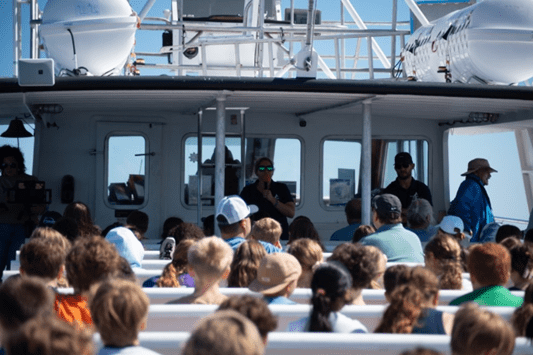
Lindsay Hirth, of Captain John Boats, gives the students a lesson on the way to the sanctuary. (Photo by Emily Spatz)
Ten-year-old Oliver Hughes was holding out hope to see one of the numerous sharks or dolphins that visit the sanctuary, but none were spotted.
Instead, students were surrounded by groups of whales diving and splashing in the water and, a couple of times, breaching. Hirth explained how lucky the children were to witness it.
Hirth encouraged students to use the clock reporting system when describing where they saw a whale relative to the boat, with 12 o’clock being directly at the front of the vessel. It was a learning curve.
Once, as Hirth pointed out a group of whales at 9 o’clock, one student shouted, “I could stay out here till 9 o’clock!”
Unfortunately, it was time to head back after an hour. During the return trip, Hirth told students about the unique markings on whales’ tails and the reasons for some of their behaviors.
By then, the once-hyper group of kids had quieted down as they reflected on what they had learned.
Bradan McLaughlin, 10, said he learned there are scars and birthmarks on whales, and scientists use those markings to identify and study them. He also learned whales swim in an “up-and-down motion” and use their blowholes to breathe.
“It’s very amazing.”
Emily Spatz can be reached at emily@plymouthindependent.org.