
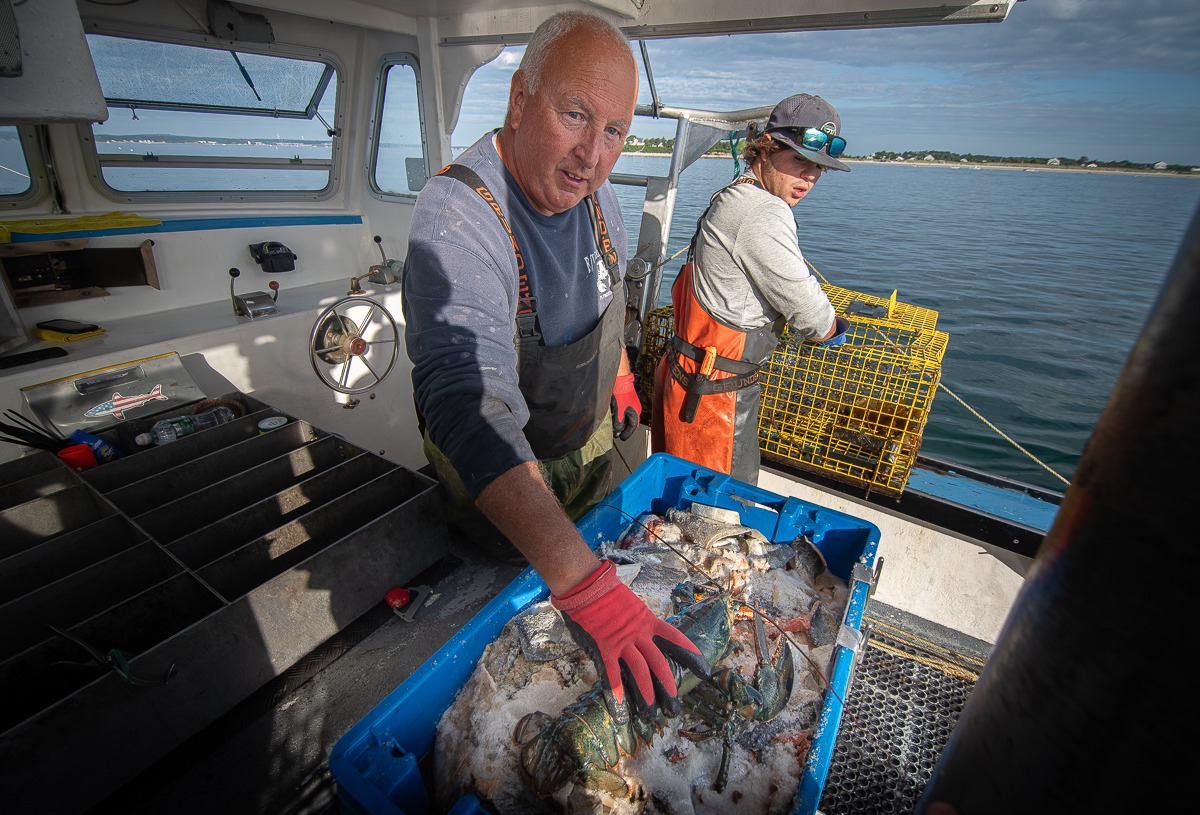
A lot has changed since Tom O’Reilly threw his first lobster pot in the ocean more than four decades ago.
Back then he was using wooden traps which had to be laden with rocks so they would sink to the sea floor. Once the wood became waterlogged the rocks were no longer needed, but they were heavy even when empty. Each pot was hauled up one at a time using only muscle power, a slow and arduous task. And he worked year ‘round.
Now 65, O’Reilly – a big, affable man with short cropped white hair and piercing blue eyes – employs a “stern man,” currently 18-year-old Kyle Moyen, of Manomet. Wooden traps have been replaced by lighter, coated wire traps strung together in groups of 15, each separated from the others by 90 feet of rope. To get the traps up to the boat, Moyen uses a grappling hook to grab the rope just underneath each buoy and O’Reilly threads the rope onto a winch-like device mounted on the starboard rail. He calls it a hauler (brand name: Hydro Slave) and it does most the heavy lifting until each trap is brought alongside the boat where Moyen wrangles it onto the rail. As for lobster fishing year ‘round, that, to O’Reilly’s chagrin, has been reduced by state regulation to help save the endangered North Atlantic right whale, of which fewer than 400 remain.
When I moved to Plymouth in late 2024, I was surprised the following spring to see so many lobster buoys bobbing in Plymouth waters. It was widely reported that even Maine’s coastal waters were becoming too warm to sustain the lobster population, forcing them north into Canadian waters.
According to the National Oceanic and Atmospheric Administration (NOAA), the waters of Cape Cod Bay and the Gulf of Maine, of which Cape Cod Bay is a part, are warming faster than most global marine environments. The Woods Hole Oceanographic Institute concludes climate change has caused average summertime water temperatures in the Bay to warm by more than 3.5 degrees Fahrenheit since the 1970s. That may not sound like a lot, but even a one-degree average rise can mean the difference between thriving and dying for some species. Local oystermen cite warming waters for a drastic reduction in the local mussel population, for example.
O’Reilly doesn’t dispute the data, but says over the past ten years the temperature has been stable.
“People may disagree with me on this,” O’Reilly says, “but I’ve monitored the water temperature every day for the past ten years, and I don’t see it rising.”
He points to one of the monitors on his boat, the 36-foot Karen M, built in Maine in 1991 and named for O’Reilly’s wife. The monitor shows the water temperature is 65 degrees. “Normally, this time of year, it should be about 70,” he says, “and the lobster population is stable.”
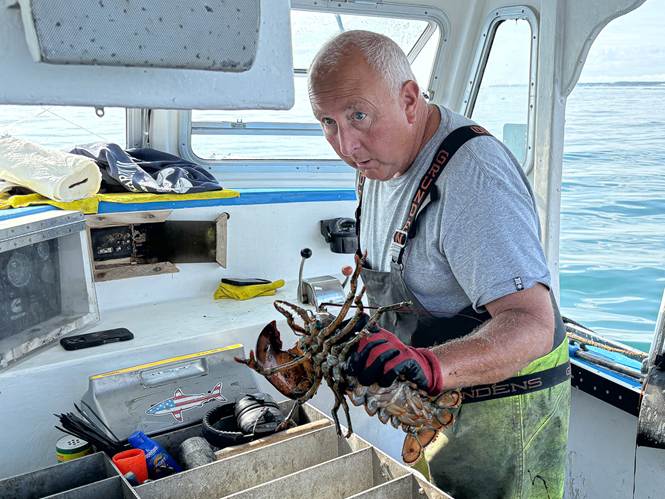
There are 45 active lobstermen in Plymouth and all but one of the nearly four dozen fishing boats calling Plymouth Harbor home are lobster boats, according to Plymouth Harbormaster Chad Hunter.
Since 2014, Plymouth’s lobster harvest has waxed and waned. Data provided by the Massachusetts Division of Marine Fisheries show the smallest catch since 2014 was in 2024 when 299,957 pounds of live lobster were landed in Plymouth with over $2 million paid to the lobstermen, known as the ex-vessel value. The best year was 2016 when 964,438 pounds of live lobster were landed with an ex-vessel value of $4.04 million.
He can’t say exactly, but O’Reilly estimates his annual catch is in the many thousands of lobsters. He has 800 traps set in the waters off Saquish all the way up to the High Pine buoy off Duxbury Beach and several miles out into the middle of the Bay. The direct-to-buyer market rate now is around $6.00 a pound; his lobsters will mostly end up at Wood’s Seafood and Bramhall’s Country Store in Plymouth, and Superior Seafood and Lobster in Marshfield.
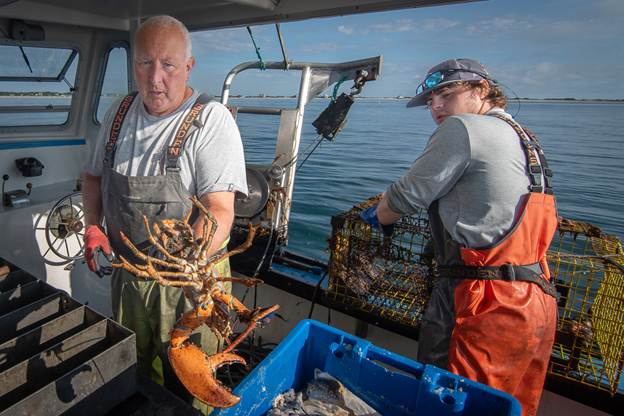
Watching O’Reilly and Moyen work, it’s the efficient choreography that is most impressive. Moyen hoists a trap the hauler has brought alongside the boat and within seconds flips open the two doors atop each trap. He and O’Reilly grab each lobster and quickly assess which are keepers. In some cases, it’s clear just by eyeballing them, but by law, and to sustain the lobster fishery, a lobster must measure slightly more than 3.25 inches from the eye socket to the end of the back, the carapace. It takes just a second with a small metal gauge to measure and those not making the cut are tossed back, as are egg-bearing females, the eggs are clearly visible on the lobster’s underside. O’Reilly says more than half his catch is tossed back into the sea.
Once pulled from the trap the lobsters are put in metal tray. Moyen grabs the bait bag hanging inside each trap, reaches into a large plastic crate filled with salmon skins, O’Reilly’s preferred bait, then fills the bag with bait, closes the top doors, and slides the trap down the rail toward the stern and hoists it onto a large metal tray affixed to the port rail.
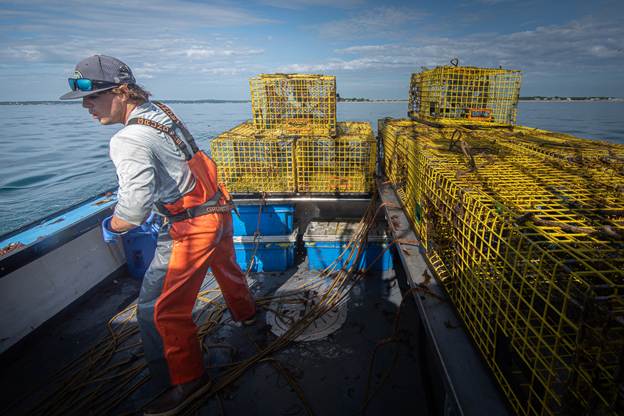
The 15 traps are neatly stacked in rows, two high in places, and when it’s time to let out the line and return the traps to the water, they go flying one by one off the back of the boat in what looks like a scene from Deadliest Catch, the reality TV series. It seems a miracle with so much rope linking 15 traps they never get entangled, at least not on this day.
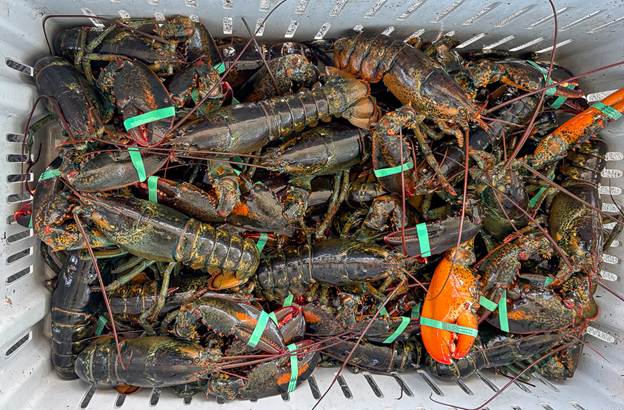
As O’Reilly steers for the next lobster buoy, Moyen uses a special tool to slip a heavy-duty rubber band over each lobster claw. I always assumed this was for the protection of those who will handle the lobster, whether it be a chef or a consumer. It’s main purpose, however, is to keep the lobsters from killing each other, something they are wont to do in confined spaces. Once banded the lobsters are placed in a tank built into the hull. Over and over, this routine is repeated until O’Reilly has his daily catch.
The lobster catch tends to increase as the lobstering season, late spring through late fall, goes on. When the fishing is good, O’Reilly can pull a thousand pounds of lobster in a day. But such are the vagaries of fishing, that some days he won’t even cover expenses.
The economics of lobster fishing can be daunting. O’Reilly estimates his costs for each day on the water to be $800. Bait, which used to cost $5 per 100 pounds is now $100, though it will last for several days. He has a stern man to pay, “off-the-charts” fuel costs, maintenance, and equipment such as traps and buoys.
O’Reilly is understandably frustrated with some of the regulations imposed to protect the endangered North Atlantic right whale, not because he doesn’t want them protected but because he thinks many of regulations are ineffective or unnecessary.
“We are stewards of the ocean,” he says, “and we’ve been fishing with whales forever.” Though the whales are susceptible to becoming entangled – sometimes fatally in the vertical ropes used by lobster and crab fishers – O’Reilly claims such instances are extremely rare.
“Most right whale mortality in the Bay is caused by ship strikes,” he adds, “and even those are few and far between, but we take the brunt of the blame.”
To help protect the whales, lobstermen are now required to use “breakaway” buoys and rope links to help prevent entanglement. Lobster fishing is banned in Massachusetts waters between February 1 and May 15, the time when right whales frequent the area. By mid-May, their food sources are depleted and they move on. But the presence of a single malingering right whale anywhere in state waters can delay the May 15 opening. Conversely, if aerial and acoustic monitoring show no right whales remain, opening day may be moved up, but no earlier than April 30. The breakaway buoys and lines seem unnecessary to O’Reilly since lobster fishing is barred when right whales are present. With 800 traps, it takes a month just to set the gear, another month to take it out of the water at season’s end, effectively reducing the lobstering season to six months a year.
Despite the bureaucratic frustrations, the harsh economics, and the hours — on a typical day, weather permitting, he’s at the dock at 4:30 a.m. and returns about 2 p.m. — O’Reilly says he wouldn’t want to do anything else.
“I love getting up in the morning, as hard as it is,” he says. “I’ll never get rich, but the independence, being out on the water, working for myself, and the freedom of being my own boss?”
That, he says, is priceless.
Peter Zheutlin can be reached at pzheutlin@gmail.com