
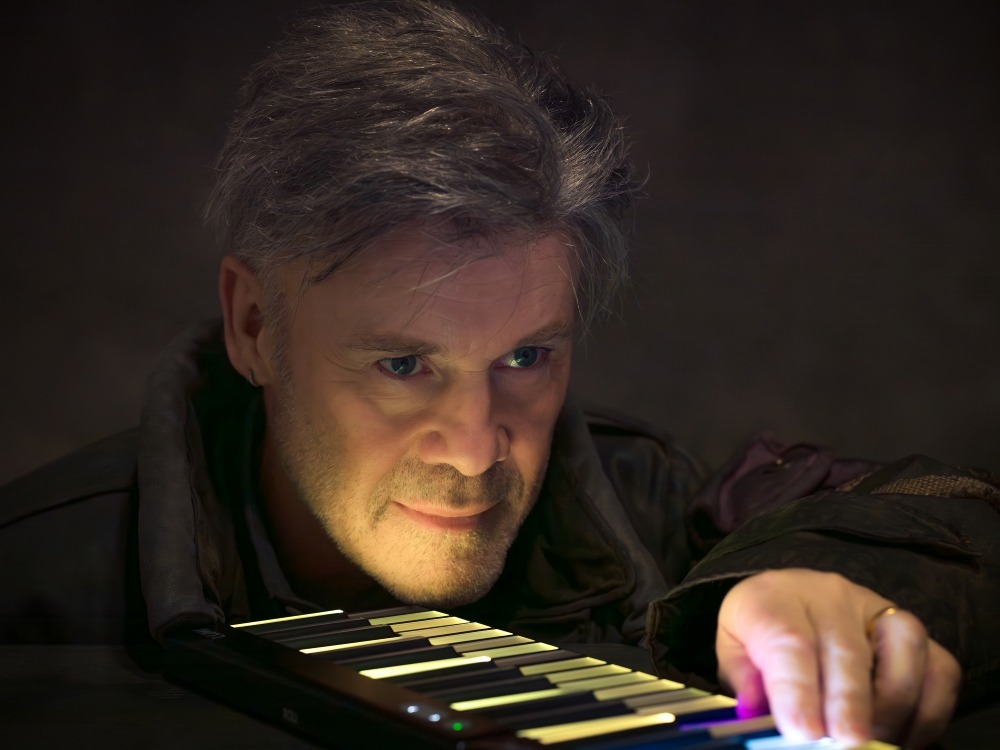
Thomas Dolby is coming to the Spire Center for the Arts? Along with longtime David Bowie bass player and singer Gail Ann Dorsey? Am I reading this correctly?
That was my reaction to seeing the listing for Dolby’s (sold out) April 14 show at the 280-seat downtown venue. His biggest hits, “She Blinded Me With Science” and “Hyperactive” – 1982 and ’84 respectively – helped fuel MTV’s halcyon era. But for those whose attention spans remain intact in our information overload daze, I’d recommend these full-length Dolby albums for a deeper experience starter pack: “The Golden Age of Wireless” (1982) “The Flat Earth” (1984), and “Astronauts and Heretics” (1992).
Yes, they’re all records from long ago, but Dolby hasn’t been encased in amber since. The British artist says he’s always running toward the next new thing.
Seeing him and Dorsey in the intimate setting of the Spire promises to be a treat. He’ll be combining music, visuals, and storytelling ingredients in a format billed as “The Iconic 80s,” a title targeted at the boomer demographic. The Plymouth show is the opener of a tour that will take him, Dorsey, guitarist Andrew Lipke, and Iggy Pop drummer Mat Hector to New York, Chicago, Nashville, and other U.S. cities before decamping to the U.K. and Ireland.
“Renaissance man” is a well-worn phrase, but it applies to someone with Dolby’s resume. Making his own music is just part of the list.
He’s produced and played on a wide range of artists’ recordings, including Def Leppard, the Thompson Twins, and Belinda Carlisle. He played keyboards during David Bowie’s Live Aid set, and did the same for Roger Waters’ The Wall Live in Berlin.
In the 1990s he founded the now defunct Silicon Valley company Beatnik. It devised ringtone technology that ended up in more than three billion phones made by Microsoft, Motorola, and Nokia.
For 12 years, he served as musical director for TED Conferences. Since 2014 he’s been a faculty member at Johns Hopkins University’s Peabody Institute, where he heads the Music for New Media program. He’s also written books – including a memoir, 2016’s The Speed of Sound: Breaking the Barriers Between Music and Technology – and made a documentary about the decommissioning of a lighthouse off the coast of England.
I recently spoke with Dolby about the tour, his wide-lens personal history, and his thoughts on the state of music. He was polite, thoughtful, and mostly serious. I suspect he may have been wondering: “What the hell is the Plymouth Independent?”
This interview has been edited for clarity and length.
Can you talk about the tour concept?
For years, I’ve tended to unpack some of my songs when I play live, whether it be telling the story of how I came up with a song or some anecdote of what was going on at the time, or sometimes sort of explaining the song in advance. For example, I tell a story about playing with Bowie at Live Aid, and while I’m telling it, I play this ambient version of “Heroes” with some Brownie camera snapshots that I took on the day behind me on a screen. I think fans of my music like seeing behind the scenes, hearing some of the background.
This is maybe a reflection on the fact that when you listen to music today there are so many distractions. You’re halfway through the intro of a song and suddenly into your feed pops up a zebra being eaten by a python, right? You have so many stimuli coming at you from all directions, whereas when we were all younger, music felt like a slightly more rarefied and precious commodity. We’d pore over the lyrics or the credits on the back of an album cover and listen to it, flipping between side one and side two and back to the beginning.
It occurred to me that I’d like to put this together in a sort of narrative through-line – to tell the story of my journey. I’m working up to doing this maybe sometime late this year or next with a symphony orchestra. But before I let it anywhere near an expensive orchestra, I need to work the material, like a comedian will work up new material in a club setting. So this tour is really a sneak preview, a beta version of that show.
And the sneak preview starts here in Plymouth. Plus, you’re bringing Gail Ann Dorsey, who, of course, also has a major link to Bowie. [She played with him from 1995 until his death in 2016.] How did the collaboration come about?
I met Gail on stage with Bowie at the Beacon Theater in New York around the turn of the century. We didn’t really talk much then, but when I was putting this show together, I needed a bass player and I also needed guest lead vocalists because some of the songs had female vocals to begin with, or the male vocal is now too high for my register. Gail was really an obvious choice. She has very strong connection to that era – the Bowie thing. She’s a lovely bass player and amazing alto singer, very captivating. When she takes a bit of the lead vocal, people’s jaws are hanging open. Gail has a solo set that she does as well, and then she’ll rejoin me on stage for parts of my set.
Audiences obviously want to hear the hits and yours start with “Science.” I’m wondering how you’ve navigated that through the years. Do you feel it’s a crucial part of your legacy, an albatross, both, or neither?
It’s been a pleasure, really. If it hadn’t been for my mass-market appeal, a lot of people would’ve never have discovered the deeper cuts that you referred to. I always saw it as a springboard, a way to reach a wider audience. A select few find their way to the more personal, atmospheric stuff that that there’s actually more of in my catalog. I don’t see it as being a choice at all. I see it as a great way to balance art and commerce.
I find it interesting that you’ve always embraced the possibilities of tech, but your music also evokes nostalgia, or an appreciation of a revisionist kind of history. Was that a conscious thing or something you simply gravitated toward?
It’s probably what I gravitated toward. In quite a lot of my work there’s a sort of dystopian alternative reality – what if steam and cogs had prevailed over electricity? What if the German army had occupied the British Isles? I just imagine alternative scenarios like that. I find that a fertile setting for some of my lyrics and and some of my soundscapes.
You’ve lived through the evolution of the music business, as well as massive changes in technology, especially in recording and synthesizers.
Yes, there used to be the inconvenience of the hardware, all the wiring, all the knobs that can get accidentally bumped when the cleaning lady comes in. And the fact that I live in two different countries, having the right gear in the right place was a bit of a headache, so it’s a lot more convenient to have everything right there on my laptop. In the mid-seventies, late-seventies, you had to be a university experimental music department or a big studio or a rich rock star to own a modular synthesizer, for example. The first drum machines weren’t really designed to be programmable in the way they are now. And to record you had to go to an expensive recording studio, which meant finding somebody stupid enough to loan money to a musician.
The key word being “loan.”
Yeah, exactly. But as you know, those technologies started [getting better], the prices came down, and there were more manufacturers, so they were more accessible. Suddenly you could do this stuff in your back room instead of in the studio. It became possible for somebody who was just a music fan to get their hands on this stuff and maybe reveal a talent within themselves. It started to be that the only way to get heard was not necessarily via the music business – you could DIY a little bit. Eventually, it got to the point where you didn’t need a record company to get music out a wide audience via the internet.
That was a long way from the ‘80s structure.
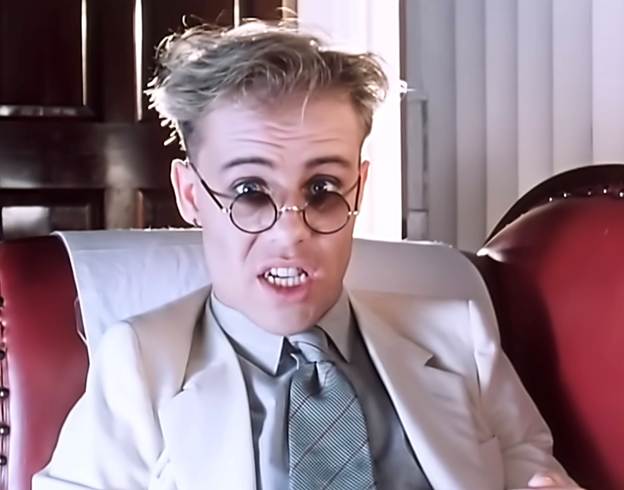
The music industry got very corporate quite quickly in the ‘80s, as did radio. But MTV, in a way, loosened the stranglehold of the corporations on music, because if you had a cool music video, you might get it on MTV regardless of the genre that radio considered it to be – , the pigeonhole that they put it in. MTV was influential enough in the first few years that radio stations had to pay attention to what was in rotation. This was a big boon for me because absent MTV, “She Blinded me with Science” might have fallen between two stools. It was kind of too R&B and funky. Once the video was hot on MTV, radio stations found a place for it in their playlists, as did dance clubs. It gave me a hit record. A couple of years earlier that might not have been possible.
The video had humor, too.
Yeah, I definitely believe that the video showed the humor [of the song]. That probably helped – the visual is just so indelible.
We don’t have time to go through the list, but how do you balance all the many things you do, and how do you know when to move on from something?
I’m always drawn to the new thing, you know, the new new thing. Often, it’s an avenue that’s been opened up by some new technology, some new development – be it synth samplers, computers, video games, interactivity, the internet, mobile phones, cheap filmmaking tools. I’m very attracted to diving in there – you know, ignore the user manual, just start making stuff. I take a lot of pleasure in floundering around in an area where I don’t really know what I’m doing.
I’m restless, no question. So it’s never really been hard to make those choices, and I’m just very fortunate that so long as the repo man is not banging on the door to take away my big screen TV, then I’m doing well enough financially that I can keep making choices on the basis of art rather than paying the rent every month. To me, that is a definition of success.
I have a sense that you got bored with music or the state of the music business at some point, hence the 15-year period from about 1991 to 2006 during which you didn’t release new material. Maybe I’m oversimplifying.
Well, the first thing is I’ve never been bored in my life. I can’t really imagine what that feels like, because rather than get bored, I’m – like I mentioned – instantly drawn to the next creative possibility. But did I realize [at some point] that there was less of a sucking sound, less of a clamor for my new material, new concerts. And that’s why I turned my hand to things like the TED Conference, and eventually to teaching, which is more about learning and the spreading of ideas. I became more engaged with the idea of passing on the knowledge and experience that I’ve gained to the next generation, and the best ways to articulate that and to communicate that.
Many artists need to constantly tour and sell merchandise to make money since they get ripped off by the streaming services. You must have thoughts on that.
I manage myself. These days you have to be a businessman and a marketeer, and so on. But unlike a real manager who’s always got an eye on the bottom line, so long as my bottom line is not red, then everything’s good. It’s a great position to be in where I can afford not to be concerned with the wrong things. But I sympathize with people for whom it is. If you’re living in Brooklyn trying to make your rent every month, then you can’t help but be concerned with those things because you really are on a tight rope.
Mark Pothier can be reached at mark@plymouthindependent.org.