
Plymouth’s downtown and waterfront businesses are putting together a plan that they hope will persuade residents and visitors to spend more time and money in the district.
Their pitch comes as the town is preparing to launch a major transformation of Court and Main streets aimed at making downtown more resilient to climate change and – in the process – more vibrant and appealing.
“Our approach is to have something going on all the time in downtown Plymouth,” said developer Rick Vayo, president of the Downtown Waterfront District, a nonprofit association of 22 downtown businesses with ambitions to rapidly grow. It had a modest start in 2023 but recently relaunched – partially powered by Vayo’s clout. Among other things, the group hopes to organize a seafood festival, a holiday stroll, and a harvest festival.
Overall, the downtown area has been on the upswing in recent years, but recent closings have left some storefronts vacant, while other buildings need sprucing up – starting with a basic paint job – and sections of sidewalks need repairs or replacement. The mix of businesses also needs adjusting.
Stephen Cole, executive director of the Plymouth Foundation, which has provided a $150,000 grant to the nonprofit, cites the Waterfront Festival, organized by the Plymouth Area Chamber of Commerce, as a potential model for future events.
Vayo, who has made revitalizing downtown a personal mission, says the goal is not to just get people downtown – especially in summer when tourists tend to stick to the waterfront – but to get them to spend time and money there. That one block between the waterfront and downtown can sometimes seem like a mile.
For instance, a ticket to the seafood festival could come with discounts and offers at downtown businesses. He said there could also be themed weekends for Valentine’s Day, Saint Patrick’s Day, Easter, and Thanksgiving. (Despite the town’s history, downtown is nearly deserted on the fourth Thursday of November.)
“We need people making more events so we can have more people in the downtown,” said Cole.
He pointed to a modest improvement that Downtown Waterfront District businesses have already made for pedestrians: Mutt Mitts bag dispensers, which have helped to reduce dog poop in front of businesses.
“Quite a bit of dog waste in the downtown prior to those things,” Cole said. “Just left on the sidewalk in front of restaurants that you are expecting people to go [to].”
Cole also has a plan of his own to spur more economic activity downtown: a co-working space. The Plymouth Foundation has selected a Chicago-based national operator of co-working spaces to run it. He did not want to reveal the location or the operator’s name yet but anticipates the space – with room for up to 100 startups – will open this fall, attracting new customers for the area’s shops, restaurants, and bars.
“We [will] have a co-working space of young people, entrepreneurs and professionals, who are already downtown, going out to lunch, staying after work for drinks and dinner,” Cole said.
Vayo said business owners want to make downtown Plymouth a year-round destination.
Over the last two years, downtown and the waterfront have undergone an accelerated transformation with the opening of businesses such as Vayo’s Plimoth General Store, The Black Dog, 71 West Atlantic, La Baia, and Vitamin Sea, with its waterfront patio and taproom. On a summer weekend, the brewery – fast becoming known for its massive paninis as well as beer and other drinks – becomes a gathering place for hundreds of people.
“The biggest thing for us is just trying to draw more people, whether it’s from Plymouth or the South Shore or beyond, trying to get them to think of Plymouth as a destination,” said Dino Funari, owner of Vitamin Sea. To accomplish that, he said, downtown and the waterfront need a combination of events and more promotion of existing businesses.
Another longstanding issue is the lack of “nice” hotels downtown and on the waterfront, limiting the amount of time visitors might spend in the area.
That could change soon. The 80-room John Carver on Summer Street was recently bought for $14 million by Boston-based Mount Vernon Company. The company’s portfolio includes hotels and major apartment developments, and it has plans for a major overhaul of the underwhelming hotel. Founder Bruce Percelay says Mount Vernon is “very bullish on Plymouth.”
Meantime, Vayo is building a small boutique hotel on Chilton Street that he plans to open next year.
Another one of his properties, the long dormant Eastern Bank building on Main Street, will become home to two new stores in September. He’s not ready to divulge their names.
Five years ago, empty storefronts could stay vacant for a long. time, Vayo said. Today, spaces fill quickly. The Eastern Bank building took longer to lease, Vayo has said, because he was looking for tenants that would be right for the downtown retail mix.
The Downtown Waterfront District has used the grant from the Plymouth Foundation to hire Christine de la Torre, formerly the owner of the Sprezzatura shop on Main Street as a full-time marketing manager. She’s already off and running.
“I hope to bring more events and visitors and awareness to people to come downtown,” she said.
De la Torre has been posting short videos on social media platforms to remind people “what summer feels like” downtown. She is also planning an events calendar, an “endless summer” event in August, and a harvest festival in the fall.
And she wants to expand the Light the Night holiday display in Brewster Garden, which she championed from the start.
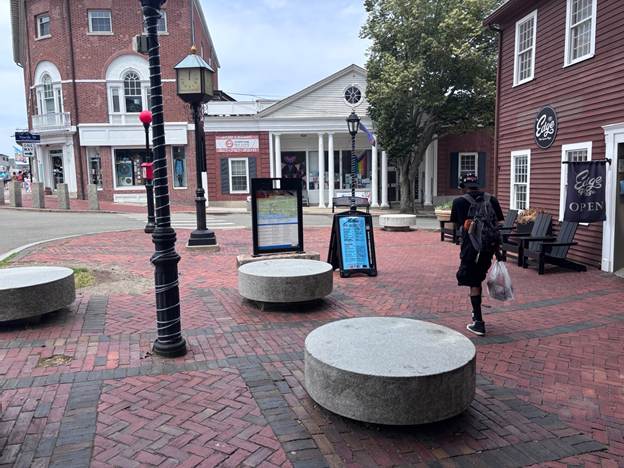
Vayo pointed to another simple improvement, funded by Park Plymouth, that he says will encourage more people to migrate to downtown from the waterfront: banners telling people how many minutes it takes to walk to restrooms, restaurants, shops, cultural venues, and historic sites.
These initiatives come as the town is planning a transformation of Court and Main streets that will improve walkability, pedestrian safety, aesthetics, and climate resiliency. Town Manager Derek Brindisi hopes the work can begin in December.
“It will improve the face of Plymouth once that’s done,” Vayo said. “Because we are behind the times when you compare us to Portsmouth [NH] or some of those other towns that have a phenomenal downtown or waterfront.”
The main goal of the project, said Michael Cahill, Plymouth’s climate resiliency and sustainability planner, is to reduce the urban heat island effect downtown, which lacks many trees, and improve the management of stormwater through rain gardens that will allow the town to capture and treat water before it flows into the harbor.
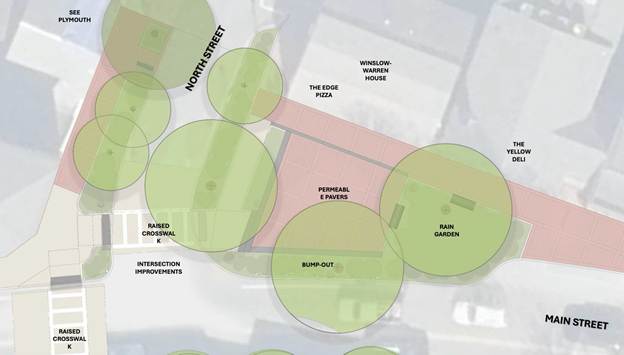
The project will also add raised crosswalks and bump-outs, Cahill said.
Like Vayo, Brindisi and Cahill point to Portsmouth as a model for Plymouth to emulate. The small southern New Hampshire city – a fraction of the size of Plymouth – has a wider range of eclectic shops and restaurants, as well as more shaded areas, and a performing arts venue that far outstrips the deteriorating Memorial Hall.
Cahill also cites Lancaster California’s boulevard redevelopment as a case study for conversion of a motor vehicle corridor to a pedestrian-friendly one. Five lanes of traffic were reduced to two and a tree-shaded walk was added to the center of the boulevard. Court and Main streets have just two lanes of traffic to begin with, so no center walk is possible, Cahill said. But more tree coverage is doable.
“Although this is a sustainability project, we’re really redesigning the entire downtown to make it a more economically friendly and viable location for businesses to come in,” Cahill said.
Cahill estimated that downtown Plymouth only has 74 trees. The town anticipates that it will add more than 70 between Shirley Square and Samoset Street.
Permeable pavers, also known as pervious pavers, and rain gardens will be installed in in several locations. They will allow rainwater to percolate through to the harbor rather than letting it go into drains. Plants in the rain gardens will filter the water. Underground streams running from Burial Hill to the harbor have for centuries been an issue.
Two large bump-outs will be placed in front of Memorial Hall to improve pedestrian safety, as well as another in Shirley Square, in front of the Yellow Deli and The Edge Pizza. Both will include rain gardens.
“The thought behind a bump out is rather than just walking directly out into traffic, you have a little bit of a better vantage point that improves pedestrian safety,” Cahill said.
The town plans to plant 11 trees in Shirley Square where there are now three.
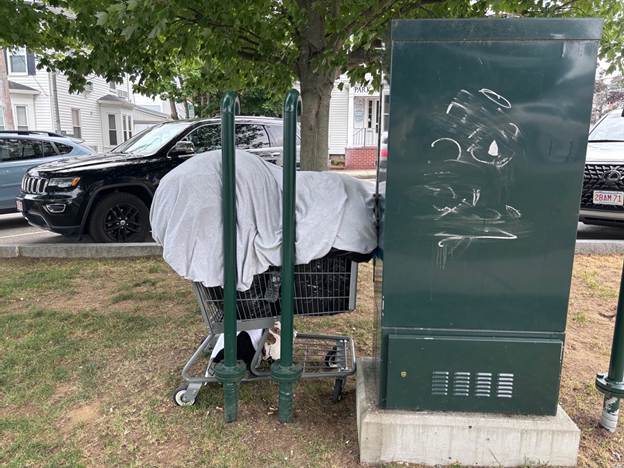
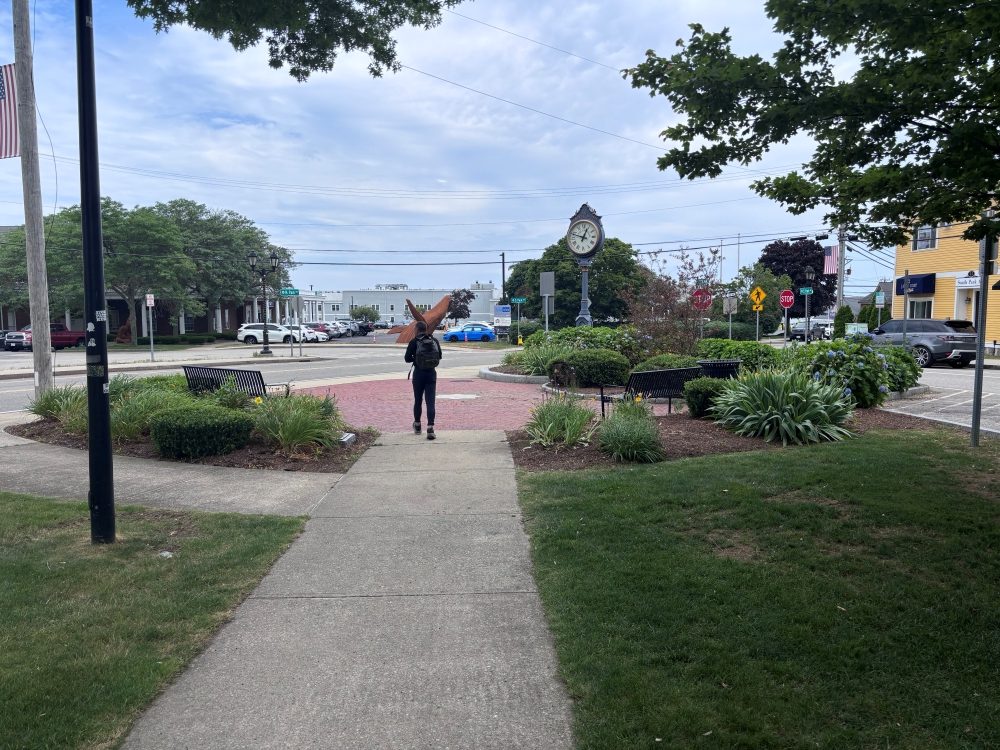
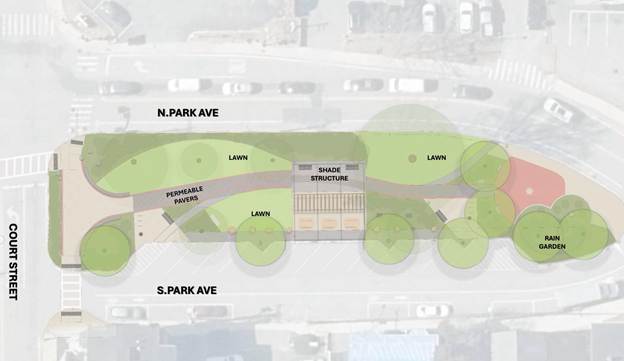
It is also planning major improvements to the little-used Depot Park, where Court Street meets Park Avenue and Samoset Street.
“Currently there is a park here,” Cahill said. “It doesn’t provide much value in its current condition. Not the most inviting park right now.”
It’s also become a hangout for unhoused residents, prompting complaints from neighbors about trash and even public defecation.
The town wants to make the park more pedestrian friendly by putting in pervious pavers, removing diseased trees and adding others, and constructing a path with embedded railroad ties and a covered pergola with string lights.
“The idea behind that is to make this feel like a train station again, a little bit of a covered area that has shade, allowing people to cool off,” Cahill said.
Contrary to what some businesses looking to expand outdoor dining had hoped for, Cahill does not anticipate that sidewalks will be widened in many places beyond the bump outs. Some parking spots will be removed and others added, he said, but most parking on Court and Main will remain.
Brindisi said drop-off locations are being considered, too.
“Say you wanted to bring somebody who’s more senior down to one of the local restaurants,” he said. “If we have these drop-off zones with a bench, you could pull into the drop-off zone. You could have that person get out, sit there, go park behind Town Hall, and then meet them at the drop-off zone.”
To fund the work, the town has applied for a $3 million grant through the state’s Municipal Vulnerability Preparedness program. Town Meeting will be asked to fund another $1.5 million. If the funds come through, Cahill anticipates construction could begin in December, continue through spring 2026, pause for the summer to give businesses a break, and resume in the fall, with completion projected in spring 2027.
But that’s only the beginning. Once it has completed the first phase of the project, the town plans to improve Courthouse Green in front of Town Hall, Town Square, and the Main Street Extension parking lot, which is unsightly, cramped, and increasingly angled toward Town Brook below it.
Fred Thys can be reached at fred@plymouthindependent.org.