
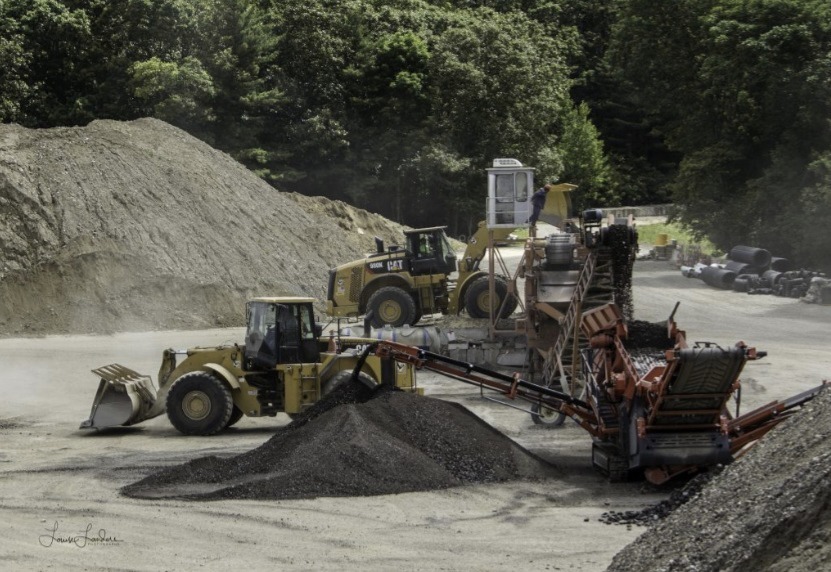
The scale of global ecological collapse can feel overwhelming to face, but the destruction of the planet is harder to ignore when it is happening in our own neighborhoods.
There are at least 110 documented sand and gravel mines in the Plymouth-Carver Aquifer region, with at least 44 located in the colonial borders of Plymouth. I say colonial because these borders did not exist prior to the genocidal and ecocidal processes of settler colonization that commenced a few hundred years ago and which continue today.
I believe in the importance of facing the destruction and excavating its root causes if we are to attempt to co-create a healthier bioregion for the future generations. To do less is conducive to false solutions and meaningless greenwashing. The critical inquiry that I advocate for necessitates looking at sand mining through a systemic and historical lens.
Neoliberal capitalism emerged in the 1970’s as a response to the contradictions between democratically governed nation-states still partially responsible to their citizens, and a global economic system organized around profit-seeking corporations and financial capital. This phase of capitalism – neoliberalism – emerged as an attempt by the Western elite to complete the enclosure of whatever commons/public resources were still being protected by the liberal nation-state.
Since the 1970’s, a primary feature of neoliberalism has been the relentless privatization and commodification of social life and the natural world. These processes are often advanced through relationships and decision-making processes that limit meaningful public participation and democratic oversight.
While neoliberal capitalism is a global world system, it appears to manifest locally as town officials and zoning boards sanction ecological desecration for the short-term profit of a few so-called “developers,” despite overwhelming public opposition and ceaseless evidence of escalating ecological collapse.
For example, acting as a quasi-governmental entity through its blurred relationship with the town, the Plymouth Foundation uses public resources to funnel common and unceded indigenous territories and public lands into corporate hands for the sake of private profit and so-called development. Such hollowing out of public resources and common lands to advance the capital accumulation of a few is a hallmark of neoliberalism.
As the late anthropologist Patrick Wolfe and many Indigenous scholars have explained, settler colonization is not a historical event but an ongoing process replicating in the present day. While the theft of local Indigenous territories predates this iteration of capitalism, neoliberalism furthers continued colonization.
The privatization and closed-door sale of a portion of the Herring Pond Great Lot to the Plymouth Foundation for $1 in 2022 – which then generated $3.4 million through a sand-mining purchase – is just one of many instances of hundreds of years of colonial land theft by the municipal, State, and federal colonial government.
The egregious sand mine operating within this unceded indigenous territory is one of many, and it is, in my opinion as based on robust academic literature, an act of active colonization as facilitated by the neoliberal state.
If history is a teacher, then colonial governance regimes that relentlessly sanction the destruction of the Earth are not up to the task of facilitating the ecological regeneration and climate adaptation that is urgently needed today.
However, hesitantly giving the benefit of the doubt, the Select Board has an opportunity to begin the process of socio-ecological repair within the Herring Pond Wampanoag Great Lot in Cedarville through its decision regarding the 138 acres up for sale, as reported by the Plymouth Independent on June 4th.
A bare minimum first step toward reconciliation and healing would be for the Select Board to recommend the town assign its Right of First Refusal to the Community Land and Water Coalition (CLWC) so the land can be conserved. While the town could acquire the land for conservation itself, partnering with CLWC is more justice-aligned given CLWC’s active relationship with local Tribes and a greater likelihood of stewardship collaboration with Indigenous community members within these unceded territories.
Yet with the conflicts of interest involved in this decision as reported by the Plymouth Independent on June 4th, neoliberalism might prevail as it does in far too many land-use decisions at all scales of the colonial state.
Despite the egregiousness of colonial-capitalist destruction, there is another way to live on these lands – millennia of place-based Indigenous lifeways are proof. Yet the commodification of earth is not commensurable with this way.
For those of us who are not indigenous to these lands, our ancestors too once lived in right-relationship with earth before their common lands were enclosed and commodified. Excavating the histories of colonization within our own ancestries—rather than the sand beneath our feet—may help us better understand the systems driving ecological destruction in all its forms on the lands we inhabit today.
Only by confronting the histories, systems, and colonized mentalities that drive these reckless land-use decisions, can we begin the work of socio-ecological repair and restore balance within the web of life that sustains us.
– Julia Chase
Chase lives on ancestral homelands of the Wampanoag people and is a graduate student of Anthropology conducting research on local sand mining. If you have been impacted by sand mining and wish to share your perspective with her, she can be reached at jchase@mymail.ciis.edu.