
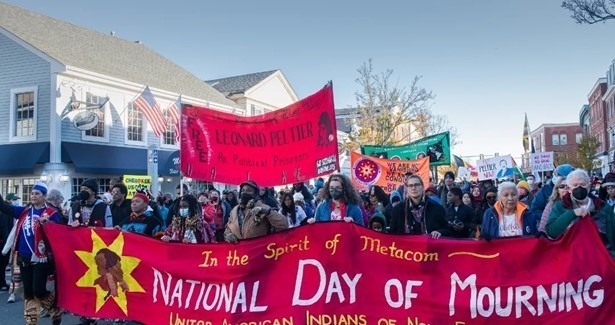
Many Indigenous people and their allies do not celebrate the U.S. holiday known as Thanksgiving. Since 1970, people have been gathering at Coles Hill to instead commemorate the National Day of Mourning (NDOM), where the genocide of millions of Native people and ongoing settler-colonial land theft and ecocide is honestly acknowledged and grieved.
In 1997, participants of NDOM were met with violent police brutality and the suppression of free speech. In exchange for dropping a civil rights suit against Plymouth, the United American Indians of New England (UAINE) came to an agreement with the town in 1998 which includes UAINE’s right to rally and march every Thanksgiving without obstruction from the town, and for the town to provide a stage for the gathering’s speakers.
On Nov. 10, 2026 the Plymouth Selectboard voted to cease compliance with the 1998 settlement agreement by refusing to provide a stage and attempting to constrain where participants can gather.
Mahtowin Munro, co-leader of UAINE explains that, “Under the terms of the 1998 agreement, we have a right to choose our own march route, yet the Town has repeatedly tried to insist that we should allow ourselves to be pushed into the far corner of a park so that we will be less noticeable. We believe they are throwing up roadblocks because they don’t want the tourists to see or hear Native Americans who are speaking about the true history of the Pilgrim invasion and resulting land theft and genocide of Wampanoag and other Native peoples.”
Attempts to make NDOM less visible are on brand for a town that continues to privatize and enable the desecration of unceded Indigenous lands (including open pit mining in the Herring Pond tribes historic reservation land).
Such attempts to conceal the collective public acknowledgment of histories of genocide are strategic for a town whose tourism revenue depends on distorted and sanitized histories of settler-native relations.
Jean-Luc Pierite, the president of the board of directors of the North American Indian Center of Boston, said, “As long as Plymouth invests in the memorialization of settler colonialism, the town should further observe its obligations to Indigenous people.”
Not only does the town profit from a tourism industry that sanitizes history, it actively continues to engage in land grabs and ecocide. There is a jarring level of hypocrisy evident in the Plymouth Select Board’s recent celebration of the Herring Pond Wampanoag tribe’s state recognition, as they simultaneously continue to permit extractive projects on tribal lands and now seek to repress UAINE’s National Day of Mourning march.
UAINE is asking supporters to contact the Plymouth Select Board via selectmen@plymouth-ma.gov and let them know that they need to honor their agreement with UAINE.
If you value free speech, the right to publicly assemble, and appreciate the importance of Indigenous rights and sovereignty, contact the Selectboard and urge them to honor their 1998 agreement with UAINE.
– Julia Chase