
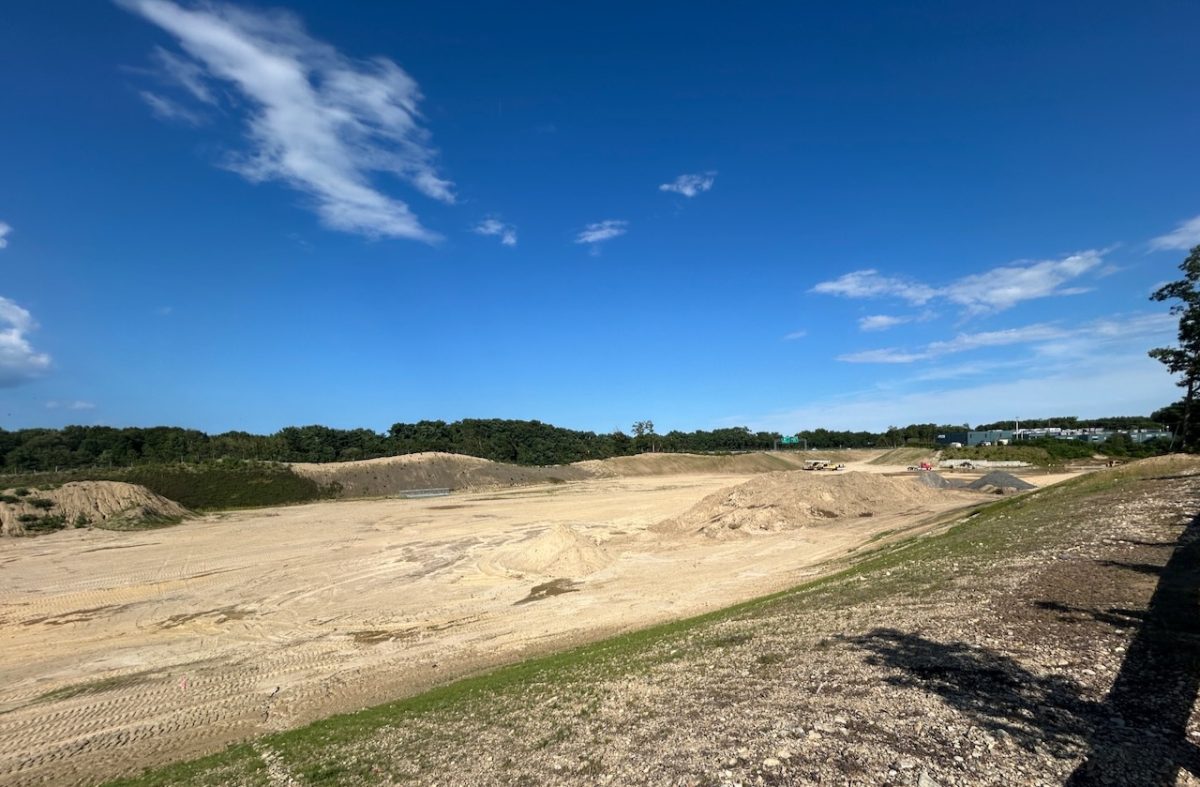
Digging stopped last December at what was expected to be the largest expansion of the Plymouth Industrial Park in decades. But since then, the 19-acre site – visible from Route 3 south of the Kingston border – has been quiet, with sand dust clouds periodically blowing across the highway.
The developer says the project is taking longer than expected but remains on track. Some local officials, though, say the lack of progress is troubling and should prompt the town to revise its bylaws on earth removal to better manage large projects in the future.
Environmental activists claim the real intent of projects like these, in Plymouth and surrounding towns, is to mine sand—a valuable commodity used in many agricultural and construction processes.
“I didn’t buy it to get rid of the dirt and walk away,” said property owner and developer Scott Spencer. “This is industrial land, and I want to do something special that’s good for the economy and good for the town’s tax base. I was born and raised in this town, and I actually care.”
Excavation of the once rolling site began in early 2022 after a lengthy town permitting process and a failed appeal by the environmental group Save the Pine Barrens Inc. objecting to the amount of sand and gravel that was to be removed from the property.
During the permitting process, the Planning Board designated the site as a “unified complex,” a provision of the zoning bylaw that allows multiple buildings on one lot to share parking, drainage systems and utilities. The provision’s intent is to maximize development on the town’s relatively scarce commercial and industrial land.
Spencer submitted plans for a phased development that would eventually include multiple buildings for manufacturing and other light-industrial uses. The first was supposed to be a 137,500-square-foot facility for Northeast Traffic Controls, a company he founded in 1994 that is now based on Scobee Circle, at the other end of the industrial park.
But Spencer sold a controlling interest in Northeast Traffic Controls in December 2022, and the new owners decided not to move the company.
“The intention to move was there,” Spencer said. “But after we started this project, I was approached by another company, and I decided to sell [Northeast].”
With the first tenant for the development out of the picture, Spencer stepped up marketing the site to other potential tenants while earth removal continued.
To level the site, Spencer was granted a permit to remove 488,000 cubic yards of material over the course of two years. That work extended to three years, with a total of 445,318 cubic yards ultimately removed, according to an April 8 letter from Atlantic Engineers of Sandwich reporting to the town the results of their “as-built topographical survey to estimate the total material removed.”
“There is no reason why they had to completely excavate and take that much sand and gravel,” said Planning Board member Frank Mand. “They could have done this so differently and in better ways.”
For example, Mand said, the area could have been built out in phases using the existing rolling topography, keeping more of the natural features of the land and protecting recharge areas for the town’s drinking water aquifer.
Spencer disagrees.
“We looked at those scenarios and they don’t work,” he said. “It would cost at least $4 million in additional site work, moving land around to level some areas and fill some areas up to 60 feet to make it buildable. And that’s why nobody did it. It’s not feasible.”
Mand, who returned to the Planning Board in May after winning a seat in the town election, was also on the board when Spencer’s project was initially reviewed and approved. Mand, though an anti-sand-mining advocate, voted in favor of the project at that time.
“I knew that I had lost. The rest of the board was supporting it, so I tried to get it improved with conditions we put on the project,” he said.
A total of 22 conditions were imposed on the project, including limits to the amount of earth removal and a requirement for finished landscaping to stabilize the site. In hindsight, they were not strong enough, Mand said.
“Looking at that site now, it is clear to me that their intent was for the sand and gravel, that was their focus,” Mand said.
Spencer said Mand is wrong. Selling off the sand and gravel netted about $1.6 million, Spencer said, which helps defray some of the costs to design and build the infrastructure for the development. “It helps make this a feasible project. It’s basically a wash for all the soft costs and site work,” he said.
Newly elected Select Board member Bill Keohan was on the Zoning Board of Appeals in 2022. He voted in favor of the Spencer project, even though he was skeptical about the scale of the earth removal.
“I can’t vote to deny something just because I don’t like it,” Keohan said. “There are competing interests and sometimes it’s better to approve a project with orders of conditions that address residents’ concerns.”
Keohan said he wants the town to make sure the conditions imposed on the Spencer project are being enforced, including adding landscaping to stabilize the exposed sand areas as soon as practical. A line of trees and bushes running along the border with Route 3 is also required to screen the site from passing vehicles.
Steven Bolotin, current chair of the Planning Board, attended the early meetings on the Spencer development as an alternate board member. He said a buffer zone along Route 3 with significant plantings was a priority.
“There was a lot of commentary from Plymouth residents about that area being a gateway to the community and they didn’t want it looking like an industrial zone,” Bolotin said.
Jason Silva, Plymouth’s director of inspectional services, told the Independent that his office is monitoring the Spencer project. He believes that while the project is moving slower than planned, it is in general compliance with the approved permits.
“We can’t force people to build things,” Silva said. “And when it comes to enforcement of permits, we don’t want to be punitive. We look for voluntary compliance.”
Silva said he spoke with Spencer recently to ask about stabilizing the open sand slopes on the property and was told that hydroseeding of those areas was underway.
“The last thing I want to see is dust rolling across Route 3,” Silva said.
Bolotin said enforcing all requirements of town bylaws and specific conditions of a particular permit is essential to “get the type of development that we approve.” And it’s in the town’s best interest to fully build out the industrial park, he said.
“We have limited land zone for commercial use and it’s very important that we utilize that land for commercial development,” he said. “The number one issue people have now is the affordability of this community. We should be encouraging the right types of businesses to come to Plymouth that provide a tax base, services the community needs, and jobs that allow people to live and work in Plymouth.”
Looking forward, Keohan wants to establish a sand and gravel working group to review the town’s bylaws and recommend updates.
“Sand is more valuable now than it was many years ago,” Keohan said. “We have learned a lot having gone through so many of these earth removal projects and now is the time to look at the existing bylaw in light of what we have learned since we first implemented it.”
Meanwhile Spencer said he remains optimistic about the success of the development. He said people can expect to see progress soon.
“I am still working on securing good tenants for that location and that’s an everyday process,” he said. “Lawrence-Lynch (company) will start putting in the road from Collins Avenue in a few weeks. They have the permits in hand for the street and infrastructure. You can already see them staging the drainage pipes and materials on site.”
Michael Cohen can be reached at michael@plymouthindependent.org.