
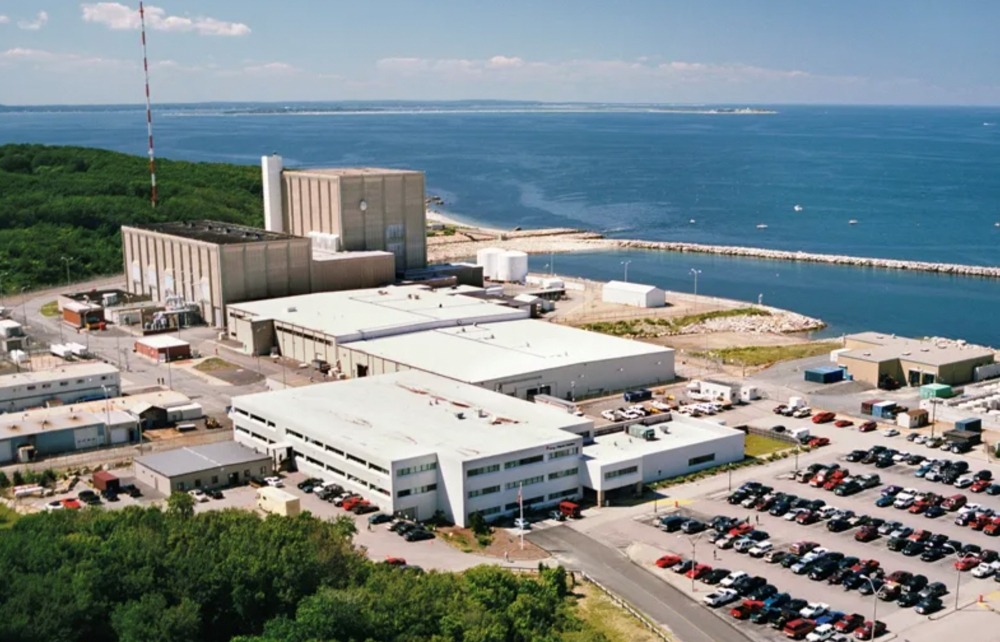
A Harvard University professor whose team recently published a study on the cancer risks near nuclear plants has been tapped to conduct a federally funded effort to measure radiation surrounding the decommissioned nuclear power plant.
The research team – led by Petros Koutrakis, professor of environmental sciences at the Harvard T. H. Chan School of Public Health – plans to install five radiation monitors in Plymouth and other nearby communities and also take blood samples from volunteers in the community and monitor air filters in furnaces in the volunteers’ homes.
The new study, believed to be the first of its kind conducted near a decommissioned nuclear plant, is funded by a $700,000 federal grant to fund the first year of the study awarded to Greater Boston Physicians for Social Responsibility, an advocacy group of doctors concerned about nuclear contamination.
“This is the first study that’s been done after reactors have been decommissioned that we know of,” said Anna Linakis, the group’s executive director.
Linakis said her group is still awaiting the contract from the federal government, and Koutrakis anticipates preliminary results after a year but predicts more complete results will take longer.
The Program for Global Public Health and the Common Good at Boston College and the Massachusetts Medical Society will collaborate on the study, as well as community groups such as Save the Bay, Cape Downwinders, and Pilgrim Watch, Linakis said.
She said the funding for the grant was earmarked by three members of the Massachusetts congressional delegation, Senator Elizabeth Warren, Senator Ed Markey, and Representative William Keating.
In December, Koutrakis’s team published a study of 18 years of cancer data from residents near Pilgrim and six other New England and New York nuclear power plants.
Researchers estimated about 20,600 cancer cases could be attributed to those living near a nuclear plant.

“We found that living near nuclear power plants increases the risk for cancer,” Koutrakis told the Independent in December after the study was released.
The Pilgrim Nuclear Power Station in Manomet was built in 1972 and ceased operations in 2019 when its owners at the time – Louisiana-based Entergy Corporation – cited market conditions and increased costs, including tens of millions of dollars in necessary safety upgrades.
At its height, Pilgrim was among the most controversial nuclear plants in the nation. After a series of shutdowns because of recurring equipment problems, the U.S Nuclear Regulatory Commission (NRC) in 2015 called Pilgram “one of the worst-run” nuclear power plants in the country.
After it closed, Entergy sold the station to Holtec Decommissioning International, which is overseeing the lengthy process of decommissioning the plant.
“The decommissioning work at Pilgrim continues according to NRC regulations and with strict oversight from state and federal regulators,” said Holtec spokesperson Patrick O’Brien in an email. “The NRC inspection reports and annual environmental reports continue to show compliance and adherence to our goal of a safe, efficient decommissioning to allow the property to be ready for whatever the next iteration may be for future reuse.”
Fred Thys can be reached at fred@plymouthindependent.org.