
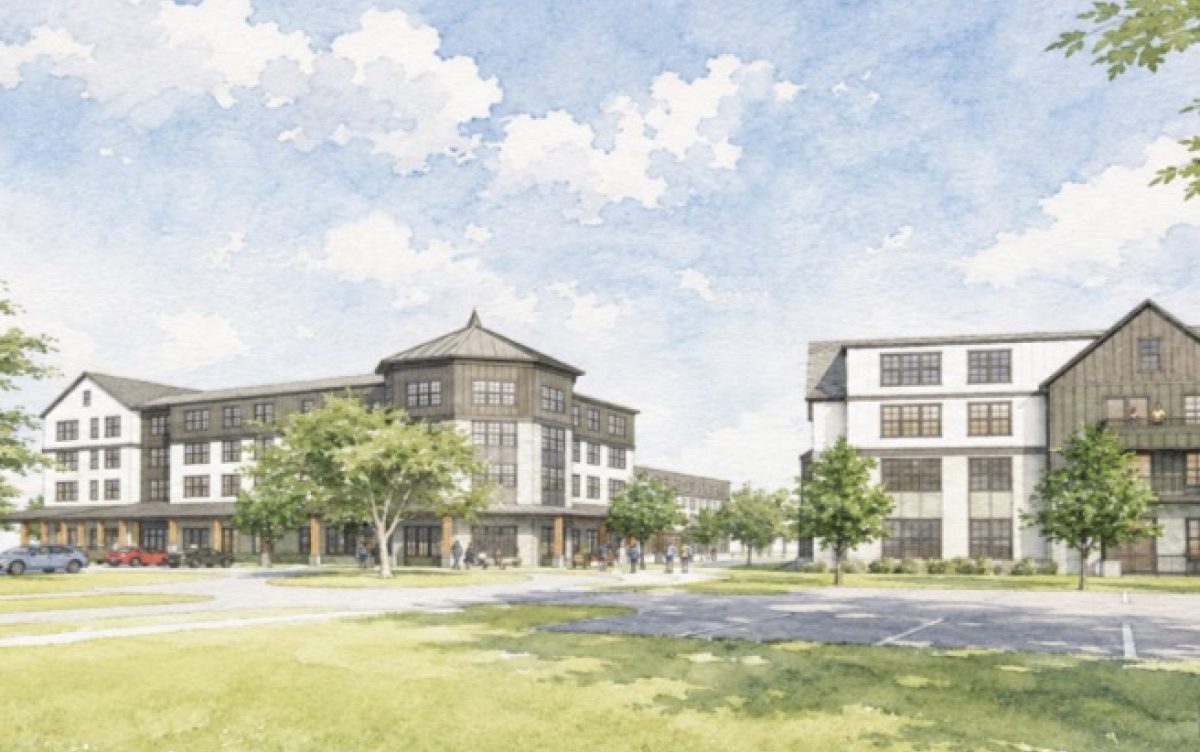
How can the town stop the proliferation of affordable housing complexes that have strained services and roiled neighborhoods over the last decade?
By building more affordable housing.
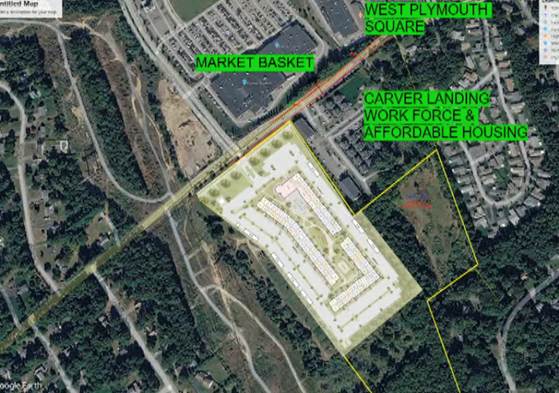
That was the pitch developer Rick Vayo made to the Select Board during a presentation last week detailing plans for Darby Farms, a 392-unit apartment complex he’s proposing for a former farm off Carver Road in West Plymouth, across from the Cranberry Crescent shopping plaza.
Vayo’s Megryco Inc. wants to develop the land under the state’s controversial 40B law, which allows builders to sidestep many local regulations if they designate at least 25% of housing units as “affordable,” based on household income limits.
But unlike so-called hostile 40B efforts – notably the battle over Pulte Homes’ attempt to force a three-building, 163-unit complex into densely-populated North Plymouth – Vayo’s project has so far been greeted with enthusiasm by officials.
The reasons are several, but at the top of the list is this: Thanks to a quirk in state law, all the apartments would count toward Plymouth’s affordable housing stock, not just the 25% leased at below-market rents.
The town already is in a two-year “Safe Harbor” moratorium period for 40B projects because it reached “certain housing development thresholds” and has developed a Housing Production Plan, Assistant Town Manager Lauren Lind said Thursday. But Darby Farms would push it above the state’s 10% threshold for affordable stock, giving Plymouth latitude to keep hostile 40Bs at bay until the 2030 census figures are released.
“It’s not about just staying in Safe Harbor and saying no to developers,” Town Manager Derek Brindisi said Thursday. “It’s saying, ‘Listen, we’re now in control, so if you want to develop in this community, then you have to propose a project to us that we think is a benefit to this community.’ No more of the days of Oasis [a hulking 40B housing complex near Home Depot] and Pulte coming forward and saying, ‘We don’t care what the community thinks. We’re going to build it anyway because the Massachusetts General Laws allow us to.’ And that’s been the situation this town has dealt with for decades.”
Vayo’s project is considered a “friendly” 40B, meaning he is willing to work with the town to mitigate the impact of the nearly 400 apartments on traffic, water, and public safety services. To that end, he already has agreed to pay $1.2 million for the “permitting, design, or construction of improvements” to the West Plymouth water system, $600,000 to match a state grant to hire eight firefighters, $500,000 for “improvements to the Cranberry Crescent sewer pump station,” and $200,000 for a new recreational space in the area.
In addition, 67% of the 32-acre parcel would remain open space, and there would be no gravel removal, a source of concern for environmentalists and land preservation groups.
“What we’re developing is what has fundamentally already been developed by the farm that’s been there for many, many years,” Vayo told the Select Board during a lengthy meeting last Tuesday.
He said a study showed there would be “minimal” traffic impact – about 1,000 trips daily – because Carver Road is a major route designed to accommodate it. Plans call for lane changes and other improvements for the intersection at Market Basket aimed at keeping vehicles entering and leaving the apartment complex from creating congestion.
“It is a big development, there’s no doubt about it,” Vayo said, “but because of its placement, most traffic is either going directly across the intersection to the highway by Commerce Way or taking a right, headed toward downtown.” Few vehicles would travel into the residential neighborhoods of West Plymouth, he said.
Select Board member Kevin Canty agrees.
“Carver Road down to Samoset to downtown already handles a large volume of traffic. This is going to be a drop of water in a pond,” he said. “We’re not talking about a 40B down in Atlantic Country Club territory. That’s an existential threat to those areas. Those are country roads.”
He was referring to a Duxbury developer’s bid to buy the South Plymouth golf course to build hundreds of housing units. That plan appears to have been thwarted by the town, for now.

Like Canty, Brindisi contrasted Darby Farms with the Atlantic Country Club proposal.
Vayo’s project “is ideal because we already have water and sewer infrastructure in that area,” he said. “The streets and sidewalks, although they have to be modified a little bit, are already in place. It’s so very different than the project that we were faced with a year ago with the Atlantic Country Club, where developers were looking to acquire that and build 400 units with no infrastructure.”
Darby Farms would feature one-, two-, and three-bedroom apartments, along with a pool, gym, workspaces, and other amenities commonly found in higher-end complexes.
Rents for units designated as affordable would range from about $2,200 to $2,800. Market-rate rentals are expected to be between $2,500 and $3,100.
The state’s definition of “affordable” is confounding to many people. It’s tied to income limits based on the “area median income,” or AMI. Plymouth is lumped in with the Boston-Cambridge-Quincy-New Hampshire region, which tends to skew the figures because it includes affluent communities ringing the city. For example, under the current measures, a single person earning up to 80% of the AMI, or $96,000, would qualify for a Darby Farms affordable apartment. For two people, the income limit is $109,700, and for a household of four it’s $137,100.
Even at those levels, rent often accounts for a disproportionate share of take-home pay, especially with the steep cost of food, fuel, insurance, utilities, and other essentials.
The 80% equation is “not affordable to most people,” Vayo acknowledged in an interview Thursday, “but it’s just what we have to live with.”
Canty said creating more housing stock that is “actually affordable” is crucial.
“It’s those 35-and-unders that I’m particularly worried about,” he said in an interview Wednesday. “These are people that grew up here, that want to stay, that can’t afford to because there’s nowhere for them to go.”
The situation, of course, is not unique to Plymouth. Massachusetts has faced a housing shortage for many years. Planners say one way to alleviate it is by increasing housing stock, thus better matching supply with demand and slowing the rate of housing cost increases.
In praising the Darby Farms plan during last week’s meeting, Select Board member David Golden noted that Vayo, a Plymouth resident, “is willing to live in the places he’s developing.” The implication was he has a greater stake in the outcome of his projects than out-of-town developers like Pulte that outsource management of complexes once construction is finished.
“If we’re going to get ahead of this problem, we need to be working with folks who appreciate Plymouth, and I think you do that,” Golden said. “So, I’m looking forward to supporting this.”
Select Board Chair Deb Iaquinto stressed the urgency of moving swiftly to stem the tide of less appealing 40B projects that have marred landscapes, caused congestion, and generated an increase in police calls.
“This is an opportunity that we can’t pass up,” she said during last week’s meeting. “We would be irresponsible if we turned the other way and did not act on this immediately…We’ve all been working very hard to try to reach that first threshold of the 10%.”
“What you’ve laid out here is, to me, a win-win-win-win-win all around,” she told Vayo. “Not just for the town [and] its affordable housing strategy, but for people who are looking for affordable housing and would really welcome the opportunity to live in an area that’s beautiful and very close to a lot of amenities.”
On Thursday, Vayo tried to put Darby Farms in perspective. He called it “the most well-rounded and well-thought-through development that’s hit Plymouth. There’s nothing even close. What’s great about this project is it came together out of a need for the town to solve a problem.”
Although the Select Board has no say in whether permits for the project are approved, its support matters. The board is expected to sign a development agreement with an LLC set up by Megryco and send a letter of support to the state. Pending state approval – mostly a formality – the plans will come before the Zoning Board of Appeals for a public hearing on whether to grant a comprehensive permit. That permit would allow work to begin.
The process could take six months, and issues are bound to arise, but at this point the consensus seems to be one of unbridled enthusiasm, a rarity in local government. Depending on the ZBA’s timeline, Vayo said, he hopes to break ground within nine to 12 months.
Canty said the money the developer is offering to hire more firefighters and improve infrastructure would free up funds the town desperately needs elsewhere.
“He’s setting aside money for things the town needs to do anyway,” he said. “So that’s a win there.”
Lind called it a “unique scenario.”
“You have a local developer with an interest in the community. It’s not just somebody who is going to build and sell,” she said. “Mr. Vayo has a longstanding reputation in the community. In addition to checking the boxes of meeting the affordable housing strategy, providing different types of units, and helping us get to the [10% mark], it’s going above and beyond that to have a larger benefit to the community.”
Mark Pothier can be reached at mark@plymouthindependent.org.