
North Plymouth residents are asking state and federal regulators to investigate a controversial affordable housing proposal, arguing the 163-unit Pulte Homes complex poses serious risks to people and the environment.
More than 270 Plymouth residents have signed a petition, requesting the state Department of Environmental Protection and the US Environmental Protection Agency step in to determine the potential impact of the project’s three buildings — the largest of which would sit next to a still-monitored EPA Superfund site.
The petition – drafted following an Independent story about the project’s proximity to the contaminated site – is just the latest development in a monthslong effort to delay and – ultimately – torpedo the project.
Opponents also turned out at a Feb. 9 public hearing before the Plymouth Zoning Board of Appeals, which has delayed a vote on the developer’s permit application, but time is running out.
The public hearing period ends on March 29. After that, the board has 40 days to vote on the permits, according to the state’s 40B law, which set forth steps communities must follow when considering affordable housing projects. The board will likely vote at a meeting on April 6 or 13.
Among the opponents at the meeting were Select Board members Kevin Canty and Deb Iaquinto.
State Senator Dylan Fernandes has also been fighting the project.
“I have personally called on the state to halt the Pulte 40B project in North Plymouth,’ Fernandes said in an email to the Independent. “We will continue to raise environmental and community concerns to the state and work with the community for the project to not move forward.”
Under the 40B law, developers who agree to build affordable housing can bypass most local rules. A community can reject a 40B project only when at least 10 percent of its housing stock is affordable. As of early 2025, between 6 and 7 percent of the town’s housing was considered affordable.
Of the 163 units proposed for the Pulte project, only 41 units — 25 percent of the total – will actually be affordable, based on state guidelines.
And only those 41 will count toward the 10 percent benchmark. If the units were apartments instead of condos, all the units would count toward the benchmark.
Since hearings began in September, many residents have attended meeting to slam the project, which would be spread over almost three acres between Prince Street and Sandri Drive. They’ve cited increased traffic, lack of sufficient parking and a size grossly out of scale with the quiet tight-knit neighborhood lined with narrow streets.
They are now requesting a 90-day delay to give environmental agencies a chance to review the project.
But under state rules, such a delay won’t happen unless Pulte agrees – a concession zoning board members privately admit is unlikely given the developer’s continued effort to get the project off the ground.
In the past month, opposition has grown even stronger after the Independent wrote that one part of the project – a six story 63-unit building on Sandri Drive – is located next to a federal Superfund site still subject to five-year reviews.
The property also has a deed restriction, prohibiting the development of housing or recreational facilities.
In addition, the adjacent land where Pulte wants to build was found to be contaminated with arsenic, which the state ordered the property owner, Eight Mates LLC, to remove late last year.
DEP documents show Eight Mates LLC had 7,500 gallons of water containing arsenic removed from the site and 200 tons of arsenic removed from soil in the fall.
Long-term exposure to arsenic can pose serious health risks and is a known human carcinogen.
Neither Pulte nor the Sheehan family publicly disclosed these concerns.
A document obtained by the Independent also showed another parcel owned by Eight Mates – near the two 50-unit buildings proposed on Prince Street – also contained arsenic.
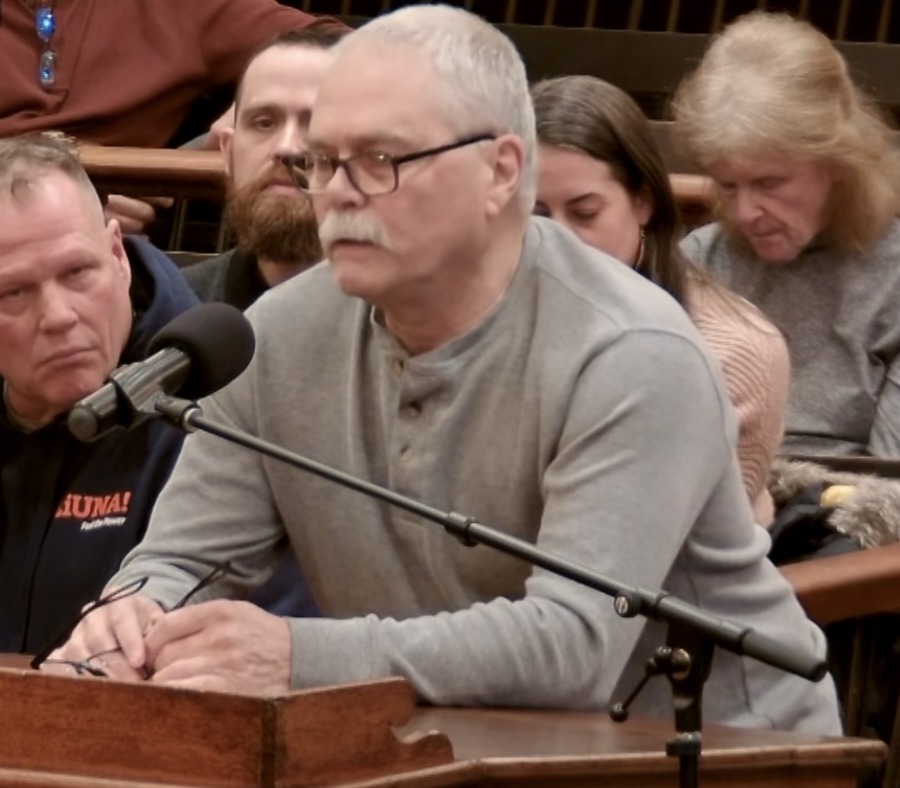
At a hearing Feb. 9, two residents who are also scientists – Rex Denton and Ed DePierro – raised questions about the potential for health risks at the Sandri Drive building.
DePierro, who described himself as a chemist, questioned how the EPA, in its most recent five-year review issued in 2023, found no contaminants had spread beyond the Superfund site.
Pulte recently discovered arsenic on a portion of the land they hope to build on, he pointed out. That arsenic was described as “historical,” meaning it must have been there for a long time. He suggested it may have migrated from the Superfund site.
“Why didn’t the EPA discover the arsenic?” he asked, questioning how far from the Superfund site the EPA engineers tested.
In addition, he said, methylene chloride, a commonly used solvent found at the Superfund site, can seep into and contaminate soil.
“So what happens when they have pile drivers and backhoes and they are doing this excavation?” he asked. “Now you have a residential complex on it. How do you remediate this with a big residential complex over it?”
But if residents want to stop the project, their only hope may be the ZBA. In recent responses to the residents, both DEP and EPA officials said they are unlikely to intercede.
“Any proposed redevelopment is an issue for the local municipality and community,” wrote Derrick Golden, an environmental engineer with the EPA’s Boston office, in an email to residents on Thursday.
ZBA members – including the most vocal critic, Ed Conroy – have made it clear they oppose the project.
There is a provision in the law allowing communities to reject a 40B project if it poses significant public health risks outweighing the need for affordable housing. The town’s lawyer, Carolyn Murray, has told board members such arguments are unlikely to sway a state housing committee, which Pulte would appeal to if the board denied the permit.
If the state housing appeals committee ruled for Pulte, the town would have a choice: Fight it in court or give up and possibly lose the right to impose any meaningful conditions on the project.
There are two permit requests before the ZBA – one for Sandri Drive and the other for the two 50-unit buildings proposed for Prince Street. The board has the power to grant or deny permits for all or part of the project.
Several residents, including two Select Board members, urged the panel to reject the permit request and let the process play out.
“I’m concerned the ZBA might approve Pulte’s permits because board members may believe fighting it would be too expensive, especially with recent budget concerns,” said Alex Cook, who lives on Prince Street.
“This is worth fighting,” he said,
Select Board member Deb Iaquinto agreed, saying the ZBA should “man up and just deny it.”
“We can’t give up,” she said. “There’s too much at stake. The community’s health is at stake. Public safety is at stake, and the environment is at stake.”
Canty suggested the DEP has an obligation to step in.
“Pulte is forcing this development into Plymouth using a state statute,” he said. “State statutes and regulations are meant to protect our environment and our residents and are our best hope of preventing Pulte from moving forward.”
Essek Petrie, a Pulte Homes representative who has appeared at each public hearing, did not respond to a request for comment. He has maintained throughout the process the project will benefit the neighborhood and the town.
A representative of Eight Mates LLC did not respond to a request for comment.
Andrea Estes can be reached at andrea@plymouthindependent.org.