
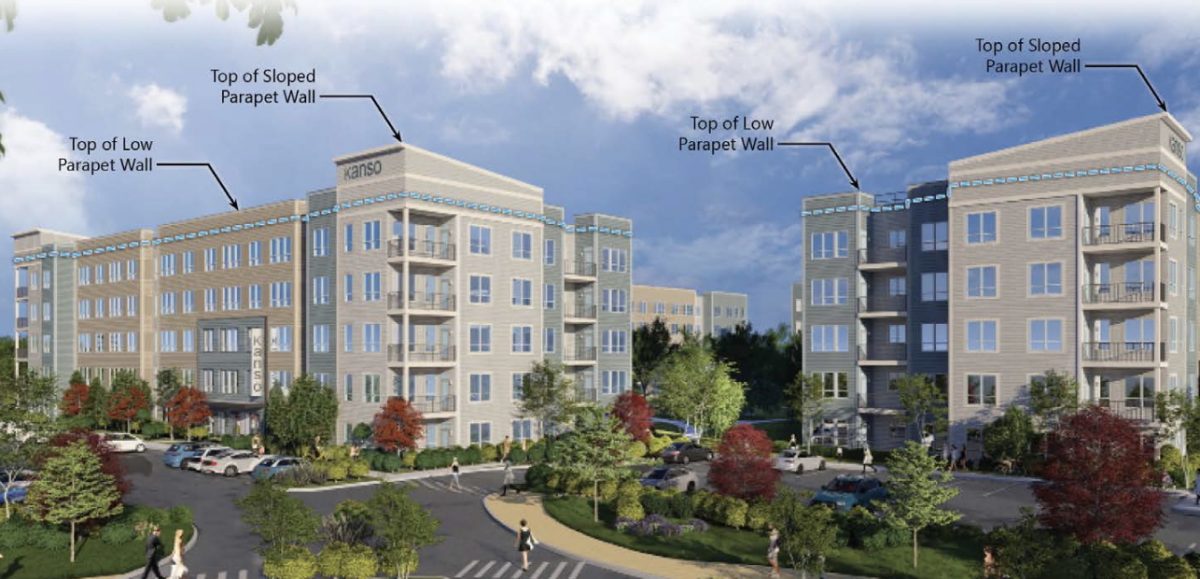
Apartment buildings in Plymouth generally must be no taller than 35 feet.
But AvalonBay’s proposed Colony Place project is different — it falls under the state’s 40b affordable housing law, making it exempt from most zoning rules. As a result, the residential complex may end up being almost twice as tall, dwarfing other buildings in the neighborhood.
A representative of AvalonBay Communities – one of the largest apartment developers in Massachusetts – recently told the Plymouth Zoning Board of Appeals that the company hopes to build Kanso Plymouth, a 300-unit, five-story, two-building complex which would top out at more than 60 feet — 59 feet, plus the possible addition of “parapets” on the roof. That could add between four and eight feet, for a maximum height of 67 feet.
Kanso Plymouth would be taller than neighboring residential buildings and even hotels in the area.
“It’s going to be a monster,” said Steve Johnson, a resident of Sawyer’s Reach, a 55+ condominium complex next door to the proposed AvalonBay site. “I’d like to see a floor taken down.”
This is the new incarnation of a project that was originally going to be a 55+ apartment building — partly three stories and partly four — with 198 units and amenities such as an outdoor pool and deck.
It wasn’t going to include affordable units, because state law doesn’t allow age restrictions in those projects. But the company, nonetheless, was going to donate $1.3 million to the town’s affordable housing trust as part of an agreement with the town.
That was until Claremont, the original developer, pulled out of the project in the face of lawsuits filed by residents of Sawyer’s Reach who opposed the project. They were aided by environmental lawyer Meg Sheehan.
Claremont presented the 40b plan to the Select Board, which approved it in December. By then the company had already decided to sell the property to AvalonBay and had a purchase and sale agreement in place at the time.
Avalon Bay is now shepherding the project through the permitting process.
It is looking to construct two buildings on nine acres — a plan that requires only a comprehensive permit from the Zoning Board of Appeals.
Seventy-five units would be classified as affordable – meaning they would be rented at below-market rates – even though under 40b all the 300 units would count toward the town’s affordable housing inventory. Plymouth would still not hit the 10 percent benchmark of affordable units that would allow it to reject future 40b projects.
The Select Board approved the project even though members generally oppose 40b developments. It had little choice.
“The state’s 40b law is hostile to the interest of towns,” Select Board Chair Kevin Canty told the Independent. “It forces Plymouth to allow overly dense residential developments, even in areas we want zero residential development, and leaves us almost no ability to protect the interests of Plymouth residents.”
But officials consider this project a “friendly” 40b because the developer has agreed to pay $2.75 million for a water booster pump and says it is willing to work with the town to address any concerns that may arise as the plan is finalized.
At a July 21 Zoning Board of Appeals hearing, some members seemed frustrated that they were unable to order major changes in the project — like shrinking its size.
“We can suggest. We can’t control anything,” ZBA chair Michael Main told the Independent.
“I’ve been on the board for over 20 years,” Main said. “Every major 40b that has come to the town, I’ve been involved in. They are very, very, time consuming and when you get right down to it, the community will end up with one. If a developer wants to build one, he’ll get one.”
Board members did take a stand on a few specific items — hoping that the company will agree to make changes.
They were dead set against AvalonBay’s plan to build 485 parking spaces, more than 100 of which would be nine feet wide instead of the 10 feet required by the town.
“Nine-foot parking spaces on the surface are not going to work at all,” Main told AvalonBay senior vice president David Gillespie at the meeting. “It’s not like you don’t have room. You have plenty of room. I can’t understand why you would want [nine-foot spaces],” he said.
The wider spaces, Main said, are “for safety because there still are a lot of very large vehicles on the road. I, for one, will not support this project with nine-foot parking spaces. I just won’t do it.”
And the board zeroed in on the proposed parapets — walls or a barrier at the edge of the roof that conceal mechanical equipment like air conditioning condensers and add architectural details.
AvalonBay is proposing parapets running the length of the buildings and sloping at the ends.
Even if the plan included only four-foot parapets, ZBA member Peter Conner said, “it’s massive — no matter what you do.”
Gillespie didn’t agree to make changes but suggested the company will work with the town to reach acceptable solutions.
Besides waivers from the town’s height and parking restrictions, AvalonBay filed for two dozen other waivers from town rules, including those dictating density, and setbacks.
For example, the density rule for multifamily buildings is 20 units per acre. In this case, AvalonBay is requesting 33.3 units per acre, according to ZBA documents.
If the developer won’t budge on parking or agree to other changes, the board can refuse to issue the permit. In that case, AvalonBay could appeal to a state board, a panel which has traditionally sided with developers, according to several town officials.
The board didn’t ask for specific details of the project — like probable rents or the interior finishes of the apartments. They are not subject to ZBA review.
But Sawyer’s Reach residents have been told what the affordable rents would likely be — between $1,958 a month for a two-bedroom apartment and $2,128 a month for a three-bedroom. To qualify for one of the 75 affordable units, a two-person household can make up to $83,400 a year, and a four-person household’s income can be as high as $104,200.
The rest of the apartments would be rented at market rates.
Even though the AvalonBay’s Kanso brand is described on the company’s website as “more streamlined,” with fewer amenities — and lower rents — than other Avalon complexes, rents at another Kanso building in Massachusetts are relatively high.
Kanso Milford is advertising market-rate apartments that rent from $2,360 a month for a one-bedroom up to $3,330 for three bedrooms.
For the town, approving Kanso Plymouth may come with a silver lining.
While the addition of the 300 units won’t push it over the 10 percent affordable housing benchmark, it would place the town in a “safe harbor,” allowing officials to reject 40b proposals for a period — between one and two years.
There are other 40b projects in the Plymouth pipeline, including a Pulte development in North Plymouth that the town has opposed, and a possible housing development on the site of the Atlantic Country Club in South Plymouth.
If Kanso Plymouth is permitted before the others, the town could reject them.
Another ZBA hearing is scheduled for Aug. 11.
Andrea Estes can be reached at andrea@plymouthindependent.org.