
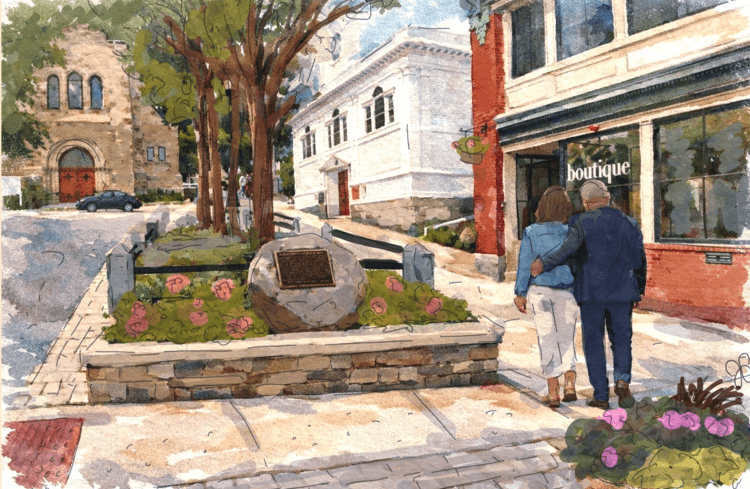
Ambitious efforts to return Town Square to some of its former pedestrian-friendly charm were unveiled at this week’s meeting of the Select Board.
Among the proposed enhancements include nine new trees, cobblestone pavement, and native landscaping, according to town planners.
“It is probably the most historical longitude and latitude in North America,” said Select Board member Bill Keohan, considered the board’s history buff.
Keohan noted it was at the location that Squanto first greeted the Pilgrims by saying, in English: “Welcome, Englishmen!”
But before the plans can move forward, the town’s climate resiliency and sustainability planner said, there are several obstacles to overcome.
A memorial to Wampanoag leader Metacomet must be relocated and planners must devise a way to deal with a steep grade leaving it out of whack with standards set by the Americans with Disabilities Act. There could also be issues with interference of utility lines.
Metacomet was the Wampanoag leader during King Philip’s war in 1675 and 1676.
Michael Cahill, the planner, said town officials are seeking approval from the United American Indians of New England to relocate the monument.
“We have reached out to UAINE and have had conversations with representatives but have not come to a final agreement on the layout,” Cahill told the Independent in an e-mail. “We will continue those discussions as we progress in the design process.”
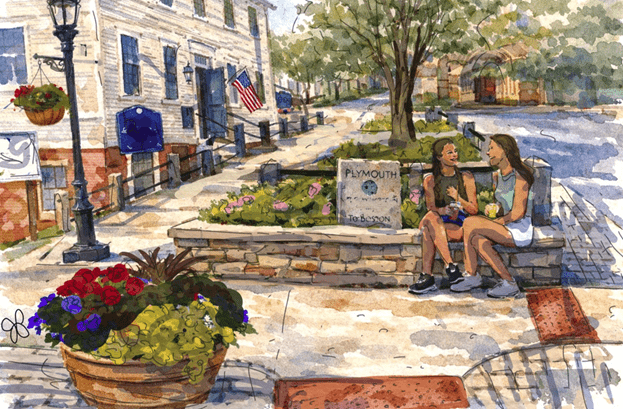
For now, the plans are purely conceptual, but they present a dramatic reimagining of what Town Square would look like and how it will be able to be used, especially by pedestrians.
David Gould, the town’s director of energy and environment, told the Select Board the11% grade is considerably steeper than the recommended 5% maximum for wheelchair walkways under the ADA.
Gould said a historical and archaeological study of the subsurface must be done before work could begin. Cahill explained the town would work with the Massachusetts Historical Commission.
“Our aim through this project is to balance preserving historical character with implementing climate resilient designs,” Cahill said.
The town’s engineering team is assessing utility records to determine which measures are possible on the site, given the location of water, sewer and electrical lines.
“Naturally, the location and depth of subsurface utilities will constrain our ability to implement tree plantings and other climate resilient features,” Cahill said.
Keohan urged Cahill and Gould to hold meetings to get public input into how to restore the square with historical materials.
The project is part of phase two of the downtown resiliency project, which also includes Courthouse Green and the Main Street Extension parking lot. Phase one covers Main and Court Streets from Samoset St. to Shirley Square.
In one sense, the project will restore the square to some of its original features, with shade trees and permeable pavement that allows the rainwater to seep into the ground before flowing on out into the harbor. Until the 1890s, four trees lined the square. The last tree fell in a storm in 1954 and was never replaced.
The square has not changed much since the 1960s, when an island was placed in the middle of the pavement. There are two trees on the island, but the rest of the square is covered with impermeable tar and cement. The proposed design would bring in nine new trees for a total of 11 and permeable cobblestones that would catch storm water, as well as native grasses and vegetation.
The changes would transform Plymouth’s oldest square from a bleak paved area unfriendly to pedestrians to a mix of walkways and green spaces under shade trees designed to draw tourists and locals.
The design and permitting phase of the project is projected to cost $175,000. Town meeting approved $60,000 in 2019 from community preservation funds. The town is seeking another $115,000 from Town Meeting coming up April 11.
There’s a way to go before construction of phase two can even begin.
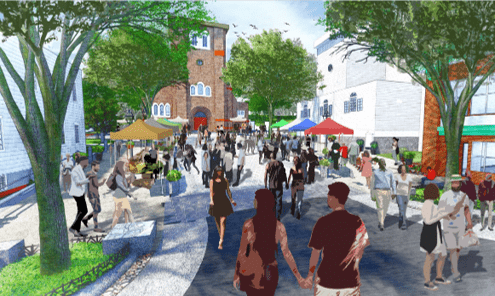
Construction of phase one has yet to be fully funded. The town was turned down by the state for a $3 million grant last year and has reapplied for that grant. Cahill told the Select Board the town should hear from the state by May whether it has received the funding. If the grant comes through, the town will ask the fall Town Meeting for another $2 million. Construction would begin in November and would be completed in the spring of 2028.
At that point the town would apply for funding for construction of Phase 2. If the funding comes through, the town would then go once again to Town Meeting for more funding. Construction would begin in the fall of 2028 and would be completed in the spring of 2030.
Fred Thys can be reached at fred@plymouthindependent.org