
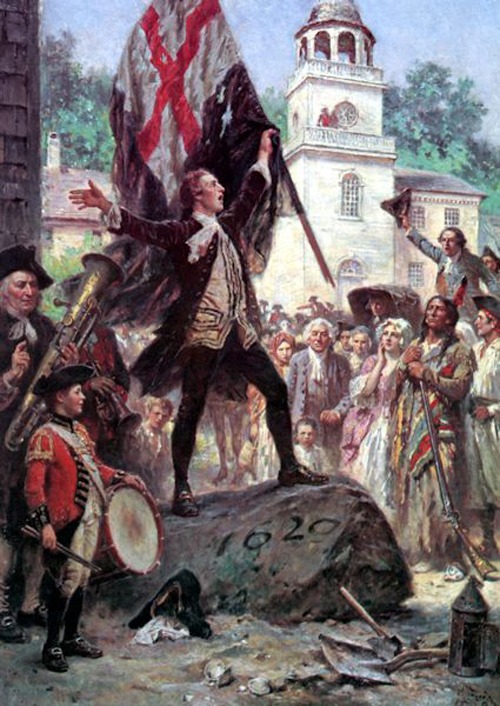
Long before the Continental Congress issued the Declaration of Independence, Plymouth was already a hot bed of revolutionary fervor. Patriots had hauled a chunk of Plymouth Rock to Town Square to protest British taxation without representation and exchanged cannon fire with a Royal Navy warship entering the harbor. Those still loyal to the Crown were leaving the community for fear of reprisals and at least two radical residents strongly advocated for the colonies to sever ties with the Mother Country.
“Plymouth was very much in the center of Massachusetts politics and the Revolutionary movement,” says Patrick Browne, executive director of the Plymouth Antiquarian Society and MC of a commemoration this Saturday of the community’s role in the founding of the United States. “It’s not like this town was on the fringe.”
A Plymouth Community Ceremony for America’s 250th will honor that spirit on June 27, beginning at 1 p.m. in Town Square. Reenactors portraying colonial residents and others will read the Declaration of Independence and “Plymouth Instructions,” a letter urging town representatives to “without Hesitation be ready to declare for Independence,” as well as the Mayflower Compact, considered the first form of self-government by European settlers in the New World.
The leadup to the Revolutionary War was a time of great tension across the colonies, especially in Plymouth. Local residents joined with other Americans in expressing their anger over a series of taxes imposed by Great Britain. In 1774, rage reached a breaking point – literally – when Patriots made Plymouth Rock a symbol of their opposition to the “Insolent & Notoriously unjust demands of the Brittish Parliament & of their Tyrannic King.”
Theophilus Cotton and other irate citizens marched to the landing place of the Pilgrims and attempted to hoist The Rock onto a wagon pulled by a yoke of 30 oxen when it broke apart. The surprised protesters moved the severed portion to the Liberty Pole, erected in front of the 1749 Courthouse at Town Square as an act of defiance. The symbolism of the sacred stone’s fracturing was not lost upon the good people of Plymouth.
“The separation of the rock was construed to be ominous of a division of the British Empire,” wrote local historian James Thacher in his 1835 book A History of the Town of Plymouth.
“The Rock weighed many tons,” notes Donna Curtin, executive director of Pilgrim Hall Museum, who is also participating in the commemoration at Town Square. “It was placed at Liberty Pole Square right in front of the meeting house. There, Thacher says, the belief is that a flag with the motto ‘Liberty or Death’ was flown over the rock.”
Locally, the rhetoric against Great Britain’s heavy-handed policies was driven by James and Mercy Otis Warren. The husband-and-wife duo were outspoken advocates of independence and urged fellow citizens to take a similar stand. James was a friend of another passionate patriot, John Adams, future president of the new United States, while Mercy penned numerous letters, plays and pamphlets urging Americans to stand up for their rights. She even excoriated Congress in a letter to Adams for hesitating to declare independence in 1775:
“You should no longer piddle at the threshold. It is time to leap into the theatre to unlock the bars and open every gate that impedes the rise and growth of the American republic.”
“A reenactor representing Mercy Otis Warren will read at the commemoration, as will other reenactors and people representing various community interests, such as a veteran, grade school and high school kids, and other citizens,” said select board member Bill Keohan, a member of the Plymouth 250 Commemoration Committee.
Much like The Rock, the Plymouth community fractured under the weight of such divergent political beliefs. While Patriots held the majority, there were still a sizeable Loyalist population. Tensions reached a boiling point when Town Meeting invoked sanctions against those remaining true to the Crown.
Edward Winslow – an eponymous descendant of one of the original settlers – felt so threatened that he left Plymouth for Nova Scotia in 1774, as did Gideon White, also related to the Pilgrims. In departing, the latter took the Royal Coat of Arms, which had hung in the 1749 Courthouse.
“It was hand-painted on a wooden board and featured the lion and unicorn, emblems of the Crown,” Curtin says. “In 1852, White’s son Cornelius brought it back to the town, where it now is on display at Pilgrim Hall.”
Another victim of revolutionary zeal was the Old Colony Club, founded in 1769 and one of the oldest gentlemen’s clubs in the country. That year, members began celebrating Forefathers Day on December 22 to honor the arrival of the Pilgrims in 1620. However, in 1774, the local Committee of Correspondence – the Revolutionary enforcement arm – informed the club it was taking charge of the commemoration. The Old Colony Club disbanded the same year and was not revived until 1875.
“Not surprisingly, the club resented this unsolicited invasion of their territory and disruption of existing plans,” states local historian Jim Baker, a former club president. “They voiced a suspicion that the committee’s members had no right to interfere in such matters. The Old Colony Club succumbed to the strains of the Revolution, which pitted the interests of the Loyalist members against those of the Patriots.”
When “the shot heard round the world” was fired at Lexington and Concord on April 19, 1775, Plymouth was quick to take up arms in what was then viewed as a civil war. More than 100 men in local militia units answered the call of duty and later took part in the Battle of Bunker Hill and Siege of Boston. Alexander Scammell, a lawyer and teacher in Plymouth, enlisted with the New Hampshire militia and went on to serve as Adjutant General under George Washington.
James Thacher, a founder of Pilgrim Society, served as a surgeon in the Continental Army during the war, then became a leading historian of Plymouth’s past. He authored several books about the Pilgrims and town history.
Early in 1776, war came to Plymouth. On March 10, the HMS Niger sailed into the harbor looking for privateers and spotted cannon near the lighthouses on Gurnet Point. Local patriots had taken up position on the spit to protect Plymouth Bay from British attack. During a brief exchange of artillery fire, the Royal Navy fifth-rate frigate destroyed one of the two beacons lighting the harbor entrance before running aground on the Browns Bank sandbar. The ship was refloated before the militia could capture the prize.
“One of the main things going on in Plymouth was outfitting and, in some cases, building privateers,” Browne says. “The British were likely making a sweep because of this and fired on the Gurnet. There were a couple of cannon and some guys posted there with muskets. The fact that the British had unfettered access to the harbor convinced the state to build a fort there later that year.”
For the people of Plymouth, it was the last straw. They were tired of all the talk about separating from England – now they wanted action. At Town Meeting on May 21, 1776, members sent a letter to James Warren and Isaac Lothrop – Plymouth’s representatives in the Massachusetts Provincial Congress, the colony’s de facto government at that point – urging them to cast their votes in favor of liberty.
Known informally as the Plymouth Instructions, the letter reads in part:
“We Your Constituents resenting such Insolent & Notoriously unjust demands of the Brittish Parliament & of their Tyrannic King do Instruct you:
“1st That you without Hesitation be ready to declare for Independence on Great Brittain in whom no Confidence Can be Placed…
“2dly We wish you to use your Influence that Such a form of Government may be adopted as may appear most Salutary & which may bid Fairest to Ensure a permanent harmony to the Colonys & the weal, happiness & Prosperity of America to the latest Posterity.”
As far as Plymouth was concerned, the die had been cast. Six weeks later, the Continental Congress followed suit and issued the Declaration of Independence, marking the official start of the Revolutionary War. It is believed the town celebrated the announcement, probably a couple of weeks after July 4, though no written account of that event has been discovered.
“There’s a letter from James Warren to John Adams, written July 17, 1776, noting that news of the Declaration ‘arrived on Saturday (July 13 in Boston), and diffused a general Joy,’” Baker says. “Word reached Plymouth a couple of days later, presumably.”
Plymouth played a prominent part throughout the Revolutionary War, sending hundreds of young men to fight in battles and supplying privateers to raid enemy shipping. A memorial honoring the sacrifice of Alexander Scammell, who was mortally wounded during the Siege of Yorktown in 1781, can be found at Burial Hill, located next to Town Square.
In addition to the reading of historic documents, the Saturday ceremony will include a flag raising, singing of “America the Beautiful” and dedications by state and local officials. For a list of events, visit https://www.plymouthindependent.org/town-gathering-celebrates-250th/. Available at the commemoration will be a Liberty Trail brochure produced by Plimoth Patuxet Museums featuring a self-guided tour of Plymouth’s Revolutionary War sites.