
I’ve lived in Plymouth for just over nine months now and have taken quite a shine to my new town. It’s been full of pleasant surprises, and writing this column has encouraged me toexplore more than I might have otherwise.
When I’ve had visitors from out of town they’re always surprised when I take them to some of my favorite places. They all seem to say the same thing: “Who knew?”
The ocean vistas are spectacular, downtown is lively (some recent restaurant closures have been offset by the opening of Tumeric House and dazzling new space for Kogi), and the arts scene is surprisingly varied. In the last couple of months I’ve seen Graham Nash at Memorial Hall, the legendary Texas swing band Asleep at the Wheel at the Spire Center, performances of “Hello Dolly” and “Man of La Mancha” at the Priscilla Beach Theater, and a sold out screening of the new film “The History of Sound” at Plimoth Cinema followed by a Q&A with the Academy Award-winning actor and Kingston resident Chris Cooper, who, as always, turns in a terrific performance.
With the arrival of warmer weather last spring, I got in the nearly daily habit of taking a book, my camp chair, and my dogs, Tot and Salina, to sit atop Coles Hill where I can admire what is truly a beautiful harbor, framed as it is by the jetty, Long Beach, and just beyond that the Gurnet, Saquish, and Clark’s Island. I was tickled when a tourist, pointing to Long Beach, asked me if that was Cape Cod.
Now, given my growing affection for Plymouth, I can’t help but notice some small things – and others not so small, perhaps – that could make a big difference in making the business district even more alluring. You could call it a wish list. I know there are projects underway that will improve downtown, such as a boutique hotel, a major makeover and upgrade to the John Carver Inn, and the long-awaited demolition of Bert’s (not downtown, I know), the town’s number one eyesore. But this is my idiosyncratic list of things that have me wondering, “Why doesn’t someone do something about that?”
None of this is meant as criticism or implies that the powers that be are, to borrow a phrase, asleep at the wheel. Some may be impractical for reasons not apparent or just can’t compete with issues that the town must prioritize. And some are private matters but with public implications, such as the beautification of downtown. So, here goes.
First, litter. A lot of tourists and residents come through downtown Plymouth and the waterfront and people inevitably produce trash. Although there are a reasonable number of trash receptacles along the waterfront, downtown could use a few more (with an option for recycling). And we could use a litter patrol. This might be a volunteer effort by various civic groups and larger employers with rotating responsibility on a weekly basis, say, for scooping up trash that collects along curbs and on sidewalks in the town’s historic core. Plymouth’s litter problem isn’t terrible, but we could do better.
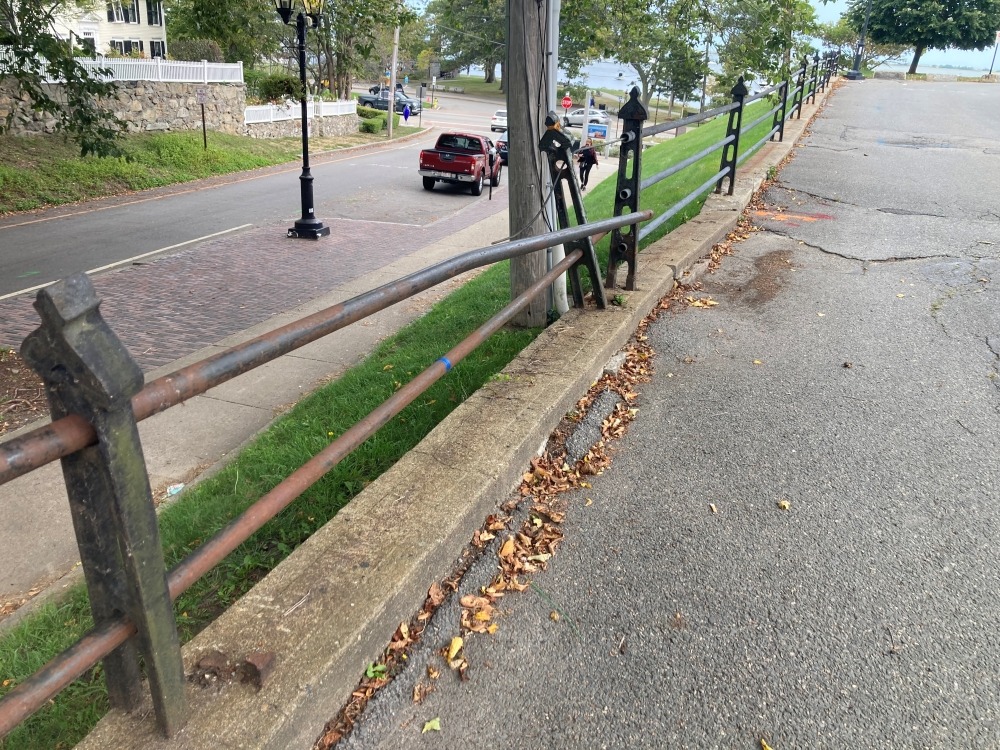
Second, replace the broken iron railing that divides North and Carver streets. This is the heart of historic Plymouth and replacing what is now an eyesore with a beautiful wrought iron railing would, for a relatively modest amount of money, make a big difference.
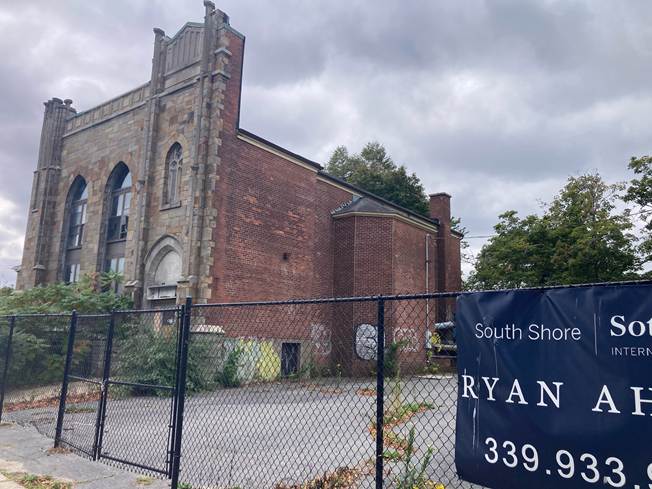
Third, in the same general area, atop Coles Hill, is that vacant building at the corner of Carver and Middle streets with a commanding view of the harbor. A former Baptist Church and then the local headquarters of the Salvation Army, the building and adjacent parking lot is surrounded by a chain link fence. The stone structure looks sad and derelict. Given its prime location and views of the harbor and beyond, it’s a shame this property is languishing. It’s been on the market for some time. Renovations would no doubt cost a bundle and it’s not the town’s responsibility to tackle, but it sure would be nice to see something go there. Maybe an inn and restaurant with outdoor seating in the warmer months.
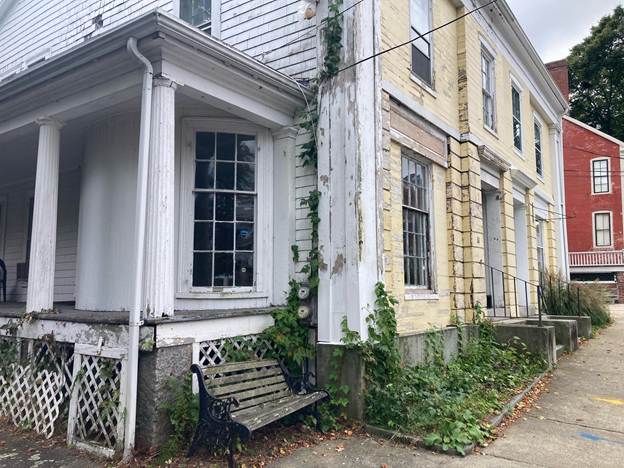
Speaking of eyesores in the downtown area, there are two neighboring structures on North Street where it meets Carver Street, just a stone’s throw from the Plymouth Center for the Arts and the Spooner Museum. One used to be the Old North Street Tea and Curiosity Shop and the other the Trask Museum. Both are said to be haunted. I’m no expert in real estate finance, but what a shame that these two buildings, right across from the handsome Mayflower Society House, look like they’re ready for a bulldozer.
Fourth, I’ve never understood why parking on Main Street is free (for up to two hours in most spaces) but metered on side streets such as Middle and North. Obviously, meters are a source of revenue, but would free street parking throughout downtown be good for business? It’s a long-debated subject.
And while we’re on the subject of streets, a stop light where Water Street, Market Street and Main Street Extension converge is high on my list. It’s a free-for-all there.
After I’d compiled my wish list, I sat down with Christine de la Torre, the new marketing manager for the Plymouth Downtown Waterfront, an association of local businesses. We tossed around some other ideas to make downtown and the waterfront more appealing. Since parts of the area – including Cole’s Hill and Pilgrim Memorial Park at the harbor – are under the domain of the state Department of Conservation Resources, and other properties are town or privately owned, it would take coordination to make some of these things happen, but here’s what we came up with in no particular order.
- Consistent signage to make it easy to navigate the area and, because we have many foreign visitors, signage that uses universally understood symbols.
- General beautification is needed especially along the streets that connect Main/Court streets and the waterfront. To lure visitors strolling along the waterfront to businesses up the hill you need inviting streetscapes. Leyden Street offers that, but Middle and North streets do not.
- More hanging flower baskets and flowerpots and small gardens throughout the area.
- A local version of Boston’s famed “Freedom Trail,” a yellow brick road, so to speak, that connects historic sights. Kids especially love to follow a marked path, and this one might just take some thought and paint. On that point, as we were chatting, we ran into Michael Davis, a Plymouth resident who works downtown and has a young daughter. “Few businesses here cater to young families,” he said.
But there are some family friendly activities coming to downtown in the weeks ahead. Christine pointed to the Harvest Festival on Oct. 25 and 26, and Halloween on Main on Oct. 31 where kids can safely trick or treat.
Plymouth is on the upswing and bursting with potential. It will be interesting to see what unfolds in the months and years ahead.
Peter Zheutlin – a freelance journalist who has written frequently for The Boston Globe, The Christian Science Monitor, and many other publications – brings the perspective of a Plymouth newcomer to the Independent. He is the author or co-author of nine books, including the New York Times bestseller “Rescue Road: One Man, Thirty Thousand Dogs, and a Million Miles on the Last Hope Highway.” Zheutlin can be reached at pzheutlin@gmail.com.