A six-month push to ease Plymouth’s public school transportation costs has hit a roadblock after a key proposal failed to advance from a crowded legislative education committee agenda. The setback means Plymouth taxpayers will continue to shoulder the nearly $11 million it costs to bus students to schools across the town’s more than 100 square miles, which makes it the largest municipality in the state geographically.
Aside from $1.3 million in a special education circuit breaker reimbursement – which provides financial assistance to public school districts to offset the cost of travel services for special education students – Plymouth’s public schools do not receive any state transportation assistance, said Adam Blaisdell, the school system’s business administrator.
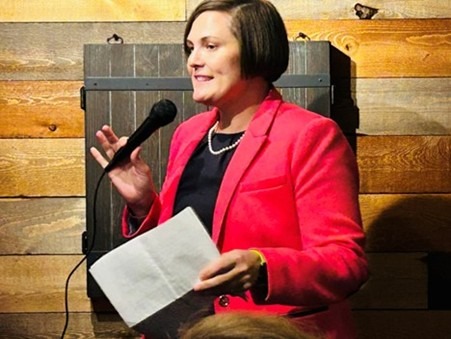
The bill’s sponsor, Rep. Michelle Badger, D-Plymouth, lamented the outcome, but said that decades of experience in working on school transportation issues have taught her that this is not the time to back down.
“We just keep building, and you never take no for an answer,” she said. “Hopefully, we’ll get to refile it next session and just keep working hard because it’s a problem that we have across the state – transportation for public schools.”
With a self-described passion for school transportation issues – she calls herself a “school bus transportation nerd” – Badger began working on transportation reform while serving on the Plymouth School Committee.
Over the years, she and her colleagues locally and on Beacon Hill have pursued various strategies, from budget amendments targeting Plymouth alone to proposals seeking subsidies for towns exceeding 100 square miles to bills covering more districts. They have not yielded significant results.
Post-pandemic, school transportation operating costs rose further, intensifying the challenge. Against this backdrop, Badger and Rep. Kathleen LaNatra, D-Kingston – whose district includes part of Plymouth – introduced a measure to bridge subsidy gaps between regional and municipal school districts.
During a June education committee hearing, Plymouth Public Schools Superintendent Chris Campbell, Blaisdell, and Select Board member Kevin Canty joined Badger in testifying in favor of the bill.
The busing disparity between Plymouth and other nearby communities is striking. For instance, the Whitman-Hanson Regional School District serves 3,483 students over 22 square miles and received $1.2 million in subsidies last year based on state law Chapter 71’s commitment to regional school districts.
Plymouth, as a municipal school district serves 7,000 students across 104 square miles. Of those, 4,849 are signed up to take buses to the town’s elementary and secondary schools, and another 236 students are bused to charter schools, according to Blaisdell.
The Commonwealth’s reimbursement system is complex. According to state law and Department of Elementary and Secondary Education regulations, the transportation subsidy system includes seven separate programs with widely varying reimbursement rates.
The state fully funds transportation for homeless students and partially subsidizes it for cross-district vocational and foster students. Plymouth students in grades K-6 who don’t qualify for the service, and all students in grades 7-12 who live within two miles of school but want to take a bus, must purchase a pass for $150, with a maximum annual cost of $450 per family.
Badger said that even some regional districts struggle to secure full transportation subsidies, and many districts are concerned about the lack of competition among bus vendors.
Though the bill did not result in funding for public school transportation in Plymouth, Badger put an upbeat spin on the disappointing outcome, saying it created a meaningful conversation. State lawmakers are beginning to recognize school transportation as a significant issue that could financially cripple districts, she said.
The latest state budget includes a new $100,000 appropriation for districts to study school transportation, evaluate procurement processes, and explore more efficient solutions.
“Plymouth is doing a really wonderful job of thinking ahead,” Badger said. “We started these conversations years ago, and going out there early for the [bus company] contract because they want to see what the cost could be [to make] the best plan.”
Badger acknowledged that expecting a bill to pass on the first try would be “naive,” but would not concede defeat.
“Everybody is working together to solve this problem because it becomes critical to the community,” she said.
Dinghan Meng is a Boston University student enrolled in the school’s statehouse program.