
As town officials fight against a maligned 40b condominium project proposed for North Plymouth, they are working on a separate plan that would help them gain control over future development in Plymouth.
A statehouse committee this week is scheduled to review the town’s land bank proposal, which Town Meeting approved in October 2024 by a single vote after moderator Steve Triffletti broke a 71-71 tie.
The controversial measure, now before the state Legislature’s Joint Committee on Housing, would give the town authority to collect a transfer tax of one or two percent on the sale of real estate.
That tax, which could generate an estimated $7 million a year or more, would be used to fund projects residents support including affordable housing, conservation, and town services.
It would give the town leverage to jump in and buy land that might otherwise be used for affordable housing projects it opposes — like the three-building 40b Pulte project in North Plymouth.
“The only way to control development is to own the land,” said Planning Board chair Steve Bolotin, who drafted the legislation. “The land bank would allow Plymouth to compete with developers to purchase properties and then decide how it can be best used for the benefit of the residents.”
But not everyone supports the idea. Select Board member Bill Keohan, who formerly chaired the town’s Community Preservation Committee, said a true land bank uses money to set aside land so it cannot be developed.
This proposal, Keohan said, would give power to a small commission that would decide what to buy, what to sell and what to develop, he said. That power currently rests with town meeting members, he said.
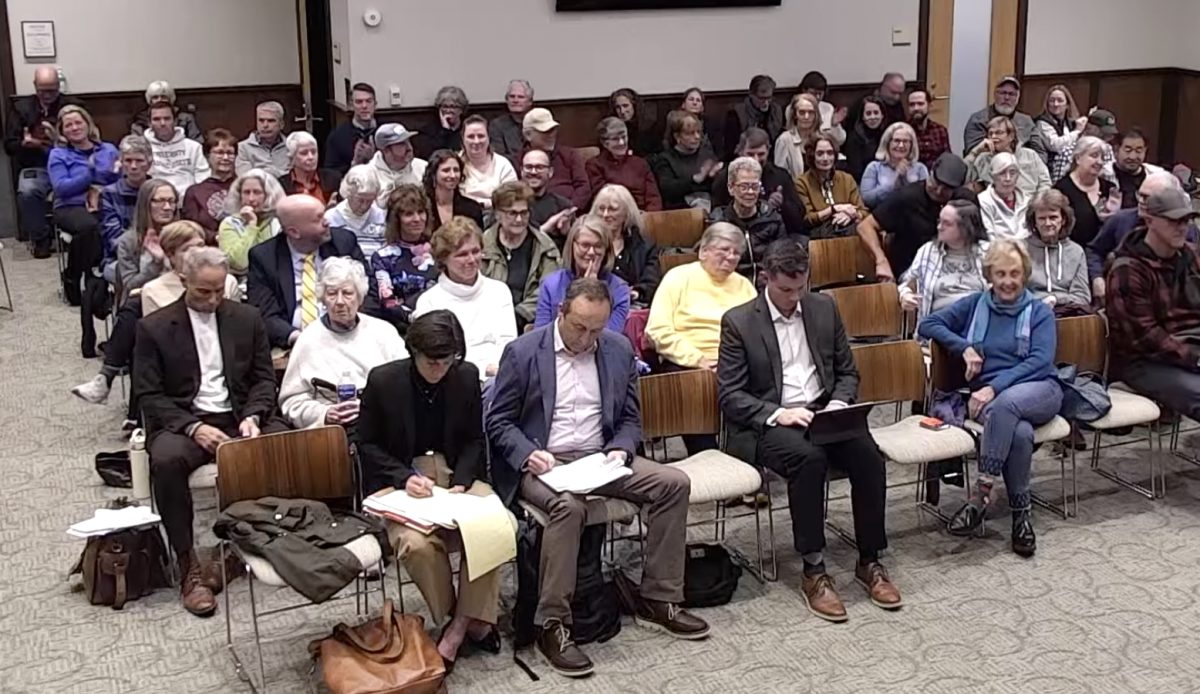
Meanwhile, residents last week packed a Zoning Board of Appeals meeting at Town Hall, pleading with the panel to reject Pulte Homes of New England’s proposed 163-unit condo project, spread over almost three acres between Prince Street and Sandri Drive.
A succession of speakers slammed the plan, each one sparking applause from the crowd — despite warnings against outbursts by ZBA chair Michael Main.
No one spoke in favor of the project — which requires a “comprehensive permit” from the ZBA to move forward.
Pulte representatives, including project manager Essek Petrie, watched stoically, not reacting to the blistering critiques. They have pledged to work with town officials and neighbors to address their concerns.
The subject of the hearing was potential traffic impacts, but one resident didn’t dwell on those details.
“I’m not a natural public speaker,” said Delia Byrnes. “But we don’t want you here. We don’t want your project here. It’s pretty clear nobody in this room is for it. Why are we pretending we want anything to do with this project? I thought I’d just say what everyone is thinking.”
Spectators jeered as the company’s representative presented its traffic study — concluding the project would have minimal impact on neighborhood traffic now and in the future.
Carol Jankowski, a Prince Street resident, called the study “ridiculous” and the notion that there would be virtually no impact “preposterous.”
She said she read the study “in depth — twice.”
It didn’t consider the hours when children arrive and leave neighborhood schools, Jankowski said.
Nor did the study take into account weekend traffic from the area’s six churches, which she said can reduce streets to a single lane.
“The study was done in February – in February,” she added for emphasis. “It seems rather suspicious actually that a study in a little congested neighborhood, a tourist town with two schools within a mile and six churches, would be conducted in February.”
Select Board member Deb Iaquinto agreed.
“I don’t think there are enough (negative) adjectives to describe our responses to Pulte’s traffic study,” she said.
Iaquinto said she was “stunned” when she walked the site with the developer in the spring and saw the scale of the proposed project.
“Plymouth desperately needs affordable housing…but we need housing that is going to complement our neighborhoods,” she said.
Select Board member Kevin Canty said his board had already discredited Pulte’s traffic study, which he called “patently ridiculous,” and urged the zoning board to do the same.
“I would ask the Zoning Board of Appeals to deny the application for a comprehensive permit,” Canty said. “The Select Board is in opposition to this project. We ask that you stand along with us in this effort as well.”
(The town, for the first time in 25 years, had asked state housing officials to reject Pulte’s 40b application, but they denied the request.)
Zoning board members made clear that they too had major reservations about the project, but fear if they deny the permit, the developer will likely win on appeal, and the town would lose its already minimal power to impose restrictions on the project.
The state’s 40b law, which has been in effect for decades, lets developers build without regard to local zoning and other regulations as long as 25 percent of the units meet a formula that designates them as “affordable,” meaning housing that is sold below market rates.
ZBA member Ed Conroy asked the town’s lawyer, Carolyn Murray, what would happen if the board rejected Pulte’s application and the developer appealed to the state’s housing appeals committee.
“In your experience, has any of these even had a chance?” he asked. “Is there a chance of any of this working at all?”
Murray responded: “Towns traditionally do not fare well at the housing appeals committee and the vast majority of cases that do get appealed there are often overturned. That isn’t to say towns never win, but they rarely win.”
Then Conroy addressed the crowd.
“Sure, we can deny this, but it’s a 40b project and are we just wasting our time?” he said to a chorus of “no’s” from the audience.
“Yes, we can do it,” he repeated, “but I want you to understand … we have an extremely, extremely uphill battle — it will be very expensive,” he said.
Then, in a comment that many spectators missed, Conroy added: “But I think we should do that battle.”
Another hearing is scheduled for December 1.
The town is currently in safe harbor status, which means that for two years it can reject 40b projects. Pulte, however, filed its application before the town received that designation so local officials can’t reject the proposal out of hand.
Pulte has an agreement to buy the land from the Sheehan family and Eight Mates LLC. Environmental lawyer Meg Sheehan, one of the members of the family, has opposed the project and argued that the land should be set aside for conservation.
Sheehan has said she will forgo her share of the proceeds of any sale.
As for the land bank bill, if the Legislature and the governor approve it, the measure will go before Plymouth voters in the next town election.
Andrea Estes can be reached at andrea@plymouthindependent.org.