
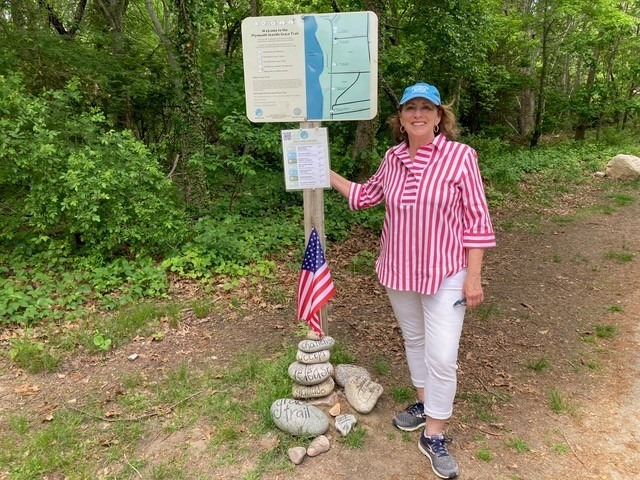
During the darkest days of his life, Chris Carazas, 41, of Kingston found daylight while walking along Grace Trail in Plymouth.
Grace Trail is a section of the rail trail variously known as the Seaside Trail, the Plymouth Seaside Grace Trail, and the North Plymouth Rail Trail, that runs from downtown north for about a mile and a half. The Grace Trail portion, about a half mile long, begins at Nelson Waterfront Park.
Along Grace Trail are five granite boulders, each inscribed with a question: What am I grateful for? What do I need to release? What do I need to accept? What is my next challenge? And, what can I embrace as possible?
Chris Carazas was lucky to be alive when Grace Trail found him. After being diagnosed in his late 30s with autism, Carazas’s life took a very dark turn. The diagnosis, hard enough to accept, only complicated an already fraught and failing marriage. After he tried to take his own life, his younger sister, Michelle, drove from Kingston to Maryland to bring her brother back to Massachusetts. Several psychiatric hospitalizations followed.
Once safely home, but still struggling, Michelle one day said, “Let’s get out for a while. There’s something I want you to see.” What she wanted him to see was Grace Trail.
“’These rocks can probably help you,’ she said, but at first I just ignored them,” says Carazas. “It seemed like hippie stuff.”
The brainchild of Anne Barry Jolles (pronounced “Joe-less”), 72, of North Plymouth, the seeds of the idea that would become Grace Trail formed in 2000.
“I was sitting in my kitchen struggling and in a state of despair,” Jolles tells me as we sit in the shade at a picnic table in Nelson Park on a beautiful day in late May. Adorned in a baseball cap with the words “Plymouth, Massachusetts 1620” embroidered on it, Jolles is a Plymouth enthusiast with a great love of the town she’s called home for 14 years.
“I’d recently lost both of my parents, had two teenagers, and was working as an occupational therapist on the South Shore, and had worked the Fernald State School in Waltham,” she tells me. Fernald was a state institution for the disabled that was notorious for its human rights abuses and Jolles witnessed some of the horrors first-hand.
“I don’t usually talk like this,” she says, “but I needed to step into a state of grace. I could see the calm in the eye of the storm, but I couldn’t get there.”
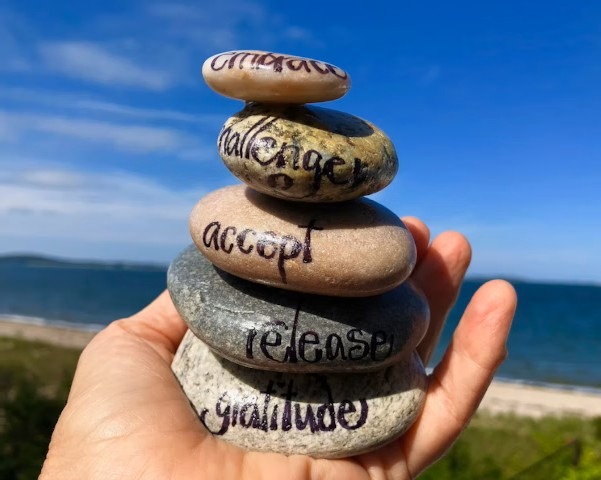
Then, seemingly out of nowhere, five words sprang to mind whose first letters spell the word “grace:” gratitude, release, accept, challenge, and embrace. And then came the five simple, yet profound questions that would one day be engraved on those granite boulders.
Jolles shared the questions with her husband Jon, a pediatrician, and he suggested he and Anne “do grace together.” During the summer of 2000 they walked every night and wrestled with the five questions, a process that enhanced their connection. As Jolles shifted careers and became a certified life coach, she found the questions enormously helpful in her practice.
In 2012, Jolles’s son, Rob, a member of the Army National Guard, was deployed to Afghanistan as a combat engineer which put him on the firing line every day defusing roadside bombs. Jolles was, understandably, riddled with fear and anxiety.
“That year I stumbled onto a story about the Appalachian Trail,” she tells me. “And I wondered, who is walking that trail? It turns out lot of veterans were walking off their war on the trail and I thought, where do I walk off my war, my struggles?”
When the Jolleses moved to Plymouth from Hanover they began walking the Seaside Trail, a more rudimentary path at the time, and not considered a particularly safe part of town.
“I started picking up the biggest rocks I could carry,” says Jolles, “and wrote one of the five questions on each with a Sharpie. I thought it would just be for me.”
But when she would return to the trail, she saw groups of people, including veterans, standing around the rocks and talking about them and the questions they posed. As time went by more and more people were gathering at the rocks.
“It became a destination,” Jolles says.
When the Town embarked on a major upgrade of the Seaside Trail in 2024, in part to make it accessible to bikes and wheelchairs, Jolles approached the Town about upgrading what had become known as Grace Trail along with it. David Gould, Plymouth’s Director of Environment and Energy, and Nick Faiella, Superintendent of Parks and Forestry, walked the trail with Jolles and became enthusiastic supporters of the idea.
“I told them what I envisioned,” says Jolles, “and they implemented it.”
Today, the granite boulders engraved with the five questions that line the trail are complemented by smaller rocks Jolles hand decorates with inspirational words. And others have started to leave their own rocks and stones. The boulders, the signage, and the engraving were all donated by local vendors.
“The five questions are there, but the answers are for each person to find on their own,” says Jolles. “This isn’t about telling people what to think. It’s about finding your footing wherever you are in life.”
After their initial visit, Chris Carazas and his sister often returned with Shadow, Carazas’s German Shepherd, and he started to reflect: “what am I grateful for? I was grateful for my family, to be home, to be in this beautiful setting, and to be in tune with nature.”
At the boulder that asks, “what do I need to accept,” Carazas realized he had to accept the past, the diagnosis, and that the only way forward was acceptance of the past.
“I started going to Grace Trail every day on my own with Shadow,” he continues. “The trail helped me keep it together. To hear the sounds of the birds and being aware of my natural surroundings was therapeutic. Grace Trail puts things in perspective. It’s so simple but so powerful.”
Today, Carazas is working, writing, dating, and playing pickle ball regularly and lives near his siblings. And he’s grateful for one other thing: meeting Anne Jolles and “being able to thank her in person.”
For Jolles, meeting people such as Chris Carazas, who have found so much solace and equanimity on Grace Trail, is its own reward.
“People need a place that helps them rise and for Chris, Grace Trail was that place,” she says.
Today, there are a dozen Grace Trails around the United States, in Wisconsin, Texas, Vermont, and Connecticut, and another in Canada, all licensed by or done with the approval of Grace Trail, Inc. which Jolles formed to hold the rights to the Grace Trail trademark and related copyrighted material. She also provides guidance to the communities that want to create Grace Trails of their own. The local communities raise the money and implement the project and have considerable latitude within guidelines provided by Jolles. Next to open this coming Fall is Grace Trail at the Brockton V.A. Hospital where Jolles’s son received many services.
Jolles’s vision is a Grace Trail in each of the fifty states, and she’s looking for a foundation or an individual who can help make that happen. It’s a full-time job she does without pay, but the rewards are endless.
“Jon and I feel a responsibility for the state of the world,” she says. “Grace Trail was gifted to me, and I want to share that gift.”
Peter Zheutlin – a freelance journalist who has written for The Boston Globe, The Christian Science Monitor, and many other publications – brings the perspective of a Plymouth newcomer to the Independent. He is the author or co-author of nine books, including the New York Times bestseller “Rescue Road: One Man, Thirty Thousand Dogs, and a Million Miles on the Last Hope Highway.” Zheutlin can be reached at pzheutlin@gmail.com.