
This report has been updated to reflect public comments made at Tuesday’s Select Board meeting.
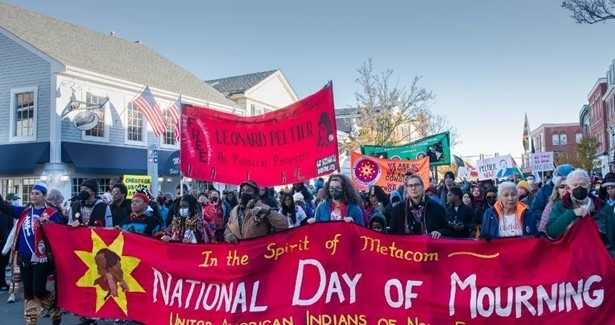
A year after the United American Indians of New England sued the town for placing restrictions on the group’s National Day of Mourning, the sides are back in court fighting over one remaining condition.
The standoff, over insurance, has sparked protests from the group’s supporters who believe town officials are trying to derail the event — charges town officials dispute.
They have inundated the Select Board with messages and planned to protest outside town hall Tuesday evening.
Last year, after the group filed suit and the judge hinted he would rule against the town, Plymouth dropped all requirements — including that the group get a permit and insurance.
But this year the town is insisting the group obtain insurance and indemnify the town to protect it in case anything goes wrong.
Those requirements, according to the group and its co-leader, Mahtowin Munro, violate a 1998 agreement drafted in the wake of a protest that turned violent at the the 1997 National Day of Mourning.
Participants clashed with police. Some were pepper-sprayed and knocked to the ground, and 25 were taken into custody. Video of the well-publicized confrontation can be seen on YouTube.
The event is a “solemn, spiritual and highly political day” where participants “mourn Native ancestors…the genocide of Native people and the theft of native lands,” the group’s lawyer wrote in court papers.
It takes place on Thanksgiving, Nov. 26, beginning with speeches and prayers at Cole’s Hill, followed by a march through downtown Plymouth. Thousands of people from around the country have attended in the past.
The 1998 agreement explicitly stated that in the future, event organizers would not be required to obtain permits or insurance, and the town would make available a showmobile — a mobile stage — for their use.
Town officials now argue no agreement lasts forever, and the group should obtain insurance and agree to indemnify the town in the event of any injuries or other incidents. Every other group holding public events complies with these conditions, they say.
Otherwise, the town says, it will not agree to help the group erect a stage for its speakers.
“Under the terms of the 1998 agreement, we have a right to choose our own march route, yet the Town has repeatedly tried to insist that we should allow ourselves to be pushed into the far corner of a park so that we will be less noticeable,” Munro wrote in a call to action on the group’s website. “We believe they are throwing up roadblocks because they don’t want the tourists to see or hear Native Americans who are speaking about the true history of the Pilgrim invasion and resulting land theft and genocide of Wampanoag and other Native peoples.”
In a Nov. 16 emergency motion, attorney Daniel Guenther asked a Plymouth Superior Court judge to order the town to relax the requirements, which the Select Board voted unanimously to impose on Nov. 10.
He argued the insurance requirement violates the law by requiring the group to pay a fee “as a prerequisite” to exercising its First Amendment rights.
He has asked for a hearing, but as of Nov. 17, no date had been set.
After last year’s agreement, the judge ordered the sides to hammer out conditions for future National Days of Mourning beginning in 2026 — and discussions have been ongoing for months, according to both sides.
Town officials backed off most of their requirements, but insist the group obtain insurance for the stage and indemnify the town from liability in case of any incidents.
Select Board members said they have received hundreds of messages from the group’s supporters, who believe the town is reneging on its longstanding agreement with the Native American group.
“We are very supportive of the day of mourning,” said Select Board Chair Deb Iaquinto.
“We’ve been working with them for months,” Iaquinto said. “We agreed on security and other things — we offered them to use Pilgrim Memorial Park which has a hatch shell and power.”
The group’s supporters packed Tuesday night’s select board meeting, and speaker after speaker accused the board of placing unwarranted obstacles in the way of the event.
They called town’s actions “appalling,” “inappropriate” “troubling” and “disrespectful.”
Rev. Rumni Saha, minister of First Parish Church in Plymouth, said the town “has a responsibility to uphold its word and to respect the agreement it made with the indigenous community.
“An agreement is a commitment,” he said. “It does not become optional simply because honoring it becomes inconvenient or politically difficult.
“To withdraw the town support just days before this event is deeply troubling and sends a painful message about whose voice and histories are valued here,” he added.
Peter Matlon, a member of Plymouth For All Committee, said the decision “appears to be an insult to the indigenous people of our country.
“I am curious about how the decisions were made without input from local indigenous people. What were the arguments made and how did individual members of the board vote? I think the people in Plymouth would want to know where members stood on this issue.”
Select Board members listened to the public comments, but it was unclear Tuesday whether they would take up the issue.
“I understand that people are upset,” Iaquinto told the Independent earlier Tuesday. “It makes us look like the bad guys, but we require every other group to provide insurance. The town is between a rock and a hard place.”
Select Board member Kevin Canty said the town has been clear about this condition for months.
“They’re claiming it’s unconscionable for us to do this so late in the game but we’ve been telling him the same thing for over a year,” Canty said.
The Select Board voted in a Nov. 10 executive session to reject the group’s request for the town to set up a stage on Cole’s Hill without the group providing insurance or agreeing to indemnify the town.
The first National Day of Mourning was in 1970, held to mark the 350th anniversary of the Pilgrims’arrival in what is now Plymouth.
Its original purpose, according to a filing by the group’s lawyer, Daniel Guenther, on Nov. 16, was to “educate about native history and current issues,” refute the myth that “All the New England Indians died off,” engage politically, and advance Native cultures and sovereignty.
“It is a solemn, spiritual, and political,” he wrote.
In 1997, police confronted demonstrators carrying a banner that read: “You are on Indian land.” When the protesters refused to disperse, police moved in. Although 25 protesters were arrested, the charges were later dismissed.
“More than 100 local, county and state police kettled our peaceful march, knocking many participants to the ground,” Munro wrote. “Participants were dragged by their hair and the police kneeled on the necks of protesters. Pepper spray was used on numerous people, including those who were handcuffed. Images of Plymouth’s violent suppression of free speech appeared in media all over the world, and thousands of Native people and organizations and our allies demanded justice and a boycott of Plymouth.”
Amid the backlash, the sides negotiated the 1998 agreement, which required the town to either provide a stage for the event or help install and power one.
That’s how it went for decades — until last year, when the town officials imposed the new conditions.
In 2025, Guenther wrote, the town “attempted to rewrite for that year the settlement agreement that had been in place for 27 years.”
Over the past few weeks, the sides negotiated to try to avoid litigation, but were unsuccessful, the group argued in court papers.
Andrea Estes can be reached at andrea@plymouthindependent.org.