
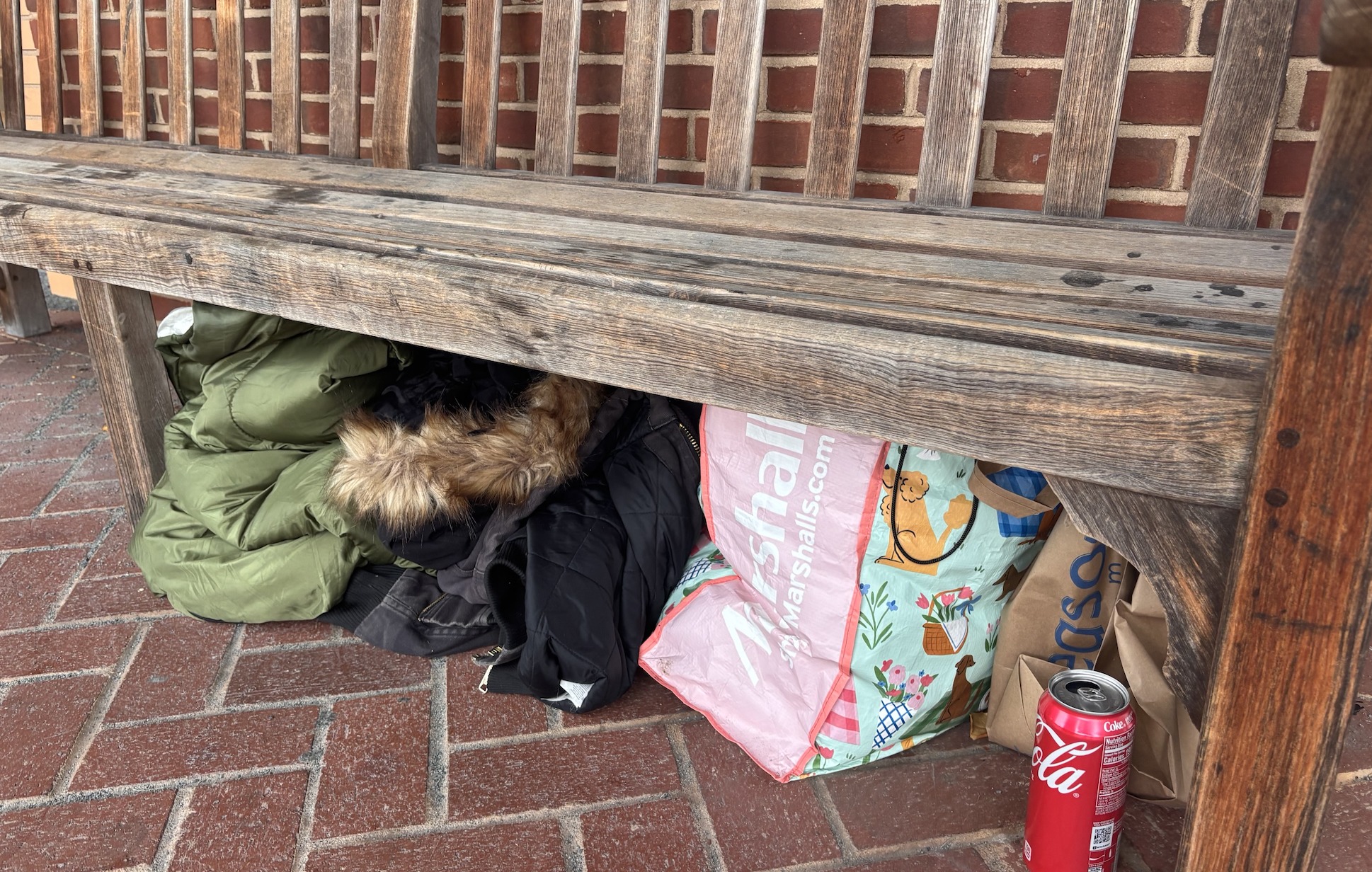
In the rising light of a chilly morning, a young man huddles on the porch stretching along the library’s façade. He’s surrounded by his belongings, including a sleeping bag. Nearby, another man sits inside a rust-flecked truck, its back windows blocked by what looks like clothing and trash.
Both are regulars at the main branch on South Street. They’re waiting for the doors to open in a couple hours. The public library, like most around the country, is one of the few places where people without homes can find brief refuge without being told to “move along.”
“We welcome everyone, we treat everyone equally,” said library director Manny Leite.
His employees aren’t counselors, but they are given training through an online workshop called “The Librarian’s Guide to Homelessness.”
“It’s starting to get cooler now, so we’ll see more unhoused people in the building using it as a warming shelter,” Leite said. “We also have a food pantry. We provide canned goods, dried foods like spaghetti, and toiletries as well – everything from a toothbrush and toothpaste to a bar of soap. Some do utilize those services; some don’t want to.”
Librarians – along with police officers, firefighters, EMTs, counselors, the Salvation Army, nonprofits, and other organizations – stand on the front line of homelessness in Plymouth. They are familiar with the “regulars.” They know who is likely to come indoors when winter descends, who wears their independence like a shield, and who roams the streets, plagued by demons that drive self-destructive decisions.
This year, with cost-of-living essentials higher than ever, officials say more people across town are teetering on the precipice of calamity. Housing and its associated expenses are the primary burden.
Plymouth’s Five-Year Consolidated Plan, adopted in July, highlights the economic pressures squeezing residents. It says a “typical home” valued at about $628,000 requires a household income of more than $167,000 – over $3,200 weekly. The median annual income, however, is $37,000 less.
Renting an apartment is almost as challenging as buying and maintaining a house. Up-front costs alone can top $10,000, beyond the reach of those with checking accounts that zero out before month’s end.
“Housing, utilities, taxes, and insurance have increased beyond what many working residents can afford,” the report says. “Local housing advocates report that even fully employed individuals are becoming homeless due to the lack of affordable rentals. Long‑term homelessness persists because there are too few affordable units in the community.”
But ending up without a place to call home is more complicated than that. It involves “coexisting situations with mental health, perhaps addiction, and economic stressors,” said Michelle Bratti, Plymouth’s commissioner of health and human services. “With the economy the way it is, so many people are that one paycheck away from living in a car.”
Bratti said the town has become more proactive in its approach to the chronic problem, including through a partnership with the nonprofit agency Child & Family Services, whose programs include a mobile crisis van covering Plymouth.
Someone open to assistance “doesn’t have to go find a ride to an office somewhere to sit with a therapist or a counselor,” Bratti said. “It’s not advertised or blaring. They can climb into the back of the mental health van and sit down with someone and talk about ways that they can seek help.”
Bratti said she’s gone out with Plymouth police officers and representatives from the regional nonprofit Father Bill’s & Mainspring to scout locations where people without homes are known to set up makeshift living quarters. Encampments can sometimes be found off Town Brook beyond the skateboard park, in the scrub bordering the North Plymouth rail trail, under bridge abutments, and in the thick woods of Myles Standish State Forest. At another site, atop a steep slope behind Walmart, the only signs of activity on a recent afternoon were empty liquor bottles, worn-through shoes, and a mold-encrusted mat that may have served as a bed.

The aim isn’t to roust people, but to engage with them face to face, Bratti said. So far, Plymouth – with an unhoused population estimated in the dozens to low hundreds – has not faced the “tent cities” that have raised sanitation and safety alarms in Boston and other communities such as Lawrence.
“We’ve also created brochures and resources for materials to say, ‘You need a hand? Here’s where you can seek all the resources you need in your community with dignity,’” she added.
No one expects to eradicate homelessness, but Bratti and others say the Westerly Road housing resource center Father Bill’s & Mainspring is preparing to build will go a long way toward mitigating the problem.
“It will change the landscape,” she said.
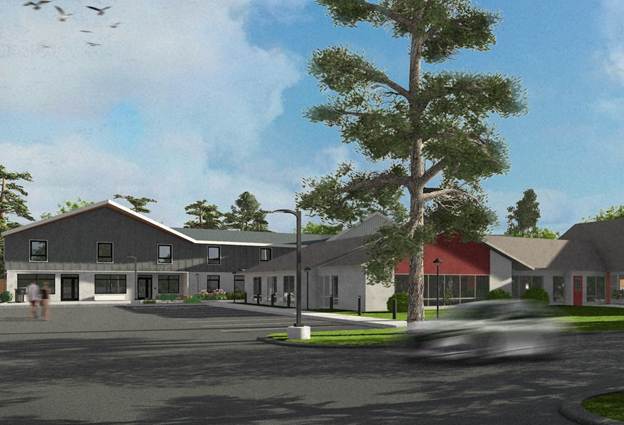
Plans for the complex on the site of the First Baptist Church call for a day center with an array of support programs and services, a 30-bed overnight shelter, and 16 long-term housing units. It’s being funded in part with $11.7 million from the state and $50,000 from the town’s Affordable Housing Trust. The organization is in the process of raising the balance – about $5 million.
Father Bill’s & Mainspring already operates about 70 housing units for the “formerly unhoused” in Plymouth, said John Yazwinski, CEO of the Brockton-based organization. This year alone, it’s found permanent housing for about 60 people who went “straight from the streets or from a shelter, which is great to see,” he said.
In addition, it assists the Plymouth Taskforce to End Homelessness’s long-running Overnights of Hospitality, which this winter will provide shelter and meals on a rotating basis at the First Baptist Church, Christ Church, and the St. Mary’s parish center.
Connie Melahoures, who heads the volunteer task force, said in an email she expects “between 20 and 25 individuals to come to shelter each night” when the program starts up later this month.
A January 2026 census of Plymouth’s homeless population identified about 24 unhoused people, Yazwinski said, on top of the 76 who stayed at least one night in a church shelter last winter.
“The actual number might be higher, but that’s what we found that night,” he said. “It has doubled over the last five years. Just through the last four months, we’ve already worked with 50 individuals who have been unsheltered on the streets of Plymouth.”
And the age of those without a stable home is trending upward, Yazwinski said.
“We are seeing more individuals between 55 and 70,” he said, “and more people are living in vehicles rather than outdoors. The elder population is our fastest-growing population for homelessness.”
Yazwinski recited a list of sobering statistics about clients Father Bill’s & Mainspring provides services to: 46% have physical disabilities, 50% suffer from at least one chronic health condition, 84% rely on Medicaid, and 70% rely on SNAP food benefits, which, he added, are “under attack.”
“As we’re seeing more elders and more people on fixed incomes, severely disabled people, we’re seeing some of the safety-net programs potentially cut,” he said. “We’ve seen a lot of the smaller, family-owned nursing homes disappear over the years here on the South Shore, especially. A lot of people that would’ve been going into assisted care, they just can’t. The beds aren’t available, or they can’t afford it. They’re showing up at our doors instead.”
Then there are the compounding issues of mental illness and substance abuse. A 2024 study published on the Journal of the American Medical Association Psychiatry site said mental illness affects two-thirds of people “experiencing homelessness.” That’s in line with what Father Bill’s & Mainspring finds in Plymouth.
Sue Giovanetti, CEO of the Plymouth Area Coalition for the Homeless – which operates family shelters in the Plymouth Industrial Park and Kingston – knows well how mental health can affect a person’s ability to live independently. She’s witnessed it for decades.
Recently, she said, “every single family that we had in Kingston had mental health issues that were burdensome and make it very difficult for them to get in a situation where they can say, ‘OK, can I work? Am I able to work? Am I able to manage what my family needs? I have to get my child into Head Start. They’re helping me with that, but then if my child gets in, can I get a job now? Well, I don’t have a car. How do I get there?’”
Even if a parent lands a job, it doesn’t mean the family will find secure financial footing.
“We went through a long time where we had a lot of intact families – two adult wage earners potential wage earners and their children,” said Giovanetti, who serves on the Plymouth Independent’s board. “Now we’re back to more single-parent families. In most cases, they are entry-level employees, so their salary potential isn’t strong. And to get into an apartment, you need to have first, last, and security. It’s almost impossible.”
She cited the state’s HomeBASE program as a potential lifeline. It provides qualifying applicants up to $30,000 over two years for needs such as first and last month’s rent, a security deposit, a monthly rent subsidy, and basic furniture.
“It helps you kind of ease your way into taking on the full burden of an apartment,” she said.
But there’s no guarantee a family won’t end up in an emergency shelter again. The maximum stay as of Nov. 1 is nine months, up from six in the last fiscal year.
The limit is “not necessarily a bad thing, but it means everybody has to be on their game,” she said. “The caseworkers have to be working aggressively, trying to identify obstacles and trying to find housing options that might fit the family.”
“When they go into shelter, they sign agreements, and one of them is that they have to spend 30% of their time each week looking for housing,” Giovanetti said.
All of this heightens the importance of the housing resource center, which won’t offer family housing, but will consolidate a roster of services – like Alcoholics Anonymous and Narcotics Anonymous meetings – in one location. The groundbreaking is tentatively set for spring, with an opening by the summer of 2028.
The purpose is “not just to be a nighttime shelter but to be open 24/7,” Yazwinski said. “We want to have daytime activities so that people don’t have to move around. It’s better for the person individually, but also better for the downtown community.”
Mark Pothier can be reached at mark@plymouthindependent.org.