
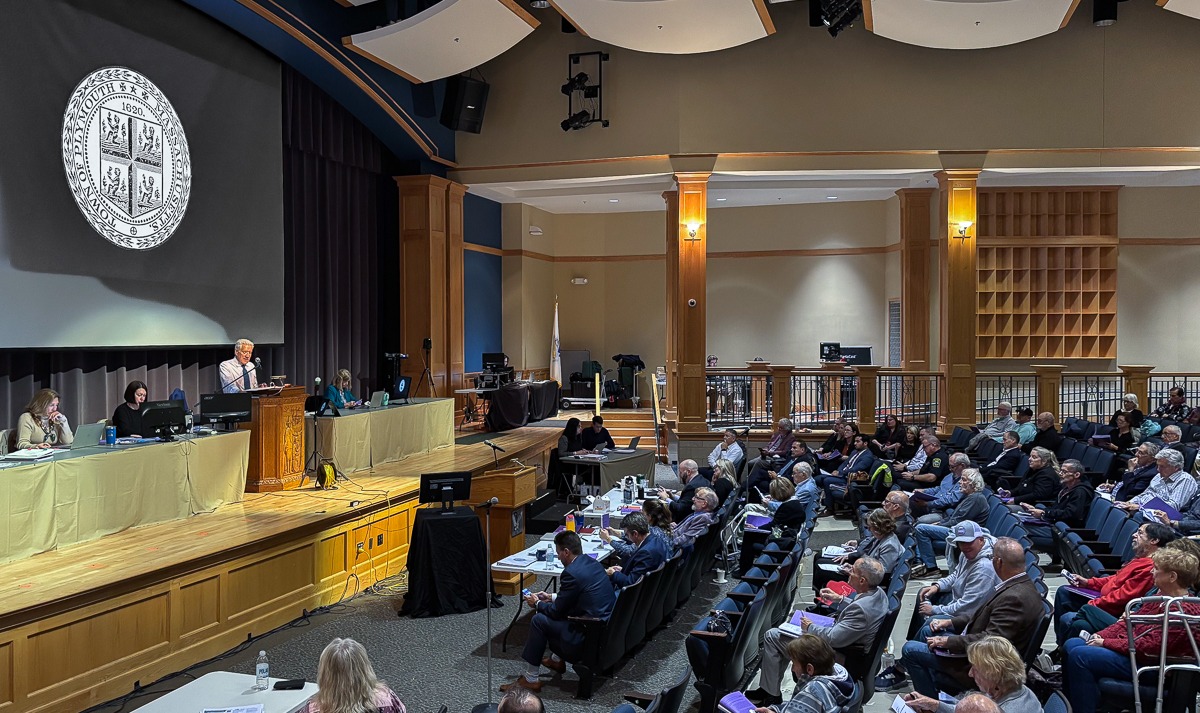
The barring of two citizens’ petitions as “out of order” at Town Meeting prompted a heated floor debate Saturday, with proponents arguing Town Moderator Steve Triffletti overstepped his authority in not allowing a vote.
But Town Meeting members did approve one other citizens’ petition Triffletti allowed to the floor after a negotiated settlement last week.
Among many other items, members also voted to borrow up to $6 million for a downtown “climate-resiliency” project, to enact a one-year moratorium on controversial high-tech data centers, and to spend $750,000 to buy an open-space restriction on 179 acres along Buttermilk Bay.
The expenditures won overwhelming approval following an opening caution by Select Board Chair Deb Iaquinto about a five-year budget forecast that projects growing deficits starting in the fiscal year beginning July 1, 2028.
Calling the predictions from town officials “a call to action not a reason to panic”, Iaquinto urged Town Meeting’s 162 elected members to consider the long-term implications of their decisions.
But the debate over the handling of citizens’ petitions provoked the most controversy.
Most articles that come before Town Meeting are sent by the Select Board, but they can also come up if 10 registered voters sign a petition for consideration.
Triffletti allowed a vote on Article 24, a petition to require special permits before certain developers can skirt the town’s setback requirements.
Supporters of the petition cited a development at 71 Hedges Pond Road in Cedarville as an example of how developers can exploit ambiguities in town bylaws to skirt setback requirements. The development is designated a “unified complex,” which is essentially a group of buildings using the same underground town infrastructure.
The petition, which passed 101 to 44, requires all developers of a unified complex apply for permits before they can encroach on the town’s established setback requirements. Neighbors complained excavation at the Hedges Pond development has blown sand onto adjoining properties.
Triffletti initially barred the motion from consideration because, after it was placed on the Town Meeting warrant, petitioners had moved to amend their petition to specify to that the Planning Board, and not the Zoning Board of Appeals, should oversee special permits for unified complexes.
Triffletti had argued the amendment broadened the scope of the petition, a move he said was not allowed. Petitioners agreed to drop the amendment and put forth just the original article, which does not specify which board should have oversight, and Triffletti allowed a vote.
Town Meeting member Richard Serkey, one of the signers of the petition, criticized Triffletti for denying a vote on the petition in the first place.
“The moderator imperiously and frivolously ruled our motion out of order,” Serkey said. “He ruled that any motion to overrule him would be out of order.”

Triffletti ruled two other citizens’ petitions out of order.
“My ruling is not frivolous,” Triffletti said of his decision to bar consideration of Article 25, which would have required greater transparency in the finances of the Plymouth Municipal Airport.
Triffletti said the proposal violated state laws and guidelines and a judge’s order that the town not interfere in the airport’s finances amid a lawsuit filed against the town by airport commissioners.
Town Meeting member Al DiNardo, the chief proponent of the petition, appealed Triffletti’s ruling.
“We are the supreme authority,” DiNardo said. “The moderator is subordinate to the body.”

Triffletti said his decisions can only be appealed for procedural reasons, and in this case his ruling was substantive because, he argued, the petition was illegal.
“You are not the gatekeeper,” Town Meeting member Bill Abbott countered. “That article must be heard. It’s not your job to block it. You’ve suppressed many articles. That’s not your job. This body is the ultimate decision-making body.”
Town Meeting member Patricia Adelman called Triffletti’s ruling “an insult to our Town Meeting members.”
Triffletti also ruled Article 26 out of order, saying the citizens’ petition, which sought to change the number of the town’s neighborhood steering commissions and how they are selected, would violate the town charter. The charter says the Select Board must appoint committee members unless the charter or bylaws say otherwise.
Anthony Mayo, the petition’s leading proponent, argued that once an article is on the Town Meeting warrant, the moderator cannot rule it out of order.
Petitioners lost both arguments, and neither petition was taken up.
In other business, the 162-member Town Meeting voted 127 to 19 to appropriate $6 million to make Main and Court streets more climate-resilient by planting trees to provide shade and installing rain gardens to filter storm water before it hits the harbor. The project would also make it safer for pedestrians to cross the street and make the area more wheelchair accessible.
A state grant of $3 million will cover half the cost of the project, but the town will not be reimbursed until it has spent the money. Construction is expected to begin in January and be completed by 2028.
“This project could transform our downtown,” said Town Meeting member Michael Hanlon.
Paul Blanchard, vice chair of the town’s Historic District Commission, argued the project would create “a far more welcoming and enjoyable downtown.”
Town Meeting members also voted 139 to 7 to spend $750,000 in Community Preservation funds to buy an open-space restriction for 179 acres on Buttermilk Bay, which would protect the land from any development in perpetuity.
Fred Thys can be reached at fred@plymouthindependent.org.