
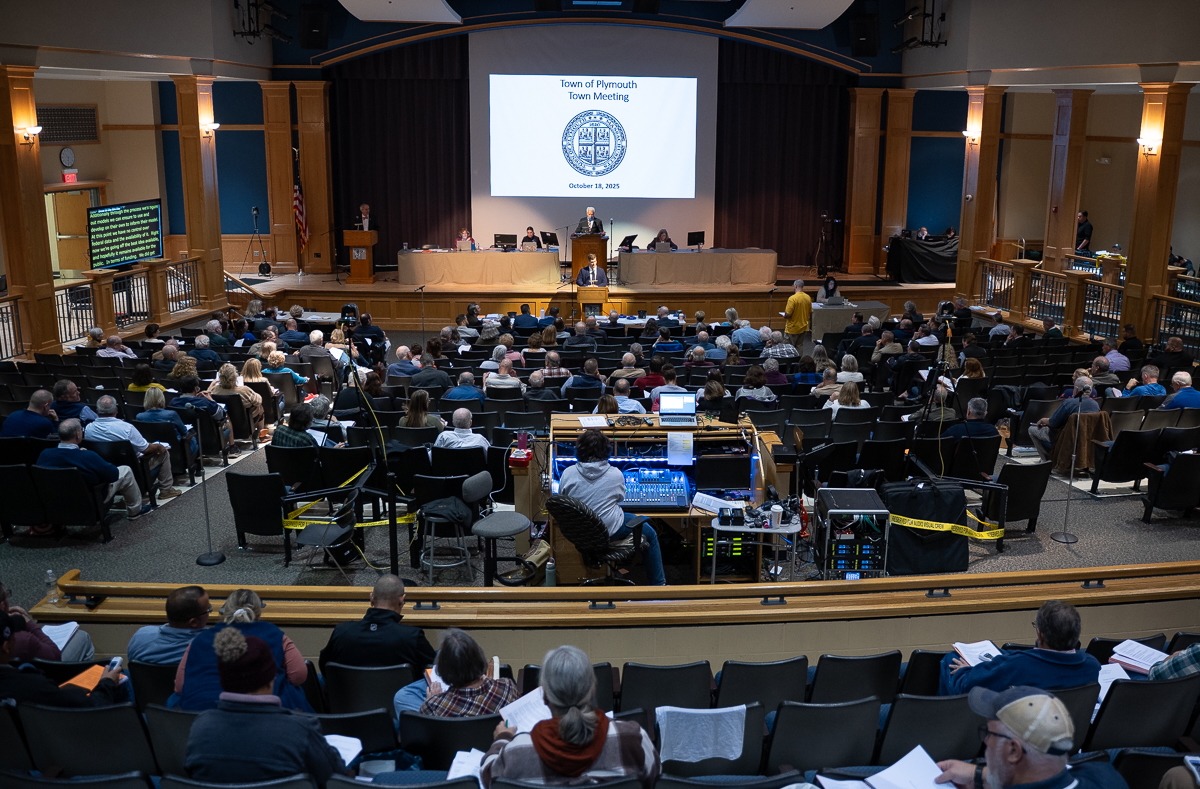
Saturday’s Town Meeting could turn especially contentious after all three citizens’ petitions were barred from consideration as improper and out of order by Town Moderator Steven Triffletti.
The citizens’ petitions call for increased transparency in the operations of Plymouth Municipal Airport, changes to neighborhood steering commissions, and changes in a proposal to stiffen setback regulations for some commercial developers.
Citing different reasons to deny each a hearing, Triffletti – the town’s longtime moderator – said none of the citizens’ initiatives will get a vote on Saturday.
The three citizens’ petitions are included among 26 articles on the agenda, or “warrant.” Most articles are brought forth by the Select Board, but state law also allows citizens to place articles before Town Meeting through a petition signed by at least 10 registered voters.
In an interview Monday, Triffletti said his reasons for denying the citizens’ petitions a hearing center on court rulings and timeliness, and not on any personal or political views he may hold on their substance.
“We can’t accept amendments to an article once it’s been submitted to the Select Board and put on the warrant,” Triffletti said. “So, that would be improper.”
Proponents of the initiatives said Triffletti can expect a fight on the floor.
Richard Serkey, the leading advocate for one of the citizens’ petitions, said Triffletti’s rulings are part of a longstanding attitude at Town Hall that the Select Board – and not citizens – should be deciding what is taken up at Town Meeting.
“There’s a lot of pushback from Town Hall,” Serkey said. “I think there’s a general distaste for citizens’ petitions in general because they’re viewed as criticism. I just don’t understand what the big deal is.”
“It angers me,” he said.
Serkey’s petition centers on an amendment to Article 24 of the Town Meeting warrant, which would require developers to apply for a special permit on certain kinds of developments known as a “unified complex.”
The new requirement was sparked by controversy at a development at 71 Hedges Pond Road in Cedarville. Developers there were allowed to skirt the normal setback requirements from roads and adjacent neighborhoods.
Supporters of the measure argue that developers have used the claim that they are building a “unified complex” to skirt town rules for minimum setbacks and natural buffers.
Article 24 will not be debated and voted on Saturday. At issue is a late amendment to the article naming the Planning Board as the town agency issuing the new special permits. Serkey said though no agency was named as the deciding authority in the original article, it later became clear the Planning Board wanted oversight, as opposed to the Zoning Board of Appeals, which normally oversees special permits.
He said Triffletti’s refusal to allow the change is arbitrary.
“I think it’s wrong,” Serkey said of Triffletti’s ruling. “That’s just preposterous.”
During Town Meeting, any member who disagrees with a decision by the moderator can call for a two-thirds vote to override the decision. Triffletti said his decisions in this case cannot be challenged because they are not procedural rulings, but rulings of substance.
“I think it’s exactly a matter of procedure,” Serkey countered.
Triffletti also ruled another citizens’ petition, Article 25, out of order. That article would have forced the Airport Commission to provide greater transparency in its finances.
Triffletti said the article violates state law and a court injunction ordering the town not to interfere with the management of the airport because of an ongoing lawsuit filed by the Airport Commission against the town and town manager.
Al DiNardo, the leading advocate for the petition, said Triffletti is exceeding his authority as town moderator.
“The Moderator does not possess the authority to bypass Town Meeting members,” DiNardo said in a recent letter published in the Independent. “Town Meeting remains the supreme legislative branch of our local government—and our right to deliberate and vote must be respected.”
Triffletti has also ruled a third citizens’ petition, Article 26, out of order. That one would change the number and composition of neighborhood steering commissions. Triffletti cited the town charter, which says the Select Board must appoint all committees unless the charter or a town bylaw states otherwise.
Town Meeting, the twice-yearly gathering of 162 elected residents, will focus on a series of other issues, including whether to borrow $6 million to begin making downtown more climate resilient, a one-year moratorium on data centers, and the expenditure of $750,000 in community preservation funds to protect more than 390 acres of land on Buttermilk Bay.
The session is set to begin at 8 a.m. on Saturday at Plymouth North High School.
Town Meeting is Plymouth’s legislature. It is overseen by Triffletti, who votes only in the event of a tie.
Each of Plymouth’s 18 voting precincts elects nine members to three-year terms. Those terms are staggered so that three members from each precinct are elected in the annual town election.
The public can attend Town Meeting in person. It will also be streamed live by The Local Seen. Anyone can speak, including non-residents, but they must wait until after Town Meeting members have spoken on a particular agenda item.
Fred Thys can be reached at fred@plymouthindependent.org.