
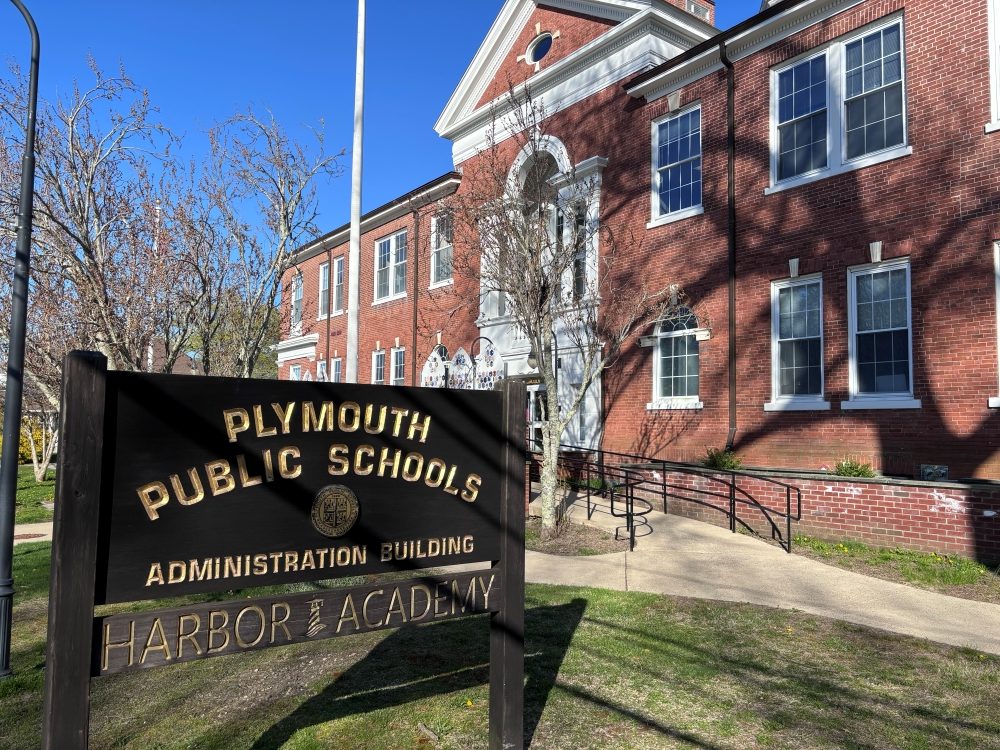
The bizarre story of Plymouth Schools’ former food services director, who dragged heavy refrigerators out the back door and stole food from the kids’ lunch program as part of a decade long larceny scheme, has raised questions of failed oversight since his 2025 arrest.
On Monday, the elected members of the town’s Schools Committee heard a presentation from district staff on the system failures involved and the long list of oversight reforms designed to help prevent it from happening again.
Meanwhile, Patrick Van Cott, now 64, awaits his sentencing on Oct. 7 after pleading guilty in May to federal charges of theft and wire fraud.
In a slide show presentation at Monday night’s Schools Committee meeting, Assistant Superintendent for Finance and School Operations Adam Blaisdell provided an update on the reforms recommended in a 12-page audit report commissioned after Van Cott’s arrest.
In it, the accounting firm CliftonLarsonAllen LLP (CLA) listed oversight failures in the $1.3 million schools lunch program, with finances and operations largely cut off from school administrators, and under Van Cott’s primary control.
“The School Food Service Department effectively operated as a siloed department with significant independence comparative to other school locations,” the report concluded. “Independence included the payroll process for hiring, recording employee salary costs, access to employee information, expenditure approvals, and asset controls.”
For years, there were lax standards in inventory for stored food, asset control on equipment, and little oversight over spending and payroll, the report said.
In addition, Blaisdell mentioned to commissioners the district is also moving to address the findings of another 2022 state inspection report where alarm bells were apparently sounded more than three years before Van Cott’s arrest.
“The school did not ensure that the storage, preparation and service of food are maintained,” state inspectors wrote. “Facilities for the handling, storage, and distribution of purchased and donated foods shall be such as to properly safeguard against theft, spoilage and other loss.”
In an interview with the Independent on Tuesday, Blaisdell said the 2022 state inspection report went straight to Van Cott at the time, bypassing his bosses in the central office.
“We did not see this report until this past year,” he said.
Blaisdell explained to commissioners how the schools’ lunch program is funded differently than the rest of the district’s operations, and therefore the revenue must be kept separate. Food services are funded not through local property taxes. Instead, the revenue comes from lunch fees, as well as state and federal tax money.
According to the CLA audit report, Van Cott exercised vast authority over his program.
“The school district didn’t allow this to happen,” Blaisdell told the Independent. “It was just that no one necessarily came forward, but when someone came forward, we took immediate action as soon as we found out.”
It started small and grew over time, he said, using a potato chip analogy.
“If someone would buy three boxes of potato chips, and all of a sudden he bought a fourth and they took the fourth, we wouldn’t necessarily know that to be honest with you,” Blaisdell said. “If it’s a small amount, unfortunately.”

Van Cott was arrested in June 2025 after an anonymous tipster reported his ongoing scheme. In May, he pleaded guilty to one count of theft and two counts of wire fraud. Van Cott earned $114,233 in 2024 and worked at the schools for 20 years.
Among the items listed in charging documents as being pilfered: two $2,200 refrigerators; a $3,950 two-door freezer; two 12-inch hot plates; a 24-inch griddle; a chargrill; a fryolator; shelving; a sandwich prep table; a convection oven; hanging chalk boards; a microwave, bagel warmer, and a Cuisinart coffee maker.
In addition, every summer starting around 2014, Van Cott collected condiments, diced chicken, hot dogs, cooking oil, snacks, paper goods, coffee, food products and other miscellaneous items paid for by the Plymouth Public Schools or supplied by the USDA, which he then used and sold at Snack Shack, a company he owned.
He is further alleged to have directed Plymouth Public Schools cafeteria workers to slice at least nine pounds of deli turkey and 4.5 pounds of deli ham, which he sold at the Snack Shack, once or twice per week starting in 2014. Van Cott was also charged with ordering over $3,000 in premium burger patties with school funds to sell at Snack Shack.
Among the evidence prosecutors listed was school department video footage which allegedly showed Van Cott loading a $2,268.99 stainless steel undercounter refrigerator onto the back of his pickup truck.
“It started as something small and grew over time,” Blaisdell said. “It started with taking a small amount of food over time, and then it grew and grew. And then obviously we caught it when someone came forward.”
He said there has been a complete turnover among leadership in the food services department, including two new assistant directors, and all three are now located in the central administration office.
“There were some practices in place that have been in place for years and years and years that we re-looked at when this whole thing happened,” he said. Now, “we should know if there’s large quantities of food that are going out the door over time that are being purchased and so forth.”
Blaisdell said his office is implementing the audit report findings, including from the 2022 report he had not read at the time.
“What would happen is the school department would receive a copy of the audit and it would be forwarded to different departments as needed,” Blaisdell said. “That was not happening with the food service, but it has been corrected, so we’re getting copies of these at this point in time.”
After Blaisdell’s Monday slide show, several committee members spoke in support of the reforms presented.
“Everything you hear about the past, not to be cute, but it was a recipe for disaster,” said Paul Samargedlis. “Everything pointed towards, here’s what could go wrong. Because there were decisions made in silos, there weren’t two signatures being required. You have to have checks and balances.”
Among some of the CLA audit findings:
The problem:
“The District maintained a listing of capitalizable items and, as part of the budgetary process, facilities reported property and equipment replacement on an annual basis. However, no records regarding property and equipment could be reviewed for the cafeteria program prior to fiscal year 2026.”
The fix:
The District initiated a full inventory audit and recording of the cafeteria program beginning in fiscal year 2026. The information is now entered into … an electronic asset tracking system, in which each tagged item receives a number, location, room location, and description, including other descriptive information. The newly added information was made readily available by the Food Services department upon request.
The problem:
“No formal tracking system for perishable items existed in the cafeteria program … Food Services does not maintain a budget for this perishable inventory. This creates risk, as there is no baseline of expected purchases to compare actual purchases against, making the detection of irregularities difficult.”
The fix:
“We recommend the District seek a software solution to track the intermediary goods used in the production of meals. The software solution should be able to calculate the utilization of inventory purchased.”
The problem:
“Employees in the Food Service Department were unaware of the overarching School policy and procedural information, although interviewees had worked for the School Department for more than 10 years. No knowledge of recurring or required training was present.”
The fix:
“Mandatory annual training fully implemented across cafeteria staff … Training tracked continuously based on DESE [state] requirements and operational needs.”
Emily Spatz can be reached at emily@plymouthindependent.org.
David Kidwell can be reached at david@plymouthindependent.org.