
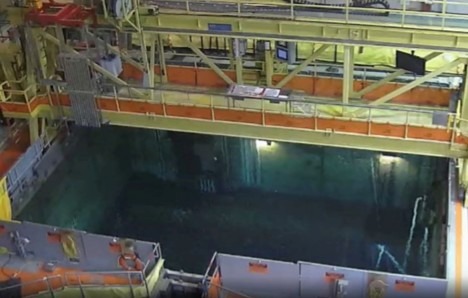
In a widely expected ruling, the state on Tuesday rejected Holtec International’s appeal of an order preventing it from discharging treated radioactive wastewater into Cape Cod Bay as the company decommissions the Pilgrim nuclear power plant.
The decision by the Massachusetts Department of Environmental Protection upholds a 2024 denial of Holtec’s request to release up to 1.1 million gallons of water from the Manomet plant and follows a review process that generated more than 1,000 public comments, the great majority in opposition to the plan.
“In consultation with the Massachusetts Office of Coastal Zone Management, MassDEP determined that the water that Holtec proposes to discharge into Cape Cod Bay qualifies as industrial wastewater, and therefore, the proposed discharge is prohibited,” the agency said in a press release.
The “final decision” can be further appealed to state Superior Court, the DEP said.
Opponents of discharging water into the sea applauded the appeal denial, but cautioned it does not address a looming question: What will happen to the many gallons of contaminated water that remain inside the plant?
“We are pleased the state prevailed in the Holtec appeal by upholding the law that finds it illegal for wastewater ‘liquid or gaseous materials’ to pollute our protected Cape Cod Bay,” said Diane Turco, director of the environmental group Cape Downwinders, in an email. “So now how will the state prevent the ‘gaseous’ release of that same wastewater (including tritium) from Holtec’s industrial decommissioning site – airborne pollution via forced evaporation?”
More than two years ago, the state determined Holtec could evaporate low-level contaminated water into the air. Seth Pickering, deputy regional director of the DEP’s Bureau of Air and Waste, said in a letter at the time
that a permit for such emissions was not needed because the amount released annually is low. Pickering also said the radioactivity levels were well below safety standards set by the federal Nuclear Regulatory Commission.
In a statement, state Senator Dylan Fernandes, whose district includes Plymouth, called the decision “a victory for our environment, our tourism economy, and the fishing families that depend on these waters.”
“From the beginning,” Fernandes added, “we’ve said that Holtec must be held accountable and that the people of the South Shore and Cape Cod deserve transparency about how waste is being handled. Cape Cod Bay is not a dumping ground.”
The bay is protected under the Ocean Sanctuaries Act, a point stressed by many of those who submitted comments to the state – including members of the Save Our Bay coalition. They “demanded” the state enforce the law, said Turco.
“That’s democracy in action with a win for the people,” she said.
Plymouth Select Board Chair Deb Iaquinto said the board will be briefed on the appeal denial in a closed-door session next week, “so I don’t really feel informed enough to comment right now.”
It’s not known whether Holtec will take the wastewater issue to Superior Court. A company spokesperson said in an email it is “reviewing the finalized denial and looking at what options may remain available. Our goal has always been to safely clean up the site for future economic reuse.”
In an apparent swipe at Holtec critics, the spokesperson said “challenges to safe discharges” have “already” delayed the cleanup process by eight years.
“We will look at the impact of a formal denial on that schedule but as always, our focus remains on a safe, efficient cleanup of the plant,” he said.
Pilgrim, which began generating electricity in 1972, had a long and checkered history that included yearslong shutdowns. In the end, however, the plant’s permanent closure by Entergy in 2019 was not the result of health and safety concerns or because of pressure from anti-nuclear groups and officials. The company said several factors – including cheaper natural gas – had made Pilgrim a financial albatross as nuclear power fell out of favor.
Later that same year, the NRC transferred Pilgrim’s licenses to Holtec. Decommissioning, with a price tag that could top $1 billion, is expected to take until at least 2035 to complete. Even then, the site will still be a nuclear waste dump. The highly radioactive spent fuel rods are likely to stay on the site – stored above ground in 62 reinforced cement casks – for many years. That’s prompted concerns about their safety and susceptibility to a terrorist attack.
Mark Pothier can be reached at mark@plymouthindependent.org.