
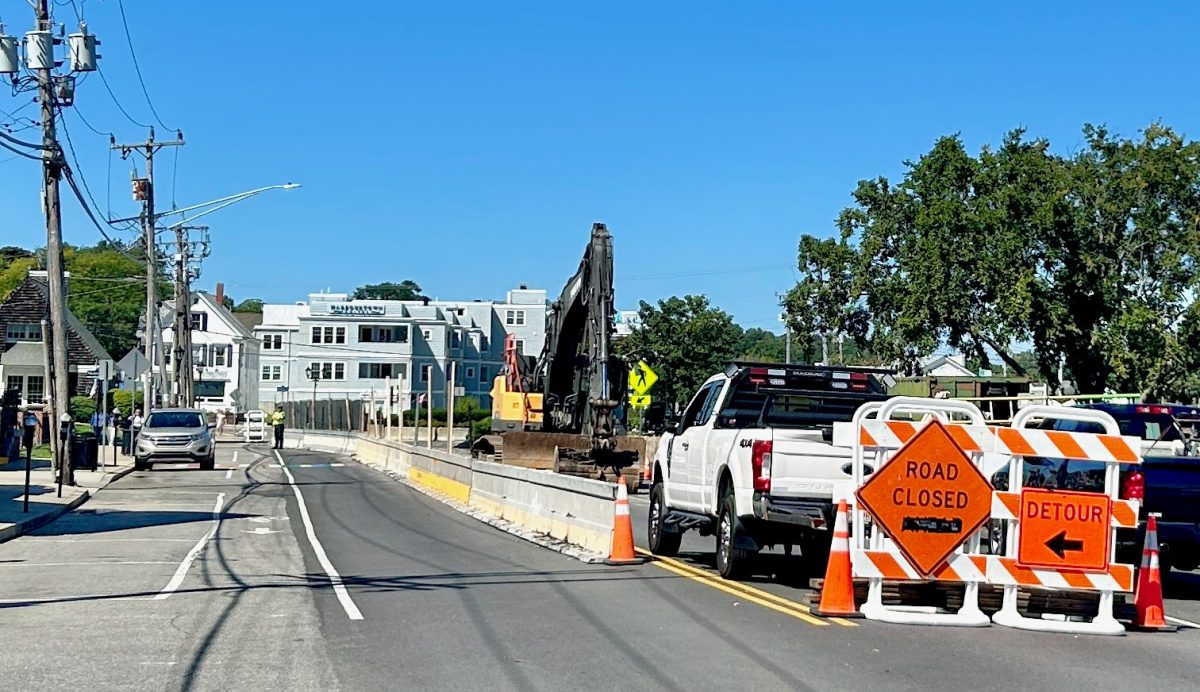
For the fourth time in as many years, construction is once again disrupting Water Street, one more last-ditch effort to build a new sewer line to replace the aging pipe running under a portion of the harbor.
Work began Monday, running from the rotary near the visitor’s center to the intersection of Chilton Street. Water Street is restricted to one-way traffic heading south throughout the area. Northbound traffic will be detoured up Chilton Street.
“Everyone is hoping that this is it, and I believe it will be,” said Plymouth DPW Director William Coyle. “We want it to be done in time for the Thanksgiving Day parade.”
This phase will replace the last 70 feet of pipe, out of the quarter-mile of new pipe already installed, because it has settled more than expected into unstable soils. To cover the cost of additional support for this last section of pipe and prevent further sagging, Coyle said the town agreed to pay an additional $800,000 to the contractor, Northern Construction, bringing the total cost of the project to $7.3 million.
The ongoing saga of the sewer line flows from the need to replace an aging quarter-mile section of 30-inch sewer pipe installed in 1969 that runs under the edge of the harbor adjacent to Water Street. Town officials were concerned a break in the old line would be an environmental disaster for the waterfront.
Northern Construction was awarded the contract to replace the old sewer line in 2022. Work began in December that year and was supposed to be finished by the end of June 2023. But in March 2023, during the first phase of excavation, groundwater problems, shifting soils, and damage to the street, sidewalks, and five buildings on Water and Chilton streets forced the project to shutdown.
One building was damaged so badly it had to be razed. The owners of the affected buildings are suing both the town and Northern Construction, seeking more than $5 million in damages.
After the debacle in March 2023, an engineering review led to additional groundwater monitoring and relief wells placed within the working trench to prevent further damage. With those modifications in place, the project resumed briefly but was put on hold for the 2023 tourist season.
Work resumed in January 2024 and proceeded without major construction problems. It was finished in May 2024. But by then, more settlement issues were being tracked.
The town ordered the current work, over the contractor’s objections, to repair the sagging line that could cause waste to back up.
The new plan to fix the last 70-foot stretch is to replace the PVC pipe initially installed with ductile iron pipe. PVC, which is a form of plastic, is more flexible and can sag if the gravel below it erodes. Ductile iron pipe is far more rigid and will not sag, Coyle said.
Plus, for additional support, crews will install steel beams under the pipe, which would work like joists holding up a floor. Those beams will be welded into the steel retaining walls that are pounded 40 feet into the ground to stabilize the working trench.
“It’s a belt and suspenders approach that should hold that pipe in place,” Coyle said.
The area now under construction has been a troubled stretch of infrastructure for years.
In 2014, an earlier attempt at replacing the sewer line was stopped relatively quickly, when higher than expected groundwater and tidal influence on the area swamped the trench, flooded the street, and disrupted the manhole and pipes installed. Details of the 2014 failure are included in the town’s 2022 public presentation about the history of the sewer project.
After the 2014 incident, numerous test borings were done to characterize the subsurface layers and monitor the flow of water in the area. That data was used to create the current design for the sewer project and was included in the 603-page description of the site and project the town issued in 2022 as its “invitation to bid” for a contractor.
Whether or not the groundwater data, and the eventual design of the project, were reliable is one of the central issues in dispute. The town has claimed the design was proper and construction methods caused problems. Northern Construction has claimed the design was based on inaccurate data. And the property owners suing argue the town and the contractor share responsibility.
For more of the history of the project see: https://www.plymouthindependent.org/dispute-will-delay-water-street-sewer-line-repairs-until-at-least-december/.
Michael Cohen can be reached at michael@plymouthindependent.org.