
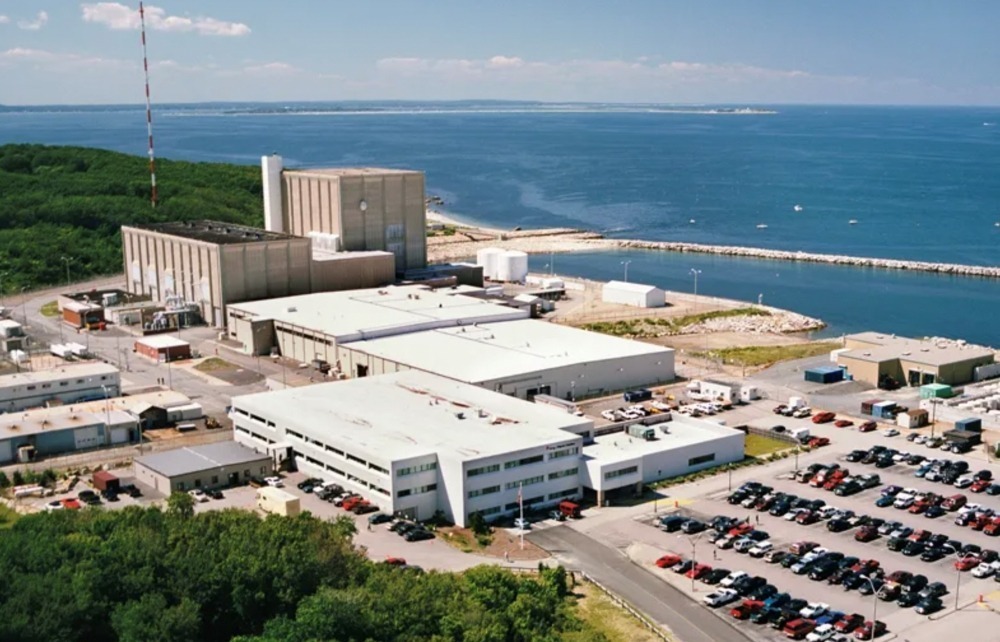
I read with interest Mark Pothier’s recent article in the Plymouth Independent about the possibility of one or more small modular nuclear reactors (SMRs, in industry jargon) at the former Pilgrim site. My views on this are informed by a career in the electric industry that spanned more than forty years, the last twenty of which were spent advising electric utilities across the US on technology and policy issues.
In my view, Pothier was right to be skeptical given that SMR technology is still in its infancy.
While SMR technology is undergoing rapid development and testing, thanks in large part to robust federal support, no units are yet in commercial operation in the US. So why does this potential use of the Pilgrim site keep coming up in conversations around town?
It is significant to note that Holtec International was recently awarded a US Department of Energy grant worth as much as $400 million under the agency’s the Generation III+ Small Modular Reactor Pathway to Deployment Program. See: “TVA, Holtec Gain $800M US Funding for Small Nuclear Reactor Builds,” Engineering News Record, December 5, 2025.
Regardless, the 345 kV bulk transmission lines that connect the Pilgrim property with the region’s electric grid are invaluable. They make a compelling case for an energy-related re-use of the former nuclear plant site. And a number of non-nuclear options do exist:
• The site could become a landing point for a submarine cable bringing wind energy and/or hydropower from Canada. The Canadian company Emera Energy proposed this in 2017 but wasn’t successful in its bid to supply power to Massachusetts under the state’s renewable energy procurement process.
• Construction of a combined-cycle gas turbine (CCGT) power plant to meet the growing regional power demand.
• A large-scale, energy storage facility, or battery project, that could be dispatched by the New England Independent System Operator (ISO-NE).
• A mega data center requiring a large amount of power to operate.
Would any of these contribute to tax revenues or economic development in Plymouth? Yes, but each would have a different profile regarding the number of temporary construction and permanent jobs created. Would energy generated on the site be directly beneficial to town residents and businesses? Probably not. The facility would become part of the portfolio of wholesale power supply resources overseen and managed by ISO-NE.
So, what’s the bottom line here? Plymouth doesn’t appear to have much if any leverage over what happens on the former power plant site since Holtec owns the property. Nevertheless, it would seem prudent to try and work proactively with Holtec on the evaluation of any prospective energy facility to mitigate potential impacts and create the best possible outcome for Plymouth residents.
– Eric P. Cody