
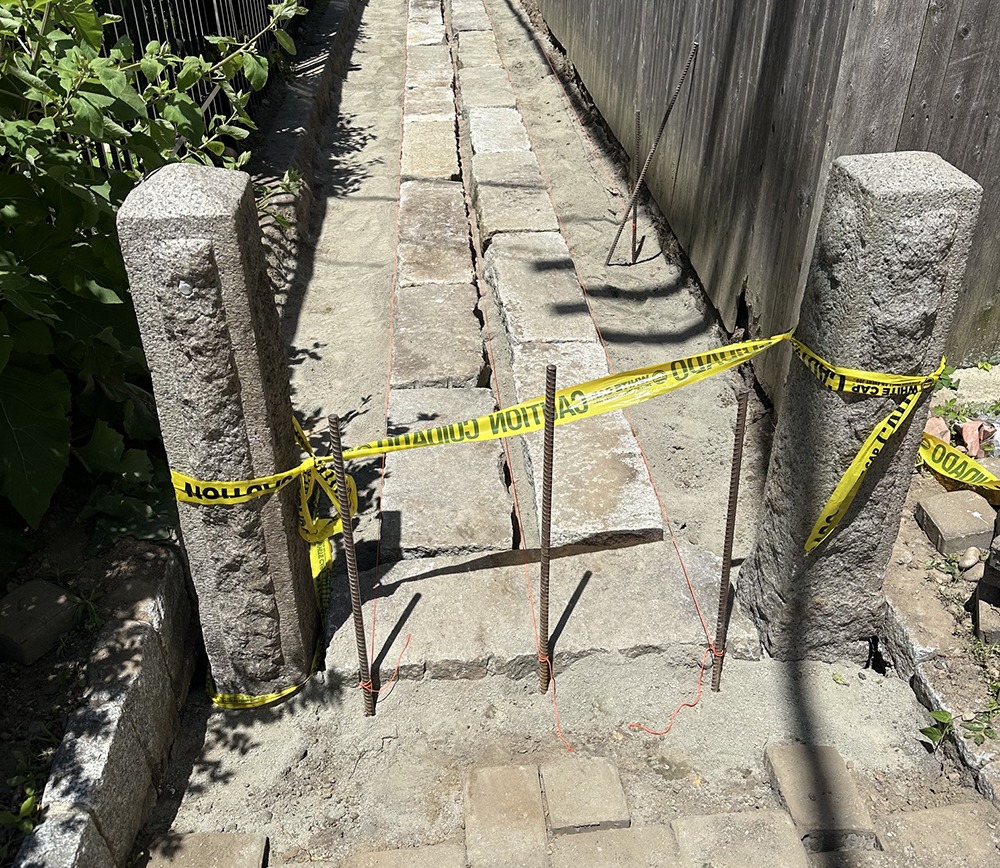
Anyone who has plodded around Plymouth long enough knows the shortcuts pedestrians take from one part of the downtown area to another. Strung together, these ancient alleyways, cracked blacktop parking lots, forgotten side roads and an occasional private property can save steps while trekking through the neighborhoods between the waterfront and shopping district.
“It’s really interesting that Plymouth has these pathways that enable us to walk around town even when it is inundated with traffic,” says select board member Bill Keohan. “People can walk through neighborhoods more efficiently because of them.”
One of these cut-throughs enables pedestrians to travel quickly from Brewster Street through to Leyden Street, the first roadway of the Pilgrims. The first part of this narrow urban route serves as a passage back to a forgotten era in Plymouth, when rope bound together 13 defiant colonies and then the new United States.
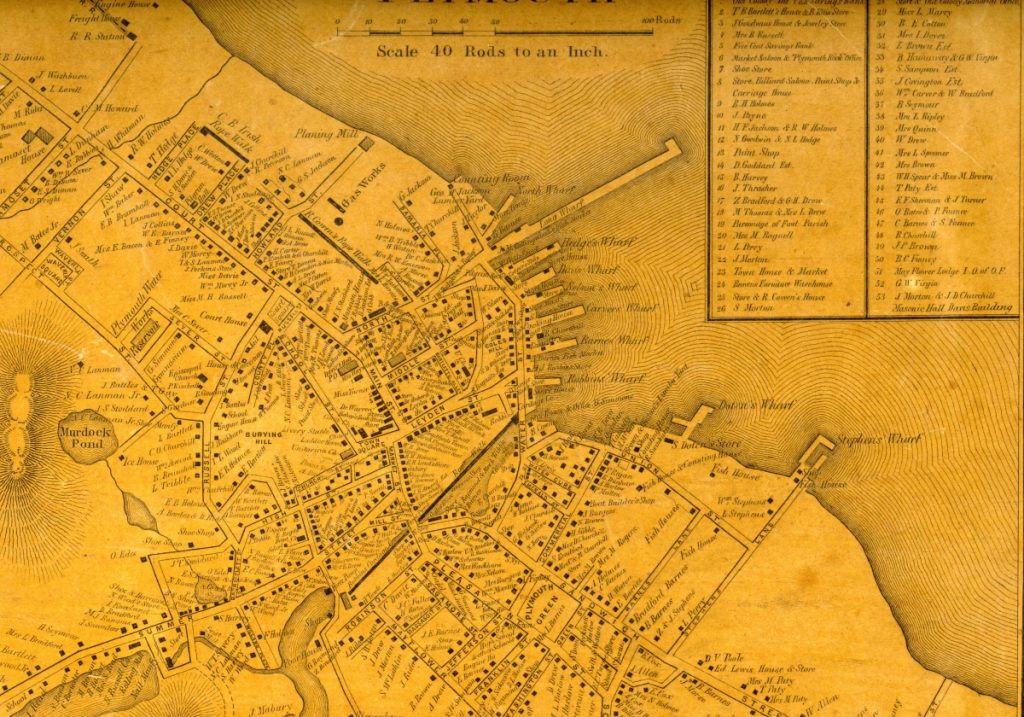
The Robert Cowen Rope Walk is now buried under the asphalt at North Lot, a municipal parking area between Brewster and North streets. It started at Howland Street, but that section today is overgrown with houses and backyards. Since 1809 – and perhaps earlier – long lengths of rope and twine were spun here to meet the needs of a growing America.
In this bygone era, cordage was a necessity of everyday life. It was used on sailing ships, fishing boats, sawmills, granaries, home and building construction, oil rigs, farmsteads and nearly all other commercial endeavors of the day. Ropewalks sprung up across Plymouth to feed this gnawing need.
“For centuries, Plymouth was a ropemaking port,” Keohan says. “Everyone needed rope, so several of these long, narrow buildings were built to produce cordage.”
Around 1809, the first building was erected on the site for what was then the Abraham and William Hammatt Rope Walk. The post-and-beam structure was only 10 feet wide but stretched an estimated 700 feet. Inside, a large spinning wheel churned out lengthy lines of cordage.
“In order to make a long rope or cable without splice or join, it was necessary to have a single straight corridor in which to lay out the full length of the line,” states author James Baker, a respected researcher of Plymouth’s past.
Cordage might have been made at this site long before the building was constructed. Co-founder Abraham Hammatt died in 1797, suggesting the company was in operation years before the lengthy wooden structure was built.
“It should be noted that early ropewalks were not housed, but done on long outdoor paths, as was still common in England in the 18th century, or simply given a roof,” Baker says.
The ropewalk was acquired by Samuel Robbins in 1833 and later conveyed to Cowen, his son-in-law. By 1850, it employed five people producing fishline and twine worth $4,250 annually, according to records.
The long and narrow shed may have been constructed along an existing alleyway, which were common in old Plymouth. In 1899, local historian William T. Davis wrote about these slender side streets in his book Ancient Landmarks of Plymouth:
“For some unknown reason alleys seem to have been peculiar to seaport places like Provincetown, Salem, Marblehead, Newburyport and Plymouth, in the last of which were in my day, Thomas’s Alley, Cooper’s Alley, LeBarons’ Alley, Spooner’s Alley and Clamshell Alley.”
Cowen’s Rope Walk remained in business until at least 1880. Fred A. Jenks, who wrote a series of articles about the town’s cordage industry in 1925, visited the site 60 years earlier as a youth:
“The writer can well remember the big wheel that stood right in front of the door. The Rope Walk was an old rope walk at that time and there was no large rope made, if, indeed, there was ever any rope of great size made there. If you had gone a little further down North Street and passed down Gordon Place, and turned to your left, you might have seen Capt. Luther Ripley and his old white horse, walking in a circle, producing the power for the Rope Walk. In those days, little was made there except clotheslines, fishing lines, spun yarn and other tarred fittings. But it was the Tar House that required the power furnished by Capt. Ripley’s horse.”
Tar, or pine pitch, was an important additive for rope and line in the 19th century. It was crucial for making cordage durable and long lasting, especially for ships’ rigging and even oil wells. Tarred rope was used on the first rigs after oil was discovered in Pennsylvania in 1859, before steel cables became common.
“Pine tar, also known as Stockholm tar, was a waterproofing and stiffening application necessary to preserve cordage at sea for rigging and netting,” Baker says. “When old tarred rope was scrapped, it was cut up and broken down into fibers called oakum. ‘Picking oakum’ was a common punishment for those who could not break stones up for paving in those days. It was used for caulking ship seams.”
Cowen’s was not the only ropewalk in Plymouth. At least six other sites are known to have existed here, including Plymouth Cordage in North Plymouth, the world’s largest producer of rope at one time. By the early 20th century, the company employed more than 2,000 people – many of them immigrants – and was a powerful force in the local economy.
Two other ropemakers were in the downtown: Charles B. Irish Rope Walk, located behind where Pilgrim Hall Museum is today, and Holmes and Barrows Cordage Co., somewhere west of Court Street. Built in 1805 by Thomas Holmes and Samuel Robbins, the Irish site featured a long ropemaking shed that ran from Hedge Place (now Memorial Drive) to Chilton Street, a distance of some 400 feet. It employed five men and made cordage, lines and twine worth about $3,800 annually. It also shut down around 1880.
Constructed by James Baxter around 1840, Holmes and Barrows employed 11 men and made 53 tons of rope valued at $10,000 in 1850. The exact location of this ropewalk is lost to history since it doesn’t appear on maps of the day, nor has an address been discovered.
Another ropemaker was situated in the vicinity of present-day Christ Episcopal Church on Court Street. Across from what is now Grant Street was the Benjamin Dimon Rope Walk, which employed three men and produced light cordage worth about $2,500 in 1850. It closed in 1885.
Manomet also had its own ropewalk, though its name is not remembered. James Thacher, a Revolutionary War surgeon and early local historian, wrote about it in his 1832 book A History of the Town of Plymouth:
“The factory, at Manomet Ponds, contains about 300 spindles and manufactures about 50 pounds of coarse warp per day, a considerable portion of which is colored, and made into cod and mackerel lines, which are lately introduced into use, and bid fair to supersede those made of hemp altogether. These are twisted and laid by water in a small line-walk attached to the factory.”
In the early 19th century, the biggest ropemaker was located at Town Brook. Founded about 1815, the Robbins Cordage Co. was massive. Its shed stretched more than 1,000 feet in length from the waterfront all the way to Jenney Pond, then known as Alms House Pond since the town’s “poor house” was located there.
“The long Robbins ropewalk extended upstream on posts over Town Brook from a spot near today’s Water Street entrance to Brewster Gardens across ‘Ropewalk Pond,’ the tidal pond that was filled in to create the Gardens in 1924,” Baker states.
At its zenith, Robbins Cordage employed 75 men and was even larger than Plymouth Cordage Co. at the time. By 1850, after two major fires, 38 people worked there producing 750 tons of tarred cordage. However, by 1862, the business had ceased operations.
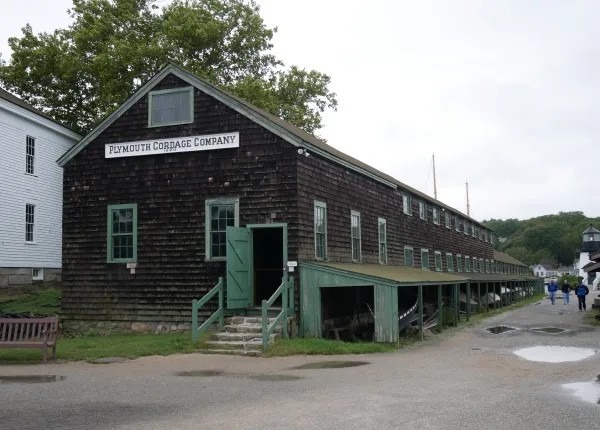
Of course, the longest lasting was Plymouth Cordage, established in 1824. It was said that ships from all points of the compass sailed to Plymouth to get new rigging there. In its early days, the company featured a covered ropewalk measuring 1,025 feet in length. In 1950, a 250-foot section of that structure was donated to Mystic Seaport Museum, where it is on display today with ropemaking exhibits and demonstrations.
After 140 years of continuous operation, Plymouth Cordage ended its reign when a hostile takeover by corporate raiders led to the selloff of its assets in 1964. Today, Cordage Commerce Center, which includes the Plymouth Cordage Museum, occupies what is left of the 2 million square feet of production space at that once-mighty enterprise.
In the downtown, asphalt and concrete cover much of what was a thriving industry. Plymouth has a tendency to focus solely on its Pilgrim history, so there are few reminders of what was once there – other than the ancient alleys.
Residents and visitors can still walk the blacktopped shortcut through North Lot where the Robert Cowen Rope Walk once spun cordage for America. It connects with two tiny backroads – Gordon Court and Gordon Street – before crossing North Street to Spooners Alley, next to Plymouth Center for the Arts.
There, town workers are restoring the walking surface so pedestrians can still stroll this narrow passageway back in time. Large stone blocks originally placed there more than a century ago are being dug up and repositioned to ensure safe footing for those who like to cut through.
“We’re fixing exposed granite stones and settling that have created trip hazards,” says James Downey, DPW assistant director. “We’re also removing asphalt that was used as patches for deterioration that happened decades ago.”
Spooners Alley, which opened in 1784, passes next to a commercial property, which has an easement from the town to use the lane for parking, to Middle Street. There, at Middle Lot, another public parking area, it connects with LeBaron Alley, which continues to Leyden Street.
During the ropemaking era, that historic street led down Coles Hill to a series of long wharves, where ships and fishing boats eagerly awaited the long coils of cordage. It’s not hard to imagine ropewalk workers using these alleyways to transport rope, line and twine to the docks on the Plymouth waterfront.
Think about that the next time you take a shortcut through the downtown.
Dave Kindy is a longtime Plymouth resident who writes for the Washington Post, Boston Globe, National Geographic, Smithsonian and other publications. He can be reached at davidkindy1832@gmail.com.