
The Salvation Army building atop Coles Hill is a small piece of Plymouth’s housing puzzle. But it matters.
I don’t mean to leave you hanging, but a bit of backstory is needed before we get to “here’s why.”
The Carver Street building has sat empty for nearly a decade – through and beyond a red-hot real estate market. The striking stone facade is more than a century old, with a multi-million-dollar view of one of the country’s most historic harbors. There’s onsite parking, too – a rarity in the business district.
Whether such a prominent parcel would remain fallow for so long in any other coastal town is a subject for another column about Plymouth selling itself short by not thinking big.
That lack of confidence does not apply to Edward and Ayli Gates. Even as the Salvation Army property lapsed into decay, the possibilities remained obvious to the local couple. In 2018, the Gates bought the building for $1.2 million, with a vision to re-invent it as a unique events venue.
But Brad Cushing, a deep-pocketed neighbor, didn’t share their vision. In classic NIMBY fashion, Cushing appealed decisions by various town boards to green light the project. When that didn’t work, he went to court.
“There wasn’t a credible basis for the lawsuits, but they took a lot of money, and they took a lot of time,” Ed Gates told the Independent’s Michael Cohen last year. The couple are also donors to the Independent and will host its gala fundraiser in September.
Cushing eventually lost the battle, but he kind of won the war. In 2023, with Ed Gates facing mandatory retirement after a 40-year career with the Boston law firm Wolf Greenfield, the couple decided it no longer made sense for them to take on such an ambitious project. They put the blighted property on the market for $2 million.
Earlier this month, it was finally sold for an undisclosed price to Richard Rosen, a Whitman developer with deep experience. His past projects include transforming a former Baptist church in that small town’s center into 15 apartments.
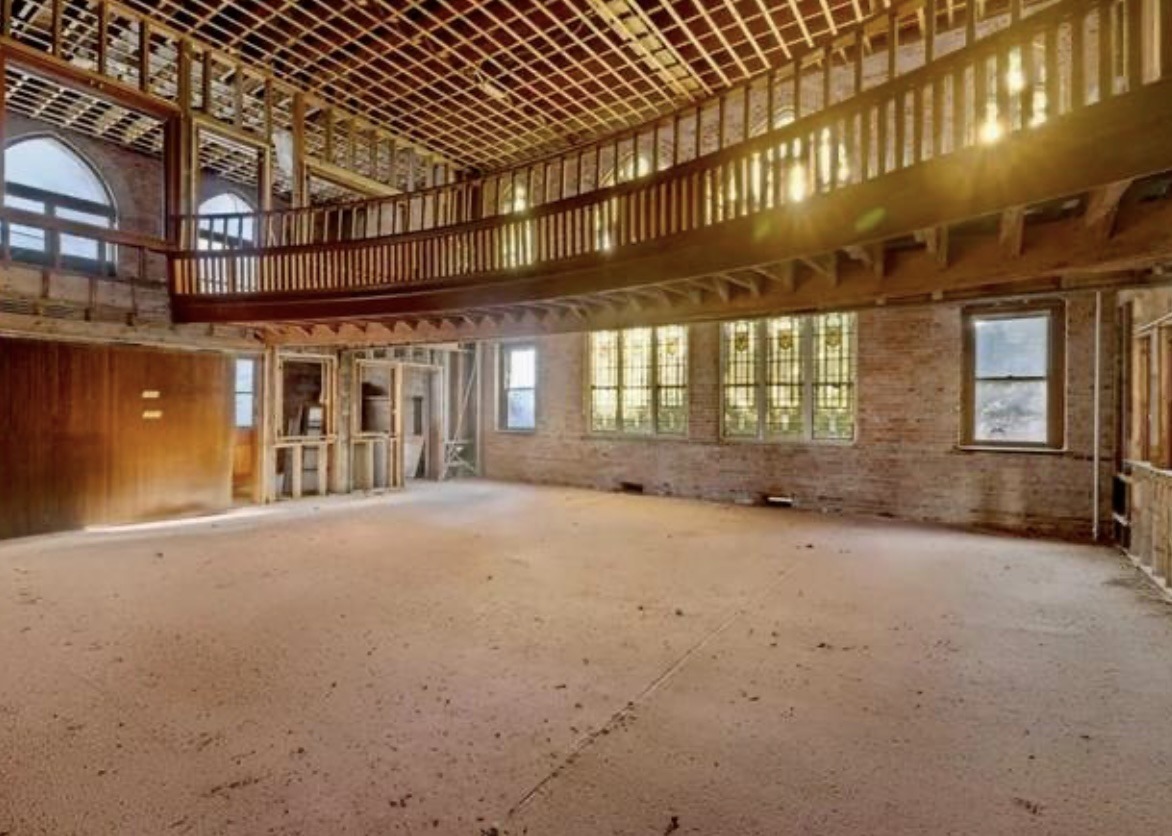
Rosen’s plans for the former Salvation Army building are slightly more modest, though the structure is in worse condition than the Whitman church. He wants to turn it into six one-bedroom condominiums of about 600-square-feet apiece, a 750-square foot one-bedroom, and a two-bedroom unit on the top floor covering about 1,200 square feet.
Rosen wasn’t planning on signing up for such an ambitious undertaking at a stage of his career where he could be content with a victory lap.
“Someone called me last July and said, ‘Hey, you’ve got to look at the property,’” he told me. “I called the Realtor and looked at the building. The outside is deplorable…The inside is completely gutted.”
But Rosen was not deterred. His reaction was just the opposite.
“I was like, ‘This is really sweet,’” he said.
Earlier this year Rosen struck a deal with the Gates. Now he’s started the process of introducing his plans to the Historical District Commission and other town committees. He knows many challenges lie beyond the red tape, including an investment of several million dollars and an undetermined timeline.
“I want to bring that building back to the beauty that it once had, and I can do it,” Rosen said. “I want people to be able to look up on that hill at Thanksgiving when you’re having your parade and go, ‘Jesus, that building looks nice.’ It’s something that everybody in town will be proud of.”
Here’s where it fits into the local real estate market equation.
“It will bring needed added housing. It will bring more tax dollars to the Town of Plymouth without providing any services, because it’s seven one-bedroom condos and one two-bedroom,” Rosen said “Having done this for a long time, I can tell you that one-bedroom condos don’t bring children. You won’t have to add any teachers to the school system. You won’t have to have any more cops or firefighters. It’s a win-win-win for everybody.”
As for parking, an endlessly hot topic, Rosen said one-bedroom units are “historically occupied by one person, and the two-bedroom is allowed two parking spaces. So the short answer is yes, there’s enough parking.”
“This particular project is a great example of a reuse of a historic structure,” he noted. “If we can find a use that will allow that structure to exist and be adaptively reused, that’s wonderful. The location of it is suitable for people who may want to live and work in the downtown. They can walk to goods and services.”
That makes sense. Yes, the units won’t be priced for first-time buyers, but no one should expect to be able to buy entry-level housing in a restored church with a panoramic vista.
Mixing more housing like this into a high-density commercial zone is a hallmark of smart-growth planning, and it’s crucial to the downtown’s vitality. Downtown isn’t merely a place to eat, drink, and shop – it’s also a neighborhood.
Some of the condo buyers might be single professionals. Others could be downsizers seeking a cool place to live that doesn’t require a lot of driving or maintenance – people who can pour money into the local economy without burdening public services. The larger homes they sell to move there could be ideal for a growing family looking to move up a step or two on the real estate ladder.
Assistant Town Manager Lauren Lind says the plans nicely fit into a niche of Plymouth’s comprehensive planning template, adopted by the Planning Board in March.
“What we heard through all of our engagement [with residents] was that housing is a need – specifically, types of housing that are alternatives to your standard single-family home,” she said.
That includes “things that are a smaller footprint,” Lind said. “The location of it is suitable for people who may want to live and work in the downtown. They can walk to goods and services, so that would be in keeping with the comprehensive plan as well.”
Contrary to a popular social media myth, Plymouth doesn’t have enough housing – it’s a key reason why homes are unaffordable for a wide swath of the population. Demand exceeds supply.
“There’s not enough inventory,” Lind said, using a real estate industry phrase. “Specifically, for those individuals who may already own a home in Plymouth and are looking to downsize, there are very limited options…If a smaller option like a condo downtown opens up for someone looking to downsize, then that does free up inventory for another homebuyer.”
And the diversity of housing stock matters as much as the overall numbers. Many people don’t need three or four bedrooms.
Then there’s the restoration element. Whether residential or commercial, repurposing existing buildings or already cleared lots is far preferable to cutting down trees and strip-mining land for sand and gravel.
“This particular project is a great example of a historic reuse of a structure,” Lind noted.
I agree. So does the man with an impressive track record of rehabbing empty buildings in Plymouth – developer Rick Vayo.
“I’m glad to see this project finally taking shape,” he said in an email.
“I haven’t seen all the plans nor do I know the developer, but I’m hoping this project is done with the care and attention to detail it deserves,” said Vayo.
His list of high-profile projects involving vacant or dilapidated buildings is lengthy. It includes condos at the old National Guard Armory on Court Street; converting the 1904 Registry of Deeds/courthouse on Russell Street into 19 condos; turning the fleabag Governor Bradford Hotel into a Water Street showcase with apartments, the La Baia restaurant, and Vitamin Sea Brewery; constructing apartments at the former Mount Pleasant School on Whiting Street; redesigning the empty Eastern Bank downtown into the wonderous Bamp’s Toy Vault; and later this year, bringing a much-needed boutique hotel – The Drew – to Chilton Street.
“Condos, in my opinion, are the best choice” for the Salvation Army site,” Vayo said, “and will again promote downtown living and support the downtown economy.”
He knows from experience Rosen won’t have it easy. Think of the last home renovation work you undertook and multiply the complications by tenfold.
“But the bones are there to create something that will last another 100 years,” Vayo said.
It’s a prime example of how to preserve a piece of the past while tackling Plymouth’s present and future needs.
Mark Pothier can be reached at mark@plymouthindependent.org.