
Growing up, David Jacobson knew his father was a hero – he just didn’t know how much of one.
His dad, Russell, served in Vietnam but rarely spoke about what happened, though David could see it was significant. His father, who had been a U.S. Navy corpsman, or combat medic, with the Marine Corps in 1967, walked with a severe limp – his right leg mostly useless – aided by a large brace and ever-present cane.
Then there were the scars. Both legs were covered with stitch marks and ugly red lines from 93 painful surgeries to restore his father’s ability to walk and return to a somewhat normal, if unsteady, life.
“There was a hole in one of his legs that had never fully healed,” says David, who lives in Manomet with his family. “It was big enough to hold several pens. I’d never seen anything like that before.”
When David asked about the scars, Russell just grinned and uttered a line from a Monty Python movie: “‘Tis but a flesh wound.”
Like many combat veterans, Russell wanted to put the war behind him. Instead, he focused on rebuilding his life, working as a physician’s assistant and pathologist, being a good husband to his wife Peggy and caring father to his sons Andrew, Matthew and David.
When the Plymouth resident died in 2015, David was left with unanswered questions about his dad’s military service. One in particular had to do with the flak jacket, or armored vest, he was wearing when wounded by machine gun fire and a grenade. Russell learned from a Marine Corps officer it would be donated to a museum.
“When Russ was recuperating at Chelsea Naval Hospital, he was told the flak jacket was going to (Marine Corps Base) Quantico,” says Russell’s widow Peggy, 80, who now lives in Connecticut.
If it did make it to a museum, David wanted to know which one, so he began searching. His odyssey would lead him to one of the nation’s most prominent museums while opening his eyes to the selfless sacrifice his father made in the jungles of Vietnam.
“I knew pieces of his story my whole life, but I never had the full picture,” he says. “I didn’t know how incomplete my picture was until recently.”
David, 49, who lives in Manomet with his family and works for Gillette in Boston, contacted several places, including Quantico in Virginia and the adjacent National Museum of the Marine Corps. Both stated they knew nothing about the artifact. Then he checked with other museums, always getting the same answer: they didn’t have it either.
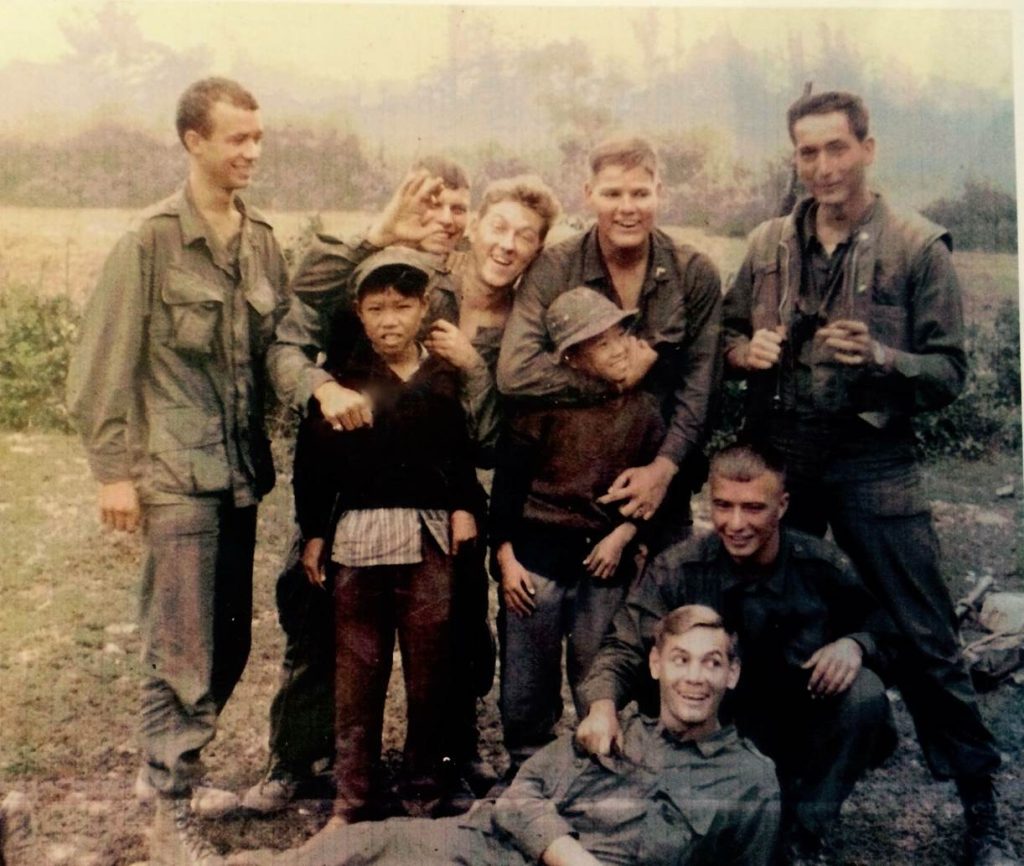
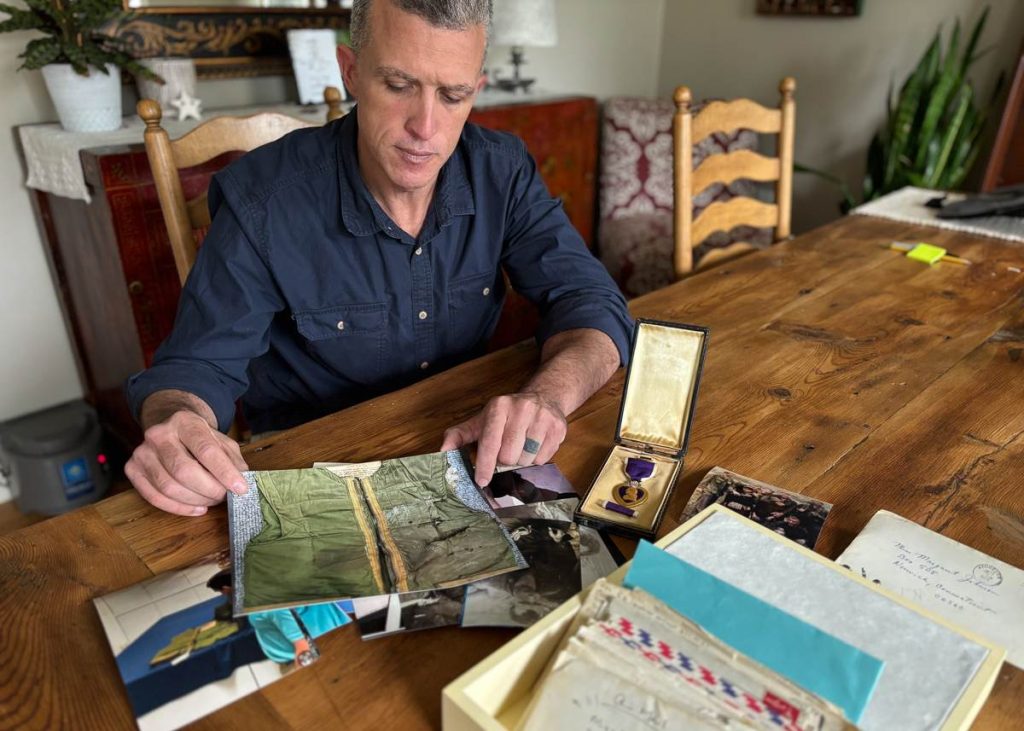
As the search continued, David began putting together the puzzle of what his father experienced in Vietnam. He perused old letters, checked newspaper articles, read books and talked to veterans who had served with Russell. Slowly, an amazing, yet agonizing, story of courage under fire and resoluteness in the face of adversity emerged – much like in the 2000 book Flags of Our Fathers by James Bradley, who learned after his father’s death he was part of the historic flag raising at Iwo Jima in World War II.
“I always knew he was brave,” David says. “I knew what corpsmen did. But I didn’t know the full extent until I started piecing it together. That part did surprise me.”
According to David, Russell H. Jacobson Jr. grew up in Norwich, Connecticut, and volunteered for the U.S. Navy in 1965 just before he was drafted. He went through basic training at Naval Station Great Lakes in Illinois and became a Hospital Mate Third Class, qualifying him to serve as a corpsman with the Marine Corps.
Russell shipped off to Asia and in February 1967 took part in Operation Chinook II, a search-and-destroy mission to root out enemy strongholds in South Vietnam. On March 16, 1967, he was on patrol with Echo Company of the 3rd Marine Division’s 1st Battalion, 9th Regiment (1/9) – a unit known as “The Walking Dead” because it had the highest casualty rate in Marine Corps history. The nickname rang true during the Hill Fights, or First Battle of Khe Sanh. That day, 20 Marines were killed and 59 wounded in a vicious firefight.
According to various accounts, Russell was with the point platoon at the base of Hill 861 when he noticed a smoldering cigarette butt on the trail. Before he could yell, “Ambush,” machine-gun fire cut into the Americans from all sides. Marines started falling and Russell, as one of two corpsmen in the battle, sprang into action. “Doc Jake” – as he was known – began treating injured men while bullets whizzed all around him. When Russell came across a seriously wounded American, he and another Marine used a poncho for a stretcher to move him out of the line of fire.
Suddenly, two North Vietnamese Army soldiers jumped out of the jungle and began firing AK47 machine guns, killing the wounded man and Marine helper. Russell rolled off the trail into a thicket of bamboo, where another Marine landed on top of him. The enemy fired at their hiding place, killing the Marine and wounding Russell in the legs.
The enemy soldiers used Russell as a decoy to attract other Marines who wanted to rescue him. To prevent his comrades from being killed, the injured corpsman yelled, “Get back!” An enemy soldier placed a grenade under Russell, which detonated and ripped through his right hip and kidney, though the flak jacket protected most of his torso. He may have died at that moment.
“Russ told me he had an out-of-body experience,” Peggy says. “He could see himself floating and then saw his late grandfather He was very close him. He told him to go back.”
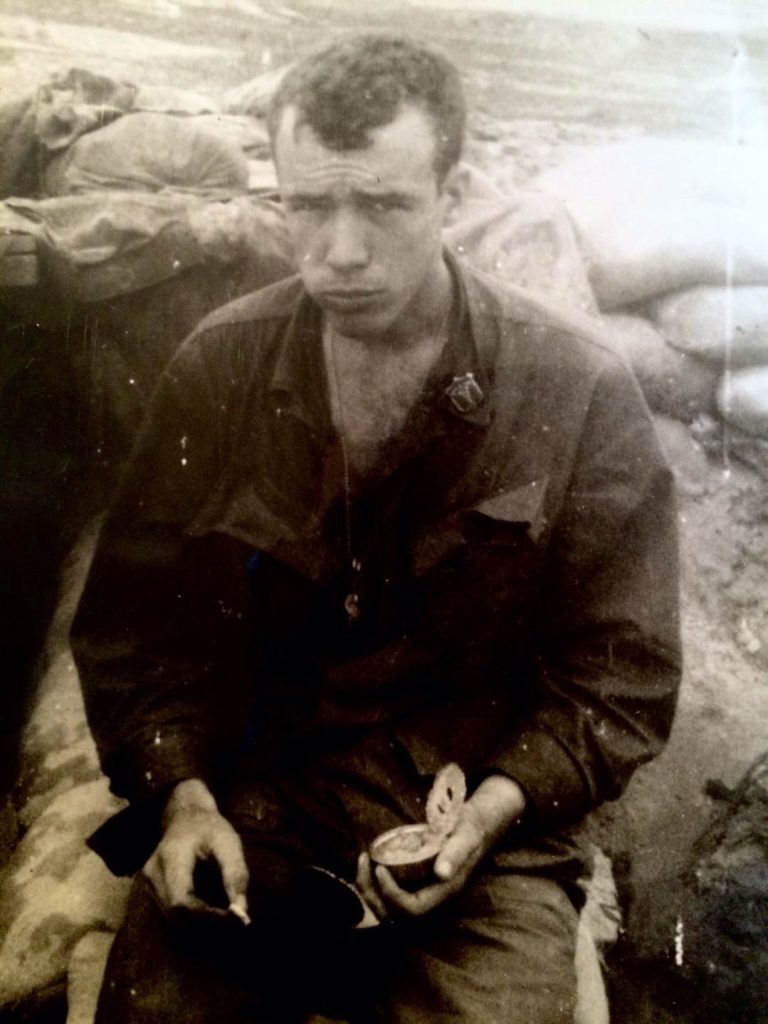
The Marines finally routed the NVA. Russell was pulled from the bamboo, though rescuers believed him dead because his wounds were so grievous. His mangled body was placed on a helicopter with dead Marines and flown back to base. There, it was discovered Russell was still alive. He was rushed to a military hospital, where doctors worked desperately to save him.
“His leg was so badly damaged they thought they would have to amputate,” Peggy says. “But doctors performed one of the very first arterial grafts and saved it.”
Through scores of surgeries, doctors removed the kidney and repaired Russell’s hip with steel rods and dozens of screws while setting the broken bones in his legs caused by multiple gunshot wounds. They removed shrapnel from the grenade but much of it remained in his body, some occasionally breaking through the skin decades later.
“He never complained about the pain and considered himself lucky just to have made it home,” David recalls.
Russell suffered through long recoveries on his stomach where he could do nothing but stare at the floor beneath him. To amuse himself, he would save food from his meals to feed the rats that ran around the ward.
“The Chelsea Naval Hospital was a pit. Conditions were horrible,” says Peggy, who was a nurse at a nearby hospital.
After the war, they married and Russell went to college, then worked in pathology at the University of Connecticut and Cape Cod Hospital. Russell and Peggy moved to Plymouth in 2005. He died in 2015 of lymphoma caused by Agent Orange, another bitter vestige of the war. The potent defoliant used by the U.S. military in Vietnam turned out to be carcinogenic, killing thousands in the years after the war. Russell Harold Jacobson Jr. was interred at the Massachusetts National Cemetery in Bourne.
As the level of Russell’s ordeal unfolded, David, Peggy and the rest of the family were stunned by the details. They had not known the extent of his courage in trying to save his comrades while under fire or his ordeal afterwards. They were also surprised when word came that the flak jacket might have been located – at the Smithsonian Institution.
Frank Blazich, curator of Modern Military History, responded to David’s inquiry with questions of his own. The Smithsonian had a flak jacket in archives that matched certain criteria but they had no documentation to ascertain where it came from or who it belonged to.
Blazich had wondered about the artifact’s backstory since starting at the museum in 2017 and was excited when he read David’s email. “I thought, ‘Wow! Could this be it?’” he says. “It’s in intriguing piece, but we just don’t know if it was worn by him.”
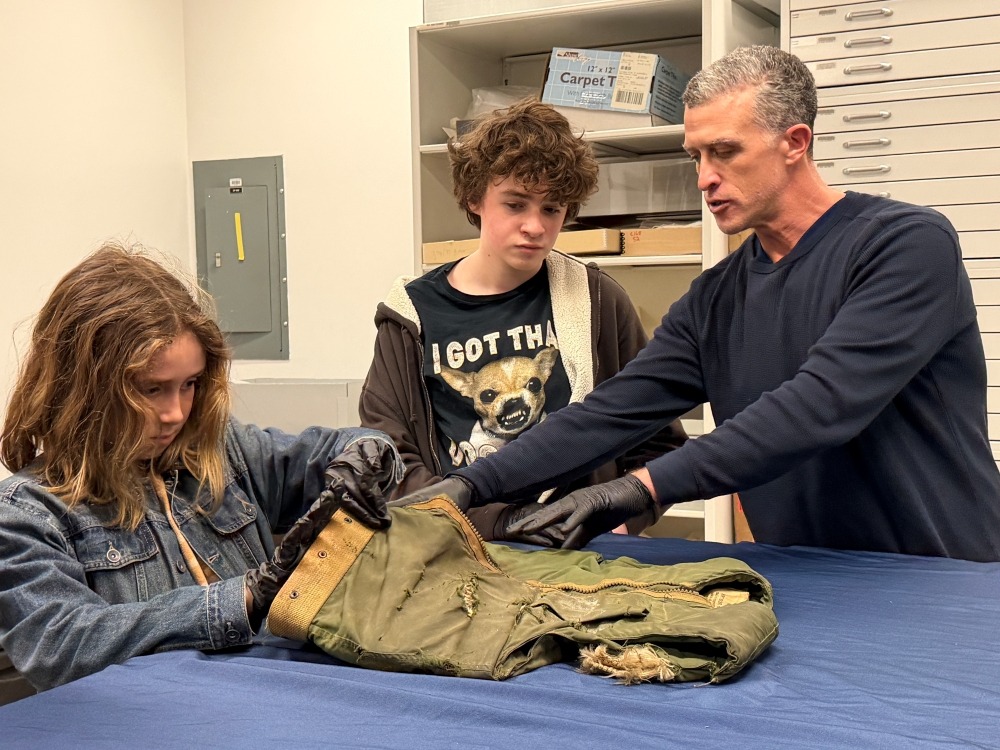
Earlier this year, David and wife Kristin and sons Eli, 15, and Abe, 11, visited the Smithsonian in Washington, D.C., where they viewed the tattered and blood-stained flak jacket. Suddenly, David began to appreciate the totality of the ordeal his father had been through.
“I always respected my dad deeply,” he says. “But holding that jacket I realized there was a whole part of him I never knew. I didn’t fully know who he was before the war and I didn’t fully know who he was after it either. There is so much he carried that I am only now starting to understand.”
David believes the flak jacket at the Smithsonian is likely his father’s, though he may never know for certain. One thing he wants now, however, is find out why his dad was never recognized for his bravery. The other corpsman at Hill 861 – Francis Benoit, who was killed that day – received a Navy Cross, the military branch’s second-highest decoration for valor, under nearly identical circumstances.
“Whenever I asked my dad about getting a medal, he would just say no,” he says. “He didn’t want to relive that part of his life.”
He adds, “I think he was overlooked for a medal because of missing paperwork. We’ve found very few records related to him. He got the Purple Heart for his wounds but nothing else.”
David is obtaining affidavits from surviving members of 1st Battalion to build his case to honor his father. One of the Marines who knows what Russell did that day is Herbert L. Thompson, who was wounded multiple times. In a letter, he describes how he and three other Marines were saved through Russell’s bravery: “Regardless of what you think, you and only you were the part that (we) made it OK.”
David’s journey to learn of his father’s military legacy has left him with a new awareness of the man he thought he knew. Learning of his dad’s courage to save others and his determination to recover from horrific wounds changed how he views him today.
“What really hit me was thinking about who he was,” David says. “He was a completely different person before that day. Not just physically, but in every way. He came home, got up every day, raised his kids, put a smile on his face and pushed through something that was not meant for human beings to endure. I always saw the physical scars but I never understood what was underneath them.”