
You’ve heard the saying “kick the can down the road.” Politicians have fashioned it into an art form, especially in Washington, where decisions on thorny issues like Social Security and a ballooning national deficit are endlessly deferred.
Some say Plymouth’s own legislators – its 162 elected Town Meeting members – acted the same way last month by refusing to make what was essentially a 1% across-the-board cut from a municipal budget of more than $331 million.
This is likely news to you. Hardly anyone pays attention to Town Meeting, even though it has the final say on how tax dollars are spent. I monitored the livestream of the marathon April 11 session, one of just two times a year representatives gather. No more than 36 people were viewing it at any one time.
I can’t fault the tens of thousands of taxpayers who decided not to spend a Saturday watching Town Meeting. Longtime moderator Steve Triffletti is skilled at trying to keep things moving, but democracy in action can make the Academy Awards look like a sprint. It took an hour and 23 minutes of ceremonies, self-congratulatory speeches, and even a poetry reading to get to the first agenda item.
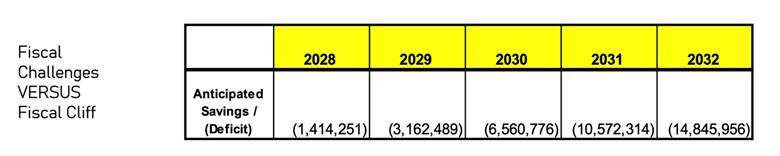
But what went down – or rather, didn’t go down – regarding the budget is important. People with knowledge of Plymouth’s financial workings believe it’s facing a so-called fiscal cliff, starting with an estimated $1.4 million deficit next year. By the following year, the budget is expected to be more than $3.1 million in the red. Then it gets worse – projections show a shortfall approaching $15 million by 2032. Finance director Lynne Barrett offered those scary details and more during an April 7 presentation before the Select Board. She used the words “fiscal cliff.”
The reason for this predicament is simple. A balanced budget is required by state law, and Plymouth is on track to spend more than it receives from tax revenues, state aid, and other sources. Something will have to give.
It’s surprising that officials weren’t sounding the alarm years ago. It’s shocking that some apparently still don’t feel a sense of urgency. During a recent WATD radio Select Board candidates forum, for example, Betty Cavacco and Dick Quintal – running as a team in the May 16 annual election – sounded as though they are in denial.
“I don’t feel that we have a fiscal cliff,” Cavacco said. “We do have some concerns.” She suggested pulling money from the town’s $11 million nuclear mitigation fund, which was established more than a decade ago to “mitigate” the impact of waning tax payments from Entergy, former owner of the Pilgrim nuclear power plant site.
Barrett told me she would not recommend using that money for “anything to do with the budget,” and no wonder. Based on the current budget trajectory, the “rainy day” fund would be quickly depleted if it were used to cover an annual deficit. Then what?
“We’re gonna have our financial woes,” Quintal said during the same forum. “I don’t know if I’ll call it a cliff yet. We’ve planned as a community for many years for this after the power plant closed.”
If there is such a plan, it’s not working.
In January, the Select Board unanimously voted to have Town Manager Derek Brindisi compile a budget proposal showing $2.5 million in trims, but by a 3-2 vote backed off on pushing for the plan after a backlash over its timing and impact.
Leading up to spring Town Meeting, other local leaders – including members of the Advisory and Finance Committee and School Committee – also recommended against major cuts, despite the looming budget gap.
How did we get here?
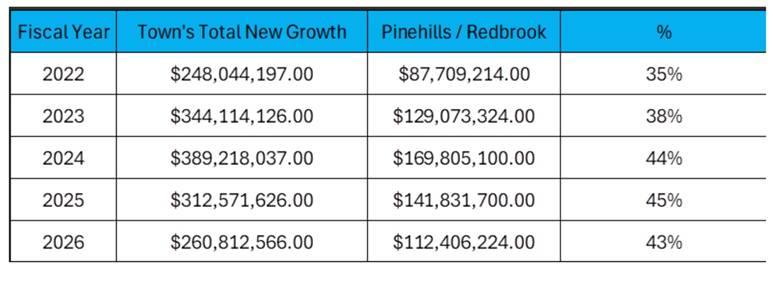
For years, Plymouth has counted on new tax dollars to keep pace with growing expenses. The problem is a hefty slice of that new money – 43% in the 2026 budget – comes from homebuilding in the Pinehills and Redbrook neighborhoods. Officials have known for years that construction in both places would eventually level off and then dwindle as they reach maximum capacity. It’s already happening.
The town’s escalating health insurance expenses – about $5 million a month – compound the crunch. Meantime, inflation continues to drive up prices on goods and services beyond its ability compensate by raising taxes.
And with property taxes near the ceiling of what’s allowed under the state’s Proposition 2 ½ law, options going forward are limited – pare the budget or ask voters to approve a permanent tax hike through an override. The latter is a non-starter.
Regardless, on Town Meeting day, the expectation was members – elected by residents in each of 18 precincts – would rubber stamp the FinCom’s recommendations. They usually do.
To be fair, precinct reps assume the budget has been examined under a microscope by the time it reaches them. But that doesn’t mean the long train of recommendations by committees and boards prior to Town Meeting can’t lead to an eventual derailment.
This year, Precinct 15 Town Meeting member Wrestling Brewster wasn’t willing to stick to the status quo. Speaking to me recently, he said the budget process is frustrating.
“The problem with our form of government is the people who decide the budget get it at the end,” Brewster said. “There’s no discussion before that. So two weeks before Town Meeting, when we get the [financial] books, nobody understands it.”
He decided to offer budget amendments at Town Meeting calling for what would have amounted to an overall reduction of about 1%. The move was as much symbolic as substantive.
“My main purpose was to say, ‘Hey, we’re in trouble,’” he said. “The definition of budgeting is saying, ‘This is what we have. How can we work within those constraints?’ If you continually raise taxes because you say, ‘This is what we need,’ that’s like going to a credit card over and over again. And the taxpayers end up being that credit card.”
Brewster said he outlined his plan to several department heads in advance of Town Meeting.
“I told them it’s nothing personal. They all said, ‘I totally understand what you’re trying to do.’”
Triffletti pointed out that it’s not possible to slice every piece of the budget.
“There are fixed costs that you can’t cut,” he said. “What would come to mind are debt obligations. You can’t not pay those.”
For instance, it would be akin to a cash-strapped homeowner deciding not to pay a portion of the monthly mortgage bill.
Another objection was what some people considered the draconian nature of the effort – extracting money from the budget in the final hours of a process that began months earlier.
Brewster said he understood all that going in. His main motivation was to sound an alarm.
His first budget reduction motion was attached to Article 7, which grouped together expenses for several departments, including human resources, town clerk, and town manager. It failed by 10 votes, 71-81, with three abstentions.
Subsequent motions to amend other budgeting articles were defeated by wider margins. Representatives reasoned it would be unfair to limit some departments’ spending while leaving those covered under Article 7 intact.
But here’s an interesting angle on that initial vote, which set in motion a domino effect. By my count, there are at least 15 Town Meeting members who are also town employees. They voted 13-2 against the motion to amend Article 7, more than enough to ensure its defeat. Those employees are generally considered exempt from the state’s conflict of interest law, so they did nothing wrong ethically. But had some of those 13 sided with the amendment, well..
Union officials and town retirees also serve as Town Meeting representatives. I suspect they voted along the same lines as current employees did.
Brewster hasn’t given up the fight, but he concedes the odds are stacked against him. Whenever the subject of tightening budgets comes up, he said, officials immediately turn to the nuclear option – slashing jobs and services – instead of mining for efficiencies.
“It’s a scare tactic,” he said.
He also noted that at Plymouth North High School – where Town Meeting was held – “teachers and all the union people were standing [at the entrance] saying ‘vote no’ on cutting the budget. It was intimidating.”
Following the session’s adjournment, Brewster said, he found reason for hope in the words of a town department head he did not name.
“He said, ‘Wrestling, we were prepared for that 1% cut.’ He understands budgeting and process, and his comment to me was, ‘I would rather do 1% this year than being forced to be three to 5% in next year or the year after because we don’t have the money. If we don’t start budgeting now, we’re in trouble.’”
Mark Pothier can be reached at mark@plymouthindependent.org.