
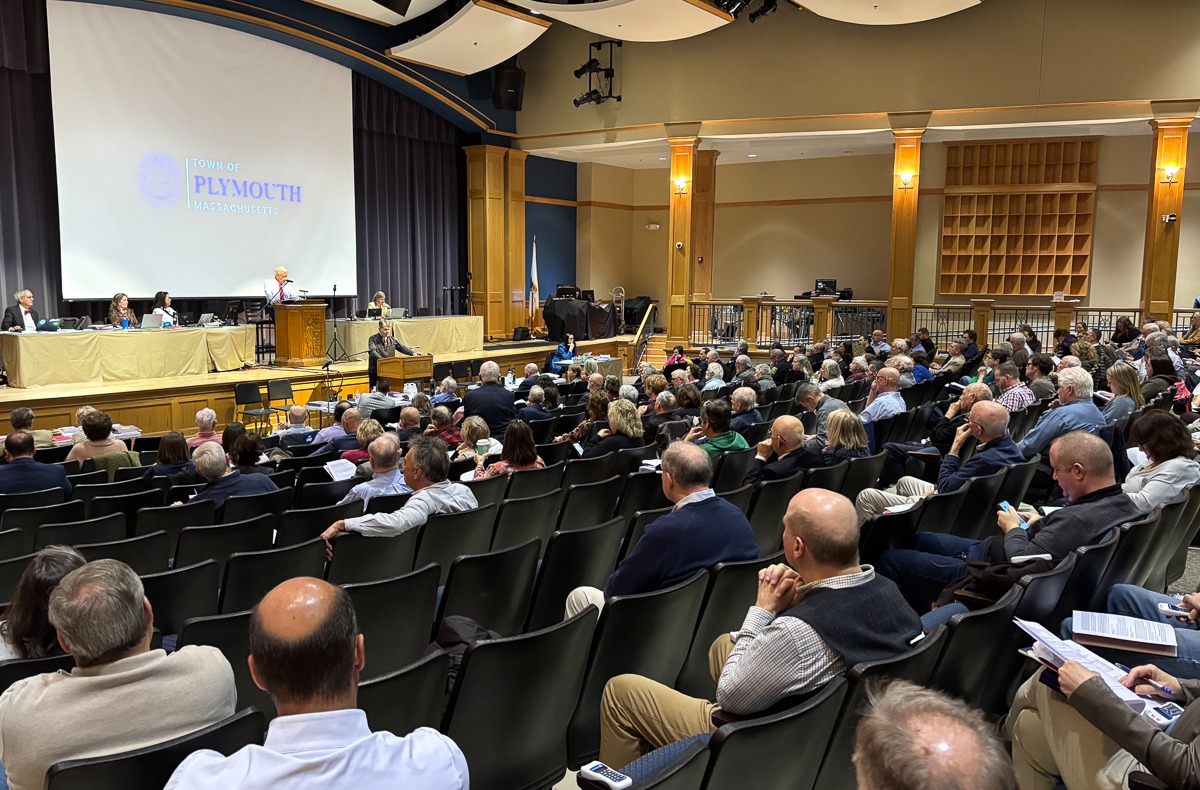
By a narrow margin, Town Meeting members on Saturday voted to codify in-town law restrictions on police cooperation with U.S. Immigration and Customs Enforcement.
The hour-long ICE discussion was the culmination marathon spring gathering of Plymouth’s legislative body lasting 9 hours. The debate over an ICE bylaw, expected to be the most contentious part of Town Meeting, turned out to be civil.
The body also voted down funding for a redesign of Town Square and rejected an effort to limit retirement benefits for new employees.
But the 162 members voted overwhelmingly to spend tax money on 4th of July and Thanksgiving celebrations and approved an effort to move Town Meeting and the town elections several weeks later to coincide with the state legislature’s funding decisions.
Members opposed a plan to redefine retirement benefits for future town employees.
The spring Town Meeting was really a two-in-one deal. The first part was a special Town Meeting to deal with items that came up after the regular warrant was closed. It was followed by the regular Annual Town Meeting. For a tally of all votes taken, go here.
4th of July and Thanksgiving celebrations
By overwhelming margins, Town Meeting members voted to appropriate $50,000 towards 4th of July celebrations and another $50,000 towards the Thanksgiving celebration.
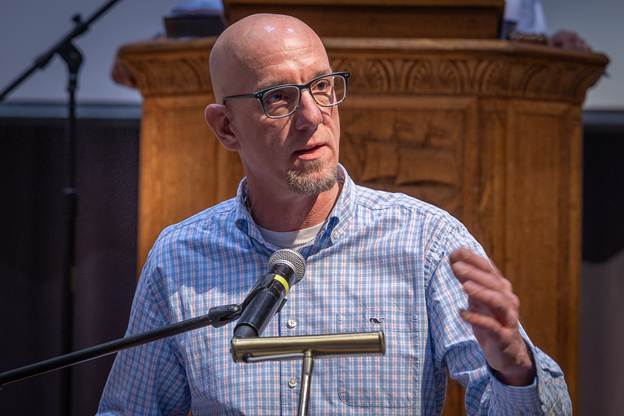
Matt Tavares, who leads the efforts to celebrate the 4th of July, said townspeople have not contributed the way they had in the past, leaving the volunteer committee running the parade and the fireworks in a quandary over how to make up the funds.
“Last year we had 52 individuals out of a community of 62,000 people donate,” Tavares said. He said his committee brought in only $18,000 last year, including contributions from businesses.
“We have had a bad year for the last six years.”
Tavares said the committee’s emergency fund, set up to offset bad fundraising years, is now “almost completely wiped out.”
Neither the appropriation for the 4th of July nor for Thanksgiving met with any vocal opposition.
Funding for the 4th of July parade passed 134 to 15, while money for Thanksgiving celebrations passed 155 to 17, with one abstention.
“This is necessary,” said Laurence Delafield of the $50,000 to go towards the Thanksgiving parade.
Moving the dates of spring Town Meeting and the annual town election
Select Board member Kevin Canty told the assembly the proposal to change the dates of spring Town Meeting and the town election is necessary so members and voters have a better idea how much the state is sending the town’s way.
He said the House and Senate Ways and Means committees in the state legislature do not reveal how much they plan to fund aid to cities and towns until May, and waiting for the information will help Town Meeting make better decisions on how to spend town money.
Moving Town Meeting from April to May would require moving the town election from May to June. Canty argued it would be better for incumbent Town Meeting members to be the ones voting on the budget because, having sat through weeks of caucuses, they would be better informed.
Former longtime town clerk Laurence Pizer said moving the election to June, past high school graduation, would lower turnout.
By vote of 117 to 37, members approved moving the spring Town Meeting from April to the third Saturday in May, and the town election from the third Saturday in May to the second Saturday in June.
Reform of retirement benefits for new employees
A citizens’ petition led by Richard Serkey aimed to change Plymouth’s generous policy which forces taxpayers to fund up to 90% of their insurance premiums once they retire. Since the insurance benefit was negotiated with the public employee unions, Serkey proposed changing the requirement only for new hires.
“I undertook this effort because I wanted to shine a light on the outsized influence the municipal unions have on our towns,” Serkey said. “Many of which are teetering on the edge of bankruptcy.”
But employees present said they gave up pay raises to keep this retirement benefit.
“Union members have consistently accepted extremely modest annual wage increases ranging from two to three percent per year, with most of these years being at two percent,” said Lisa Murray, negotiation chair for the Plymouth teachers’ contract. “Our salary increases have often failed to keep pace with the cost of living.”
Town Meeting sympathies were with the employees. Article 10 of the special Town Meeting went down to resounding defeat by a vote of 34 to 112, with six abstentions.
Town Square
Town Meeting members decided not to fund the design of a remaking of Town Square to restore it to a more pedestrian-friendly place, with added trees and permeable pavers replacing the asphalt and concrete.
“It really needs to be renovated,” said Harrison Quinn. “It doesn’t look good for our town. We should not hide away Town Square.”
Some members were concerned the Town Square proposal is phase two of the downtown resiliency project and phase one, Main Street and Court Street, has yet to receive a grant from the state.
“We should wait and see if phase one happens to see if the money comes through and maybe readdress this in the fall when we find out what’s happening,” said Lori Downs.
Michael Cahill, the town’s climate resiliency and sustainability planner, said phase two does not depend on the funding coming through for phase one. Still, members voted down the idea by a narrow margin of 69 to 77, with two abstentions.
ICE
Plymouth joined other cities and towns, including Boston, Lawrence, Cambridge, Somerville, Springfield, Northampton and Amherst in passing a bylaw restricting the cooperation of police and other town employees with ICE.
15 members spoke up, most in support of the bylaw.
They argued it would make undocumented immigrants feel safe to live in Plymouth and to call police.
“We need to make people feel safe,” said Charles Vautrain.
“Residents should not feel afraid,” said Don Williams. “This is a moral issue.”
“People are leaving our town,” said Kathleen Dunn. “It’s heartbreaking.”
On the other side, Carmen Lifrieri, whose grandfather immigrated from Italy, said immigrants should come to this country legally.
“I support allowing local police to cooperate with federal immigration authorities in appropriate and lawful circumstances,” said Lifrieri.
Police chief Dana Flynn said ICE has yet to ask his department for any help. He emphasized how police in Massachusetts are already prohibited by law from assisting ICE in anything other than criminal investigations.
Flynn expressed concern about slight differences in wording between the policy he instituted in February 2025 and the now-codified bylaw, saying it might create some confusion among his officers about which to follow.
“My officers have a hard enough job,” said Flynn.
Town meeting members were unpersuaded. By a close vote of 78 to 63, with three abstentions, they voted to enact the bylaw.
Fred Thys can be reached at fred@plymouthindependent.org